







What’s in here7 sections
- What Counts as a Real Wash Before You Give Up
- Where the Yellow Sits Decides the Verdict
- Color Is the Weak Signal: What to Check After a Full Dry
- When Two People Share a Bed, Retire One Pillow, Not the Pair
- The Next Pillow Gets a Protector on Night One
- Count Proper Rounds, Then Let the Fold and the Smell Decide
- Frequently Asked Questions
You soaked it, rinsed it, ran the dryer until it stopped, and the pillow still came out the color of weak tea. Was that round two or round six, and does the count even matter? It matters more than the shade does, and it is the whole answer to when to give up: the yellow is skin oil (sebum) and sweat that oxidized inside the cloth, so a pillow either lets go of it under a proper oxygen wash or it doesn’t, and staring at the color tells you nothing the count can’t.
A r/housekeeping thread asking whether people just throw pillows out over time splits the way most beds do, between those who toss one once it goes lumpy or nasty and those who keep one that still holds up. The chemistry of why pillows turn yellow in the first place has its own page; this one is the stopping rule, then where the yellow sits, what to check once the pillow is dry all the way through, what changes in a shared bed, and how the next pillow starts clean.
Quick Answer
Give up on a yellow pillow after two proper washing rounds have left the yellow in, or sooner if the yellow comes with a second sign: the pillow stays folded, it still smells after a complete dry, or the yellow sits in a foam core. Color alone is not the verdict. The second failed proper round is.
What Counts as a Real Wash Before You Give Up
“If it won’t come out, replace it” sounds like a rule until you try to follow it, because it never says what trying means. So people go one of two ways. They quit after a single lukewarm cycle with regular detergent, or they soak the same pillow for the sixth weekend running. Neither is a test, and before a round can be counted it has to be defined.
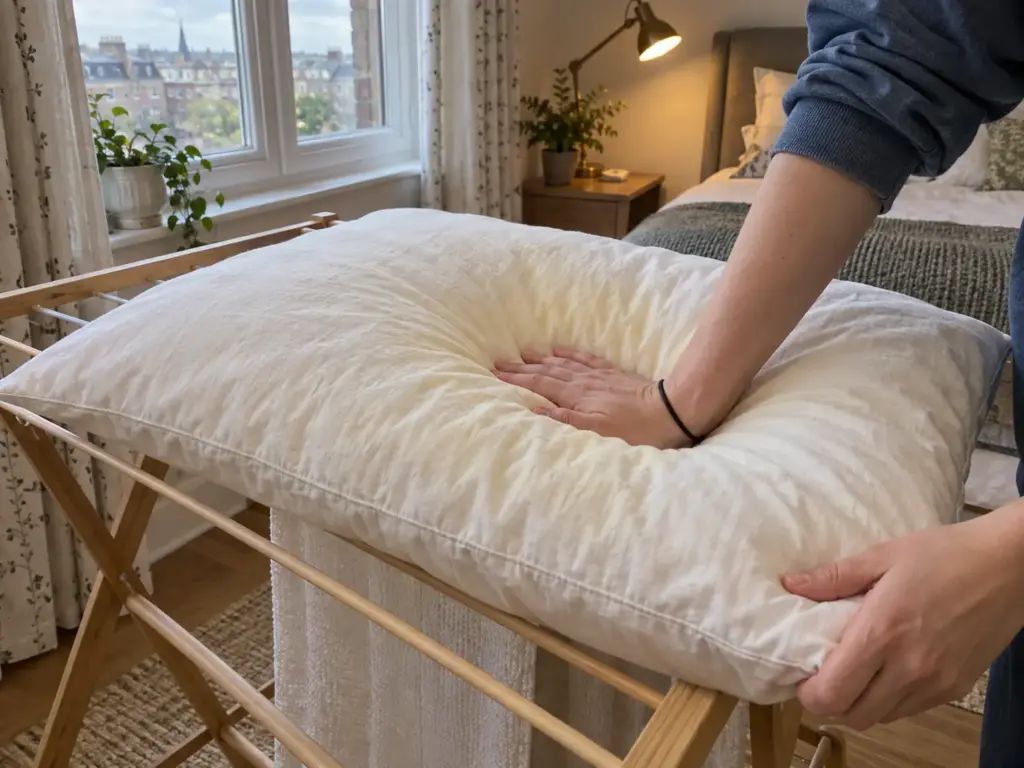
What a proper round includes
A round is five steps, in this order, and each one does a job the others can’t:
- Pretreat the stained patch with an enzyme detergent or a dab of peroxide, and give it time to sit.
- Soak in oxygen bleach (sodium percarbonate, or the liquid kind), fully submerged, for hours rather than minutes.
- Wash, then run an extra rinse.
- Tumble dry on low, with a few wool dryer balls to break up clumps, until the middle is as dry as the surface.
- Judge the result in daylight, case off, before deciding anything.
The order follows from what the yellow is. Detergent is built for soil that sits on a fiber and lifts off in water. Oxidation is a different job: the oil has worked into the cotton of the shell and the polyester of the fill, and an oxygen bleach is what breaks it into something a rinse can carry away (which is why the extra rinse is on the list at all: whatever stays in the fill dries back as a ring).
Casper’s own care steps line up with the same sequence: hot water, an enzyme detergent, oxygen bleach for yellow marks, and drying thoroughly. Read the care label before any of it, since it settles whether the pillow can take a soak and a dryer at all. The soak time and the temperature change with the fill, and the method for each one is spelled out in getting yellow out of a pillow according to what’s inside it.
Most of that list is free: a tub, warm water, time, and the detergent already under the sink. The oxygen step is the one thing worth buying if the cupboard has none. OxiClean White Revive is a liquid oxygen-based whitener, a 45 fl oz bottle used in the soak or the drum alongside your detergent rather than instead of it. It is for washable things: cotton and polyester shells, fiberfill, down.
Know before you open it that it does nothing for a memory foam or latex block, because that block can’t go into the soak in the first place.
Never grade a round under a bedside lamp. A warm bulb turns yellow into something close to cream, and a pillow that looked rescued at night reads two shades darker by a window the next morning. Take the case off, lay a white sheet next to it for reference, and decide in daylight.
Why two failed rounds is the line
Two is the count this site uses for a yellowed pillow, the same one it applies to white sheets gone gray. It is a rule of thumb, not a lab figure, and the reasoning is simple. The first proper round takes whatever yellow was still loose enough to move, and the second catches what the first one loosened but didn’t carry off.
If both leave the same shade behind, what remains has most likely bonded into the fiber, and a third soak mostly wears the shell, loosening the weave along the seams while the color stays where it was.
So a third round costs wear and buys nothing. Well, almost always. A pillow that came out of round two visibly lighter than it went in is still moving, and one more round is a fair bet; the rule is two rounds that changed nothing, not two rounds, period.
When a round does not count
Some failed rounds were never rounds. The pattern in Reddit threads on yellow pillows is the repeat soak, overnight in the tub, again and again, but a round can fail at the drying end as easily as the washing end. Three ways a round quietly stops counting:
- The pillow felt dry on the outside and was still damp at the center. The surface fools your hand, and the next night it smells, with a tide line where the damp worked outward.
- It went into a hot dryer still yellow, and the heat set whatever was left.
- The extra rinse got skipped and detergent stayed in the fill.
Before you count any of those as a failure, run the round once more, properly. That costs an afternoon and nothing else. If yours came out of the drum the same yellow or yellower, a pillow that is still yellow after washing has its own walk-through, including the check that has to happen before the dryer.
Where the Yellow Sits Decides the Verdict
A count of washes treats every pillow the same, and that is the weak point of the rule above. Pull two pillows off the same bed with the same ring in the same spot, and one of them is a case for a protector while the other is a retirement. The difference is whether the yellow lives in the shell, in a fill that washes, or in a foam core that doesn’t.
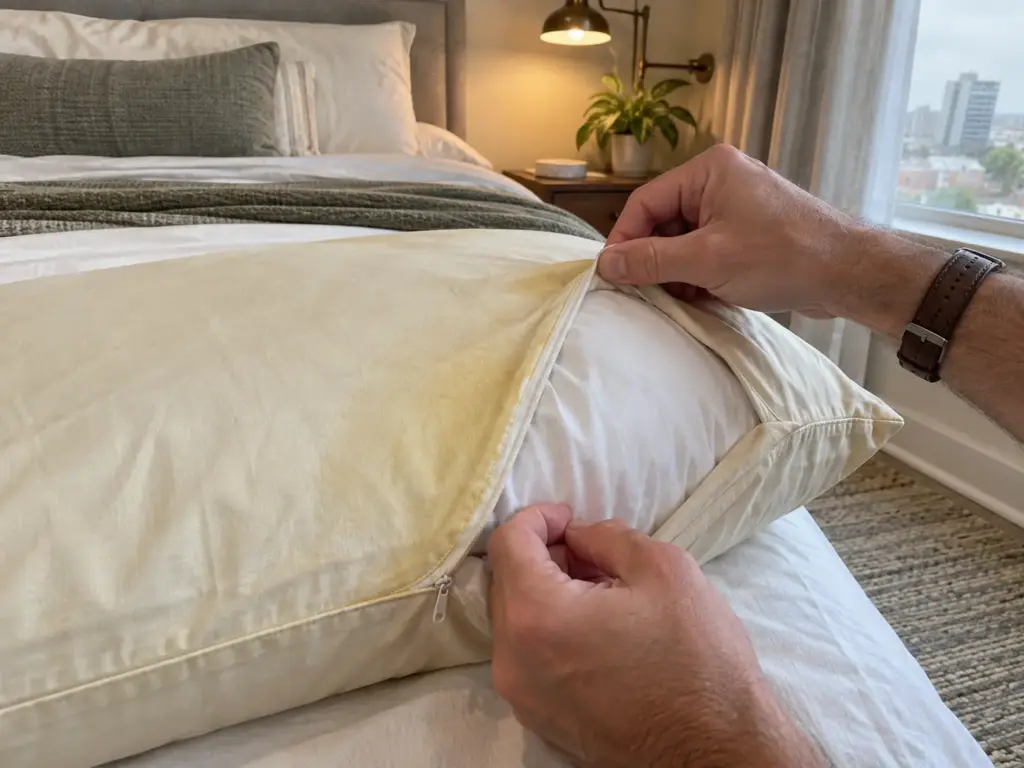
Yellow in the shell
The shell, or ticking, is the woven case the fill is sewn into, usually cotton or a polyester blend, and it is woven tight enough to keep down or fiber from poking through. That density is why sweat and skin oil stop there first: the oil lands, stays near the surface, and oxidizes in place. Shell yellow is the most common kind and the cheapest to deal with. It takes the full round, it responds to oxygen bleach better than anything deeper, and on a pillow whose fill still springs back, a faint shell stain after two rounds is a cosmetic problem with a cosmetic answer: a protector over it and a clean case on top.
Yellow in washable fill
Down, feather, down alternative and polyester fiberfill take the whole round, soak included, and they answer it. This is the pillow where two proper rounds is a fair test. The catch is that each round costs the fill something. Fiberfill clumps and loses a little loft every time it goes through the wash, so washing it harder is not automatically the safe move: on a synthetic pillow, round two is a loft test as much as a color test. One Reddit case shows the other end of it, a washable synthetic pillow with slight yellowing after eight years, kept because it still supported. Faint yellow in a fill that recovers is not a reason on its own.
Fold the pillow back on itself right at the seam and look at the edge in daylight. If the yellow stops cleanly at the stitching, it is in the shell and the fill under it is fine. If the color runs evenly into the edge and the piping too, it has gone deeper than the fabric.
Yellow in a foam or latex core
Here the obvious move, soak it overnight like the others, is the wrong one. No wash reaches a memory foam (polyurethane foam) or latex core. Casper’s guidance for its own foam pillows is to launder the cover and leave the core out of the machine, and a soaked block holds water deep in its center long after the outside feels dry.
That makes the count zero. One careful spot-clean on the surface of the block, and if the yellow stays, you are done.
Much of that yellow isn’t residue at all. Foam darkens from white toward cream and amber as the material itself ages, which is covered in what turns a pillow yellow and which kinds come back, and no amount of oxygen bleach reverses a change in the foam. An evenly amber block with a clean, supportive feel is just an old block. A blotchy one that smells is finished.
The three, side by side, once two proper rounds are behind you:
| Where the yellow sits | What it is | Does washing reach it? | Verdict after two proper rounds |
|---|---|---|---|
| Shell (ticking) | Oxidized oil in a tight cotton or poly weave | Yes, fully | Faint stain with good loft: keep it, add a protector |
| Washable fill | Oil carried into down, feather or fiberfill | Yes, but each round costs loft | Same yellow after two rounds: retire it |
| Foam or latex core | Mostly aging of the foam itself | No, spot-clean only | One spot-clean, then retire if it smells or blotches |
Color Is the Weak Signal: What to Check After a Full Dry
The table says where the yellow sits. It doesn’t say whether the pillow is finished, and a pillow can be yellow and perfectly fine. The online argument over whether sleeping on a yellowed pillow is gross, which got as far as news coverage, keeps going in circles because both sides are judging the color. The signals that decide come in a ranking: loft first, then smell after a complete dry, then how fast the pillow recovers, and color last.

The fold test, and why it outranks the color
Fold the pillow in half, hold it about a minute, and let go. If it opens slowly or stays half-folded, the fill has lost the structure that holds your head up, and no wash puts that back. That one test does more than any amount of looking: a yellow pillow that springs open is still doing its job, and a white one that stays folded isn’t. How the result reads for each fill, and roughly when each one gets there, is in how long pillows last according to what they’re filled with.
The smell after a complete dry
An odor that survives a complete dry is a stop, whatever the discoloration. The trap is timing. A pillow straight out of a warm dryer smells of warm cotton and nothing else, and the heat hides what the middle is still holding.
Casper’s care advice says to dry thoroughly to prevent mildew and nasty smells, and the order matters: a pillow that smells clean at the end of the cycle and sour the next evening was holding moisture at the center, so the round doesn’t count yet. Dry it again and repeat the check. If the smell comes back after a pillow you know is dry, that is the second sign.
Do the smell check the morning after the dry, with the pillow still out of its case, and press your nose into the center rather than an edge. The edges dry first and smell fine; the middle is where the damp, and the smell, holds on longest.
When yellow alone is a shrug
On Reddit, one commenter put the keep-it case plainly: “if it smells ok and is still supportive I’d keep using it.” That holds up. Slight yellow on a washable fill that passes the fold test and smells clean after a full dry is a cosmetic stain, and a protector hides it from here on. The yellow turns into a reason only when a second sign joins it: the fold that doesn’t open, the smell that comes back, a core that has gone blotchy, or a second proper round that changed nothing.
The calendar sits behind all of this as a backstop. Casper puts pillows at one to two years (replace every one to two years, wash the pillow itself every three to six months), and the Asthma and Allergy Foundation of America’s two-year pillow interval is stated in one line in its guide to allergy-friendly pillows: “The Asthma and Allergy Foundation of America (AAFA) also recommends that you replace your pillow every two years.” But the number depends on the pillow. Two years is a good moment to run the fold and smell tests, and a poor reason to throw out a down pillow that passes both.
Sheets follow the same logic with a different second sign. For a white set gone yellow, two failed proper rounds plus a fabric that has turned thin is the line; the round itself is laid out for white sheets that have gone dingy, and the light-and-tug check that settles whether a sheet is actually finished lives on its own page.
When Two People Share a Bed, Retire One Pillow, Not the Pair
Everything above is written for one pillow, and very few beds have just one. In a shared bed, two pillows bought on the same afternoon can end up looking years apart, and one side almost always fails first.
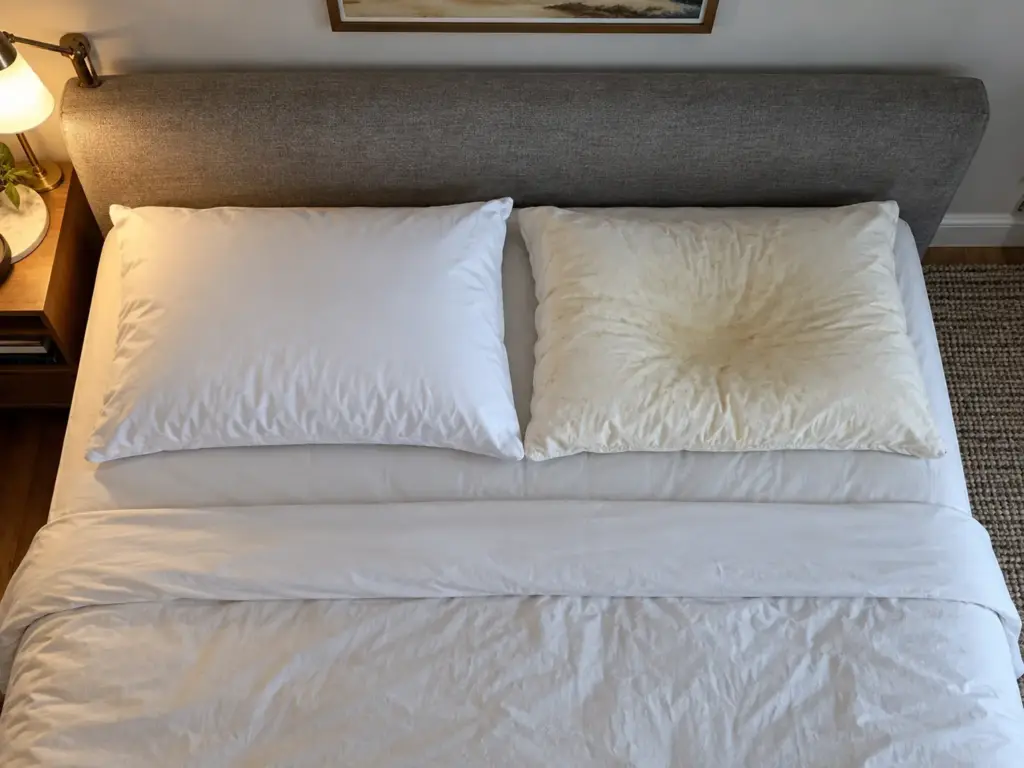
Why one side goes first
A pillow ages with what it takes in. The side that gets more sweat, goes to bed with damp hair or a leave-in hair product, or carries a face pressed into the same patch every night collects oil faster, and oil is what yellows the shell and mats the fill. (Heavy sweating that soaks through whatever is on the bed is a question for a doctor, not for a pillow.)
Which is why the two-round rule applies per pillow, never per bed: one pillow can be on its second failed round while the other has never needed a first. The yellow side is the obvious suspect. And it is not always the one that goes: run the fold test on both, because sometimes the clean-looking pillow on the other side is the one that stays folded, and it is the one to retire.
Retire one and rotate which one
Replace the pillow that failed, and leave the one that passed. That’s this site’s position, and it’s partly about waste and partly about timing. Two pillows of different ages fail in different years, so each replacement is a single pillow instead of a pair, and the decision always comes from the tests rather than from which one happens to be newer.
If the same side keeps wearing through first, swap the pillows between sides every few months so the faster-aging spot isn’t always on the same fill.
Expect the two sides to look mismatched for a while, too. A new pillow sits noticeably higher than one that has already given up some of its loft, and the urge is to buy a second so they match. Resist it: the mismatch is what a staggered pair looks like, and matching them puts you back to replacing two at once, on the same weekend, a couple of years from now. A pillow is one of the four separate clocks running on a bed, and in a shared bed each side keeps its own time.
The Next Pillow Gets a Protector on Night One
Giving up is half the job. The other half is starting the next pillow clean, so the yellow you just fought has nowhere to land, and that reset costs less than the pillow did.
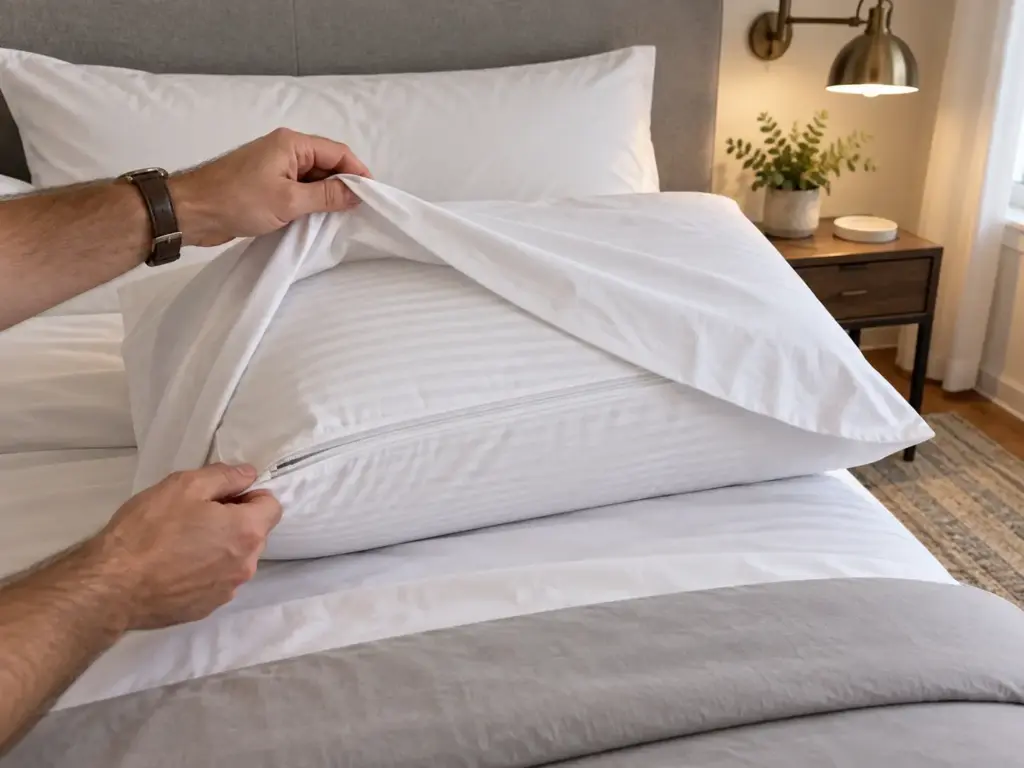
Put the protector on before the first night
The free part is the routine. Zip a protector on before the new pillow is ever slept on, case over the top, and keep a cadence: pillowcase every week with the sheets, protector once a month, the pillow itself every few months if the fill is washable. The protector is the layer that soaks up the oil so the ticking never sees it, and a cotton face takes that oil and gives it back in an ordinary wash.
The FAUNNA 600TC cotton pillow protector is a zippered, 100 percent cotton, OEKO-TEX certified protector sold as a 4-pack, which covers two pillows with spares for wash day. The 600 on the pack is not why it’s here (a count that high says more about how the yarn was counted than about the cloth); the all-cotton face is, and it carries a 4.6-star rating on Amazon.
The weak point is the zipper. Of the 239 buyers who mention it, 65 are negative, one review describes a plastic zipper and a fabric that feels rougher after washing, the listing admits slight shrinkage in the first wash, and some find it too small for a standard queen foam pillow. That first wash is the moment it can stop fitting a thick foam pillow, so check the fit after it, not out of the bag.
Tie the protector to the sheets: on the first sheet day of each month, the protectors go in the same load. One schedule is easy to keep; a second one for the protectors alone is the one that slips until the pillow under it starts yellowing again.
Where the retired pillow goes
Whether a pillow can be donated, recycled or only thrown away depends on its fill and on what your area takes, and the options are sorted in what to keep, donate, recycle or toss from old bedding. A pillow that failed the smell test is not a donation; it is one to throw away.
Count Proper Rounds, Then Let the Fold and the Smell Decide
Stop after two proper rounds, not six: pretreat, oxygen soak, extra rinse, dry through, daylight check, twice. Judge the pillow by the fold test and the smell after a complete dry, and treat the color as the weakest signal on the list. In a shared bed, retire the pillow that fails, not the pair, and put a protector on the new one before its first night.
Once the replacement has been through months of washing, look past the color to the protector: the zipper, the fit after shrinkage, and whether the ticking underneath is still the shade it was the day it came out of the bag.
Tonight, strip the yellow pillow and start one proper round. Tomorrow, in daylight, fold it and smell its center before you look at the color, and let those two tell you whether there’s a second round worth running.
Frequently Asked Questions
01When should I give up on a yellow pillow?
Give up after two proper washing rounds leave the same yellow behind, or sooner if the pillow stays folded, smells after a complete dry, or has a yellowed foam core. A proper round means pretreat, oxygen soak, extra rinse and a full dry.
02Should I throw out my pillow if it’s yellow?
Not for the yellow alone: a pillow that springs back after the fold test and smells clean after a complete dry can stay on the bed, with a protector over it. Throw it out when a second sign joins the color.
03What is the 2-2-1 pillow rule?
The 2-2-1 rule is a decorating layout for a made bed: two Euro pillows, two standard pillows and one accent pillow. It says nothing about when to replace a pillow. For that, use the fold test and the two-round rule.
04Can I give up on yellow sheets the same way?
Yes, with one change: for sheets, two failed proper rounds plus fabric that has turned thin or weak is the line. Color that survives two rounds on a sheet that is still sound can stay on the bed.





Tried it on your own bed?
No comments yet. Tell us what you changed, and what the sheet did after a few washes.