







What’s in here8 sections
You take the case off to wash it and there it is: a pillow the color of weak tea, darkest right where your head goes.
The assumption arrives at the same moment. This is dirt. This is a hygiene failure. Somebody did not wash something.
It is neither. Yellowing is what happens when the moisture a head gives off all night dries inside a fabric and then reacts with the air. Sweat and sebum carry proteins, salts and oils down into the fibers, the water evaporates, the residue stays, and oxygen does the rest over a period of years. It is the same browning an apple does on the cutting board, just slowed down from an afternoon to a decade.
And it splits in two, which is the part almost nobody says out loud. A yellowed shell and a yellowed fill are not the same problem and they do not have the same ending.
Quick Answer
A yellow pillow is oxidized sweat and skin oil, or in foam, the polymer itself aging. It is not dirt, it is not mold, and it is not by itself a reason to throw the pillow out. Whether it comes clean depends on where the yellow sits: a woven shell washes, a fill or foam core usually does not.
Yellow Is Not Dirt. It’s Oxidation
The word “stain” sets the wrong expectation, because a stain suggests something sitting on top of the fabric waiting to be lifted off. What is actually happening is a reaction, and it happens inside the fiber. Nothing is sitting on the surface waiting for you.
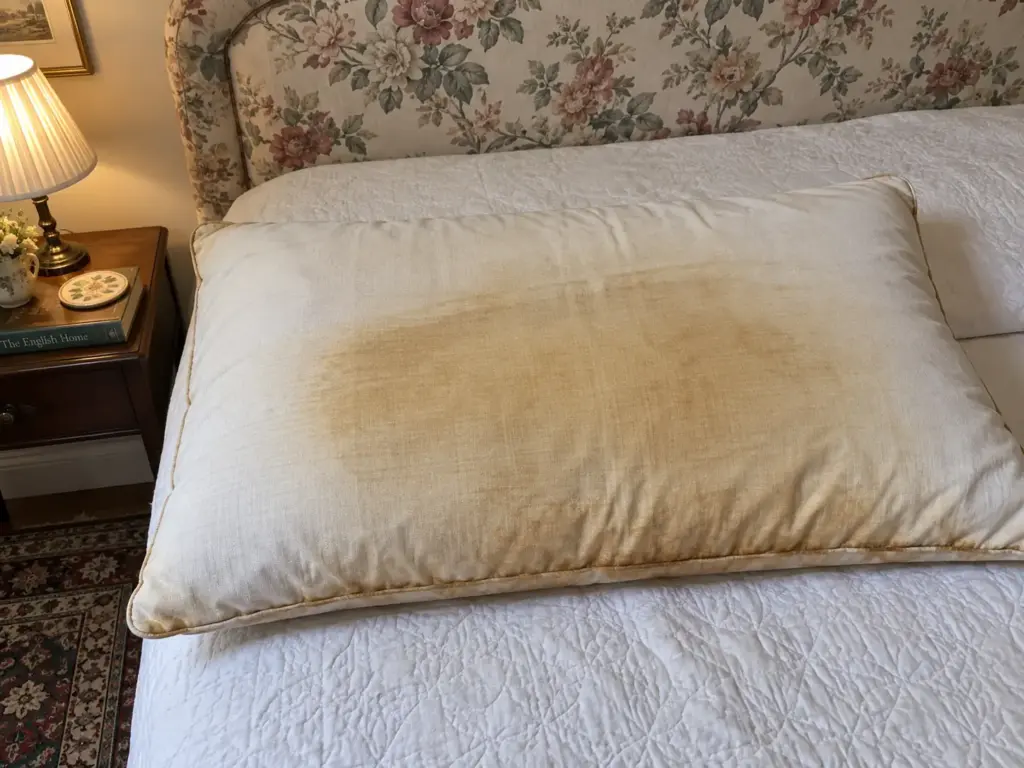
Most of the yellow comes from one thing: moisture. It carries organic residue into the fabric, the residue dries in place, and then it reacts with oxygen and darkens. The volume involved is larger than people expect. The sleeper can give off close to a liter of moisture over a night, and the pillow, pressed under head and neck for seven hours, catches more of it than any other piece of bedding.
Sebum is the fast one. Skin and hair oil stains fabric readily and oxidizes to yellow quicker than sweat does, which means oily skin or an oily scalp is a variable in how fast a pillow ages. Not a failing. A variable, the same way sweat volume is a variable. If you have ever wondered why your pillow looks worse than your partner’s on an identical laundry schedule, that is most of the answer and we will come back to it.
When the yellow pillow argument went around social media in 2023, the photograph that traveled furthest showed corners darkened almost to brown while other patches had faded back toward white. Everyone read it as one pillow, one problem. It was two.
The yellow is never uniform, and the pattern tells you something. It is deepest where the head actually rests and along the seams, because seams are where moisture pools and dries slowest. A pillow can look fine standing folded in a closet and look terrible the second you lay it flat, which is why the honest inspection is always flat, bare, in daylight.
The Shell Washes. The Fill Usually Doesn’t
That reaction happens in two different places, and where it happens decides everything that follows: whether you have a laundry problem or a shopping one.
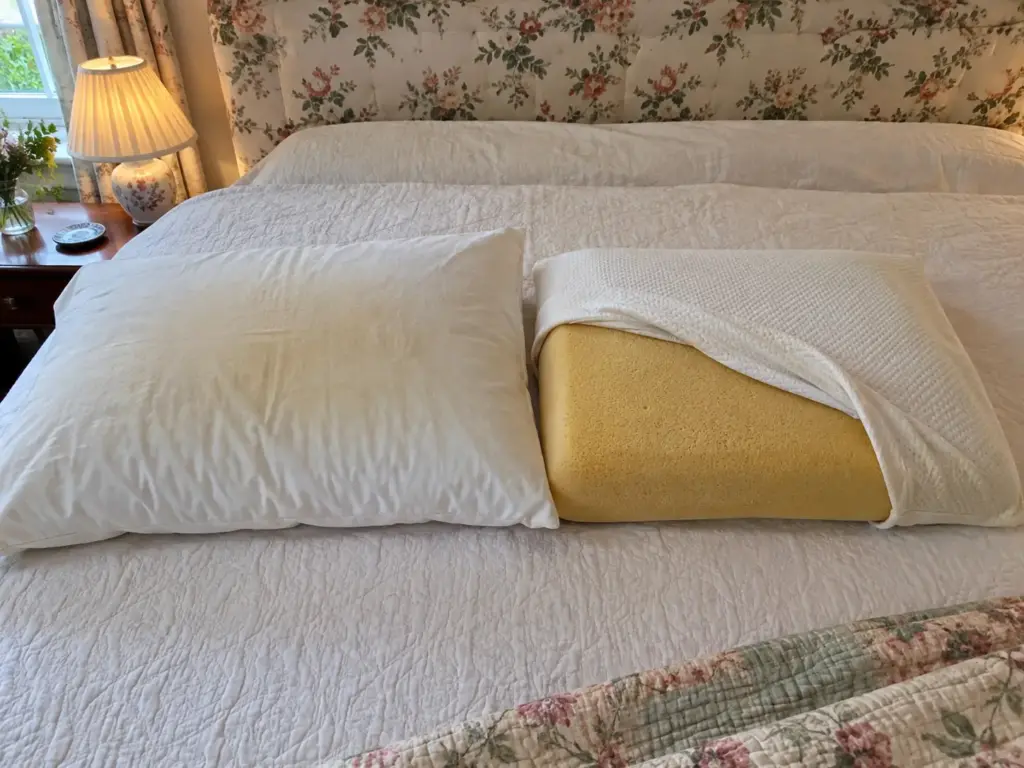
Picture two pillows, both yellow, both about eight years old, both off the same bed. One comes out of the wash noticeably lighter. The other comes out exactly as yellow as it went in and now takes two days to dry. Nothing separates them except what is inside.
The shell fabric is the woven part: the cotton ticking that contains the fill, the pillowcase over it, a protector if there is one. It yellows by surface oxidation, sweat and body oils dried into a woven cotton. That is reachable. Water can get to it, detergent can lift some of it, and an oxidizing agent can break down part of what is left — and if the care label says machine washable, most of that work happens in the machine rather than by hand.
Polyurethane foam yellows by a completely different road. During manufacture, an isocyanate reacts with water and forms an amine, and that aromatic amine then oxidizes into quinone compounds, which happen to be yellow. The foam industry’s own explanation of the chemistry puts it plainly: the more that compound keeps forming, the more yellow appears. This is the polymer aging from the inside out. It is not a stain, so nothing applied to the outside reaches it, and an afternoon spent soaking a memory foam core in oxygen bleach buys you a wet core and nothing else.
UV light, heat, humidity and even ambient combustion byproducts all speed that reaction along. A foam pillow that lives next to a sunny window yellows faster than one that does not, for reasons that have nothing to do with how clean anybody keeps it. Down and down-alternative fills sit in between: the fill holds oils of its own, and the ticking around it yellows like any other woven shell.
So here is the test, and it takes ten seconds. Strip the pillow completely bare and look at it in daylight. If the yellow rides on the ticking and the fill underneath is pale, you have a wash question. If the ticking looks reasonable and the core beneath it is amber, there is nothing there for a wash to reach, and an unwashable core changes the answer after an illness too, for exactly the same reason.
A foam core that has yellowed usually feels different too. Press a thumb into it and compare the recovery to what you remember: the same oxidation that changed the color stiffened the polymer, so the foam comes back slower and sits denser. The color is just the visible half of an aging you can feel.
Where the Moisture Actually Comes From
If oxidation needs moisture, the useful question is not whether you sweat. It is what else is arriving at that pillow every night, because for most people sweat is only part of the list.

Sweat is the obvious one, and the volume varies enormously between people and across a life. If sweat itself is the whole story for you, then the fix starts under the sheet rather than on top of it, because the layer generating the heat is usually the one nobody looks at.
Sebum is next, and as established above, it is the fastest to oxidize of anything on this list.
Wet hair is the one almost nobody counts. Go to bed an hour after a shower with hair still damp and you are running a small humidifier against one spot of that pillow, every night, for years. Whatever hair products went on before that — leave-in conditioner, oil, styling cream — travels with it. It is also the easiest item here to change, and it costs nothing.
Drool belongs on the list whether anyone likes admitting it or not. Side and stomach sleepers produce it, and it lands in one concentrated patch rather than spreading out.
Night skincare transfers straight onto the fabric when it has not fully absorbed. Serums, creams and heavy night lotions all sit on skin for a while before they sink in, and whatever skincare products are still on the surface at lights-out go onto the pillow. That is a routine, not a failing, and it needs saying before anybody feels accused by their own bedding.
The damp-hair patch has a shape, and you can identify it. It sits high on the pillow where the back of the head rests, and it is usually a ring rather than a solid blotch: the middle stays wet longest while the edge dries first, so the residue concentrates at the rim. A ring high on the pillow is a hair-drying problem. A blotch under the cheek is saliva.
Stopping It Beats Removing It
Everything above points the same direction, which is unhelpful for the pillow already on your bed and decisive for the next one. The yellow that never starts is the only yellow that comes out completely.
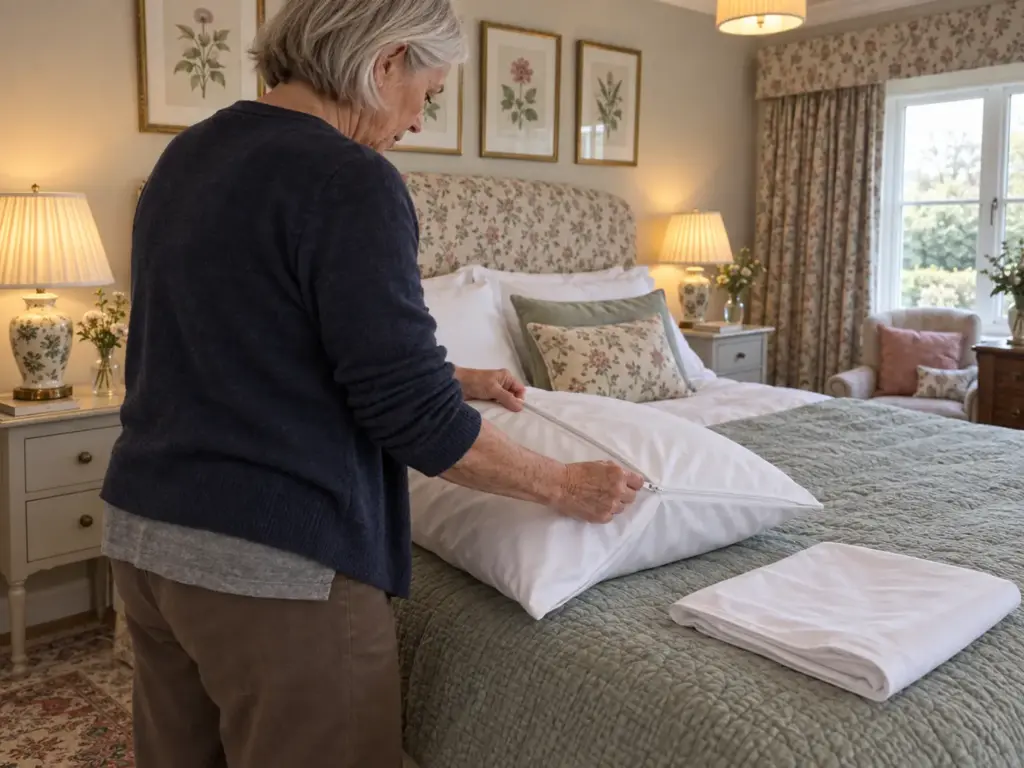
Free changes first, in this order. Dry your hair before bed, properly, not almost. Give night skincare fifteen or twenty minutes to absorb before your head goes down. And wash the pillowcase on the schedule the sheets get rather than the schedule the pillow gets, because the case is the layer taking the hit.
Then the distinction that actually matters, because it gets buried in every article that mentions it at all. A pillowcase is not a barrier. It is a filter with a generous mesh, and everything it fails to stop lands on the pillow underneath.
A pillow protector is a different object entirely: a sealed layer whose job is to stop moisture reaching the pillow shell at all. It is the first prevention step, ahead of a good pillowcase, and the mechanism is why. One slows what gets through. The other stops it.
Two things decide whether a given protector does that job. The first is the closure: a zip seals, an envelope opening is a gap where the moisture simply goes around.
The second is verifiable rather than claimed. OEKO-TEX’s own STANDARD 100 classification puts bed linens in Product Class 2, the tier for products in direct skin contact, where the testing requirements are strictest. That is a lab classification you can look up, not a phrase on a package.
The FAUNNA 600TC 100% Cotton Pillow Protector is the version of that argument with its specs visible: 100 percent cotton, 600 thread count, OEKO-TEX certified, zip closure, sold in a four-pack. Its flaw is a sizing one. The four-pack is Standard only, so a King pillow needs a different size ordered separately, and the zipper, however quiet it is called, is still a zipper you can feel through a thin pillowcase. If you would rather have stretch than a woven shell, the Guardmax jersey knit protector is the same idea in a knit.
One honest note about all of them. A protector does not make yellowing stop existing. It moves the yellowing from the pillow to the protector. That is the entire point, because the protector is cheap and washable and the pillow is neither, but it deserves saying straight rather than implying the problem vanishes.
What Actually Lifts It, and What It Can’t Reach
For the pillow that is already yellow, the honest version of this section is short. There is one method worth trying against set-in yellow stains, it works on one of the two kinds of yellowing, and it is worth knowing which kind you have before you spend an afternoon on it.
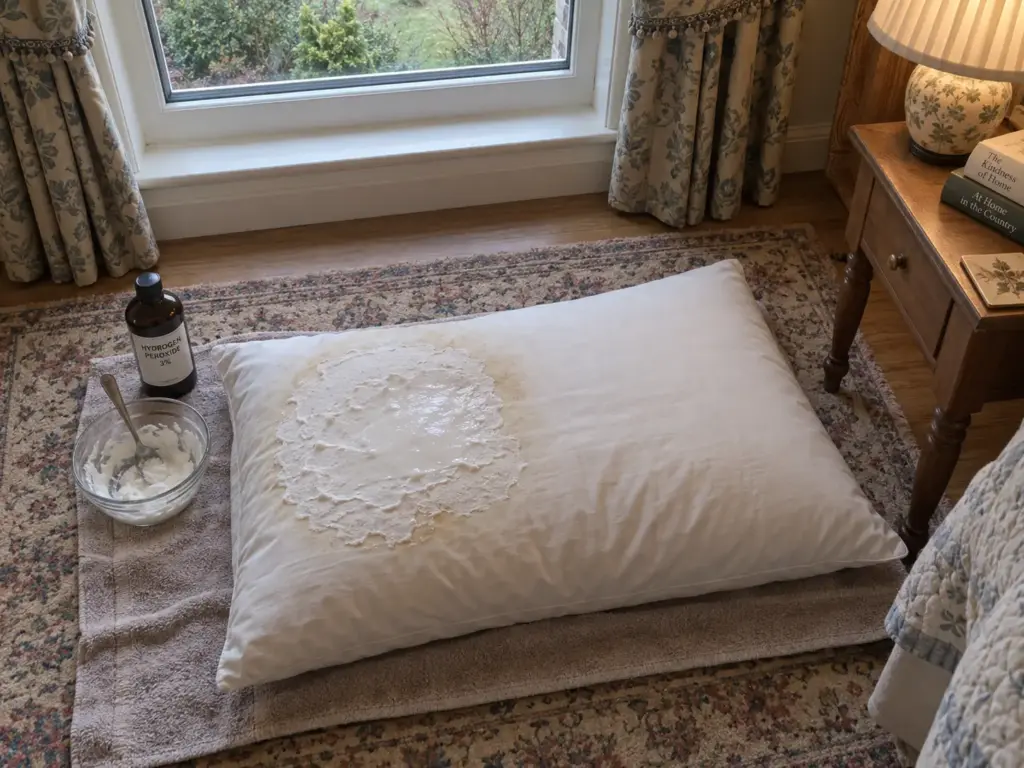
People reach for the peroxide paste because everything in it is already in the house, and that instinct is correct. Mix three parts baking soda to one part hydrogen peroxide into a paste and work it into the discolored area, or skip the paste and spray a one-to-one mix of hydrogen peroxide and water, leaving it to sit about an hour. Sun-drying it afterward adds UV bleaching on top of the chemistry you already started, so use it if the weather allows. Do one side at a time so it dries evenly rather than sitting damp in the middle.
Hot water helps on a cotton shell the label clears for it, but check that label first: it is the fiber, not the stain, that sets the ceiling.
Oxygen bleach is the wash-in version of the same chemistry. Dab it on the discoloration, work it in, give it roughly ten minutes, then wash. It is color-safe, but the fiber decides: not on wool, not on silk. OxiClean Odor Blasters is the liquid additive form of it, and its limitation is worth stating in the same breath as the recommendation. It is built as an odor additive rather than a dedicated whitener, so on set-in oxidation it does measurably less than straight peroxide applied directly to the spot. It earns its place as ongoing prevention in the wash, not as a rescue for a pillow that is already amber. And whichever product goes in, the order the wash goes in matters more than the product does.
Two limits, both firm. None of this reaches a foam core, for the reason the chemistry section already gave: if the yellow is in the polymer, the afternoon is lost before it starts. And on a shell, expect lighter rather than white. Years of oxidation do not fully reverse, and a pillow that comes back to pale is a genuine win rather than a disappointment.
The real failure mode is not the method anyway. It is the people who never try it, who have kept the same pillow since childhood and swap the case about once a year. Nothing in the peroxide bottle fixes that.
Two People, One Bed, Two Timelines
The last thing worth saying about yellowing is the thing bed sharing turns into friction, and it is barely about laundry at all.

Same bed. Same detergent. Same room, same wash night, same everything. One pillow is amber along the seams inside eighteen months and the other is still pale after six years.
Nobody is doing anything wrong, and that sentence is the one that defuses the argument before it starts.
The asymmetry traces back to the list in the moisture section: sweat volume, sebum production, hair routine, and whether somebody showers at night or in the morning. Those are chemistry and habit. They are not hygiene, and treating them as hygiene is how a cosmetic question turns into a personal one.
The internet has been having this exact fight in public for years, mostly men defending an attachment to a yellowed pillow and partners asking whether they know how a washing machine works. One line from those threads gets quoted more than any other: “You will never understand the bond between a man and his yellow pillow.” It is funny, and it is also an accurate description of two people holding two different thresholds for “still fine” and never once comparing them.
Which is really the shape of the problem. This is not one household rule. It is two personal thresholds sitting in the same bed, and the useful move is deciding them separately rather than arguing toward a single answer.
On the threshold itself, the principle: the common advice to replace every 1 to 2 years is a reasonable starting point for a pillow, and heavy discoloration is one of the signals that moves that window earlier rather than a cosmetic footnote alongside it. It moves earlier again for heavy sweaters and anyone with a real nighttime skincare routine, and later for a pillow that has spent its life inside a protector. But color is not the deciding test on its own, because the fold test tells you about the fill, not the color, and support is what you actually sleep on. Worth knowing too that each piece of the set runs on its own clock, so the pillow reaching its end says nothing about the sheets.
Built-up yellowing does eventually stop being cosmetic, and that is where the shared-bed part gets real: heavy accumulation is where dust mites, mildew and allergens collect, which turns one person’s pillow into both people’s problem.
When the fill is the part that has gone, a replacement is the answer, and the fill type is worth choosing deliberately rather than defaulting. The Canadian Down & Feather Co. Soft Support Microfiber Pillow is a down-alternative microfiber fill in a 260 thread count cotton shell, which matters here specifically because a microfiber fill does not yellow down the polyurethane road a foam core does: its shell is washable woven cotton and its fill is not a single aging block.
Its flaws are two. “Soft Support” is genuinely soft, so stomach sleepers can end up short on neck support, and like every synthetic fill it gives up loft sooner than good down does.
In a shared bed, the person whose pillow yellows faster also goes through pillowcases faster, and always at the same corner. The ring shows up on the case weeks or months before it shows on the pillow underneath, which is free warning that nobody reads because the case goes in the wash before anyone looks at it properly. Look at the case on the way to the machine, not after.
What to Do Before You Buy Anything
Three things are worth carrying away from this. Yellow is oxidized sweat and skin oil, and on foam it is the polymer aging: neither one is a verdict on your laundry. Where the yellow sits decides what happens next, so yellow on the ticking is a wash and yellow in the core is a purchase. And a sealed protector stops the moisture a pillowcase lets straight through, which makes it the cheapest thing named on this page and the only one that prevents rather than repairs.
After a season of washes, check the seams rather than the middle. A shell that is lightening everywhere except along the stitching is telling you where the moisture still collects, and that is the spot to treat next time rather than the broad face of the pillow.
So tonight: take the case off and look at the pillow bare, flat, in daylight. That one look tells you which of the two problems you actually have, and therefore which half of this page was written for you.
Frequently Asked Questions
01Should I throw away my pillow if it’s yellow?
Not on color alone. Yellow on the woven ticking is a laundry question and often lightens; yellow inside a foam core is the polymer aging and will not come out. Support, not staining, is what decides replacement, and the fold test answers that.
02Is it okay to sleep on a yellow pillow?
Yes. The yellowing itself is oxidized sweat and skin oil, not contamination. The honest caveat is that heavy built-up discoloration is also where dust mites, mildew and allergens accumulate, and that is a reason to act on the pillow rather than the color.
03How do you get yellow out of pillows?
A paste of three parts baking soda to one part hydrogen peroxide, worked into the shell and dried in sunlight, is the method that works. Expect lighter rather than white, and know that nothing applied outside reaches a foam core.
04Why do my husband’s pillows turn yellow faster than mine?
Sweat volume, sebum production and hair routine differ between people, so two pillows on one bed age at different speeds on identical laundry. It is chemistry and habit, not hygiene, and it is the most common version of this question there is.
05Does a pillow protector actually stop yellowing?
It stops moisture reaching the pillow, so the protector yellows instead of the pillow. That is the point rather than a loophole: the protector is washable and cheap to replace, and a zip closure is what makes it a seal instead of a filter.




Tried it on your own bed?
No comments yet. Tell us what you changed, and what the sheet did after a few washes.