







What’s in here8 sections
- What Actually Turns Dingy White Sheets Gray
- Why Chlorine Bleach Makes Dingy Sheets Worse
- The Recovery Wash, in the Order That Works
- When the First Round Isn’t Enough
- Why One Side of the Bed Goes Dingy First
- When Dingy White Sheets Won’t Come Back
- Two Rounds and a White Pillowcase Decide It
- Frequently Asked Questions
You pull the pillowcase off on wash day and the sheet under it isn’t white anymore. It’s the color of weak tea in a band where your shoulders lie, while the corners tucked under the mattress are still bright. You’ve tried the bleach, and you’ve tried the baking soda.
Dingy white sheets aren’t dirty on the surface: the gray is skin oil that soaked into the cotton and changed color, plus a film the wash itself left behind, and you can’t scrub a chemical reaction back out of a fiber. Below is what the gray is made of, the one bottle to put down, the recovery wash with the free steps first, the second pass, why one side of the bed goes first, and the point where no wash brings a set back.
Quick Answer
The gray is skin oil and wash residue inside the cotton, not dirt on top, and chlorine bleach reacts with what is already there and can deepen the yellow. The order that works, with the two pantry agents kept apart:
- Put the chlorine bleach away before anything else.
- Soak the set overnight in warm water with an oxygen bleach.
- Wash warm with baking soda in the drum, vinegar in the softener cup.
- Check them wet against something truly white, before any dryer.
- Dry them in the sun if you can, on low heat if not.
- Replace them if two full rounds change nothing.
What Actually Turns Dingy White Sheets Gray
The sheet looked fine in March. By September it’s gray, and nothing changed except the months.
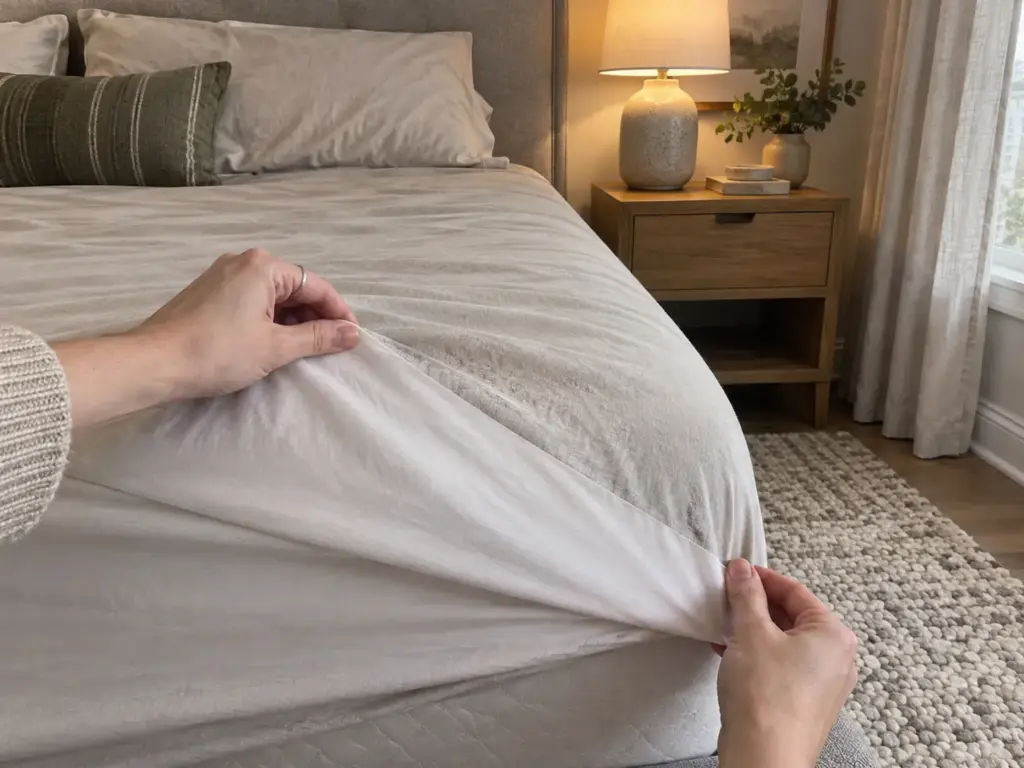
The reflex is to treat that as dirt a harder wash should shift: hotter water, more detergent, a second wash cycle. But most of the gray isn’t sitting on the cotton. It’s inside it, it arrived a little at a time, and it crossed a line you only noticed all at once.
Skin Oil That Changes Color in the Fiber
Every night you leave two things on the sheet. Sweat is mostly water and rinses out, which is why fresh sweat stains fade in an ordinary wash.
Sebum, the oil your skin makes, doesn’t: it soaks into the cotton instead of sitting on top of it, and over the following weeks it reacts with air and light, going from clear to pale yellow to something closer to brown. That oxidized skin oil is most of the color you’re looking at. It’s the reaction that browns a cut apple, and the same oxidation that turns pillows yellow, spread across a whole sheet instead of one pillow shell.
Cotton isn’t a bad fiber for this. It’s a good fiber doing the wrong job. It feels soft and takes up moisture because the fiber draws in whatever touches it, and that same habit is why it keeps the oil. A synthetic isn’t the way out, either: polyester has its own stubborn grip on oily soil, and it feels clammy against you all night on top of it.
What explains the “suddenly” is the build-up. Cotton Incorporated’s technical bulletin on fabric yellowing traces the yellowing people cause at home to perspiration, lotions, hair spray, make-up and other oily soil absorbed into the fabric, collecting slowly until the day its appearance tips over. Nothing happened that week. Months of nights happened, and that was the week they added up to something you could see.
You can read the sheet like a map of how you sleep. The band is darkest where your shoulders and neck lie and where your cheek meets the pillow edge, it fades toward your knees, and the strip tucked under the mattress, which never touched anybody, is still the white the set came in. That strip is your reference. It’s the color the whole sheet would be without you in it.
The Film the Wash Leaves Behind
The second layer comes from the laundry itself. Too much detergent, fabric softener and dryer sheets each leave a little behind that the rinse doesn’t carry out, and that detergent residue does two jobs you never asked for. It dulls the white on its own, and it gives the next night’s oil something to cling to.
Oil tends to turn a sheet yellow; residue tends to turn it gray. Most dingy sets carry both.
Softener is the sneaky one, because it does what the bottle says at first. The sheet feels softer the first week and a little duller every month after, and the two are the same film. Skin products ride the same path (the night cream, the hand lotion, the leave-in conditioner on the pillow side), which is why Cotton Incorporated lists them next to perspiration. They’re oils too.
A sheet with fabric softener buildup tells you by feel before it tells you by color. It goes faintly waxy, and a splash of water beads on it for a second before it soaks in, where clean cotton drinks it straight away. It also smells of the detergent for two washes and of the sleeper from the third, because the coating holds scent in both directions.
Hard Water, Storage and the Rust-Colored Cast
Not every yellow comes from you. Hard water minerals, iron above all, leave a yellow-to-rust tint that builds wash by wash, and it behaves nothing like oil: it tends to show evenly on everything that goes through that machine, towels included, and it gets worse under exactly the bottle most people reach for next.
Improper storage is the other outside cause. A set kept folded in a damp linen closet, with humidity and no air moving through it, yellows along the fold lines, because moisture held in the cotton is where mildew and mold start and discoloration follows. If the spare set comes out of the closet with a yellow grid printed on it, you have your answer before it ever goes on the bed.
Before you spend a wash, match the pattern to the cause:
- A yellow band where you lie, fading toward the edges, is skin oil.
- An even, all-over gray on a sheet that feels faintly waxy is detergent and softener residue.
- A rusty tint on everything from that machine, or yellow that follows the fold lines, is the water or the storage.
Spread the stripped sheet across the bed in daylight, by a window, and look at where it’s dull before you decide anything. A band says oil, an all-over cast says residue, a grid says the closet. Each one gets a different fix, and a wash spent on the wrong one is a weekend gone.
Why Chlorine Bleach Makes Dingy Sheets Worse
Once you know the gray is oil and residue inside the fiber, the bottle most people reach for first turns out to fit the problem worst. It’s the story behind the plea “I’ve tried bleach, baking soda w no luck”: a set that went into a bleach wash yellow and came out the same yellow, or yellower. A cotton research organization, a university extension office and the cleaning-products industry’s own trade group don’t agree on much. They agree on this.
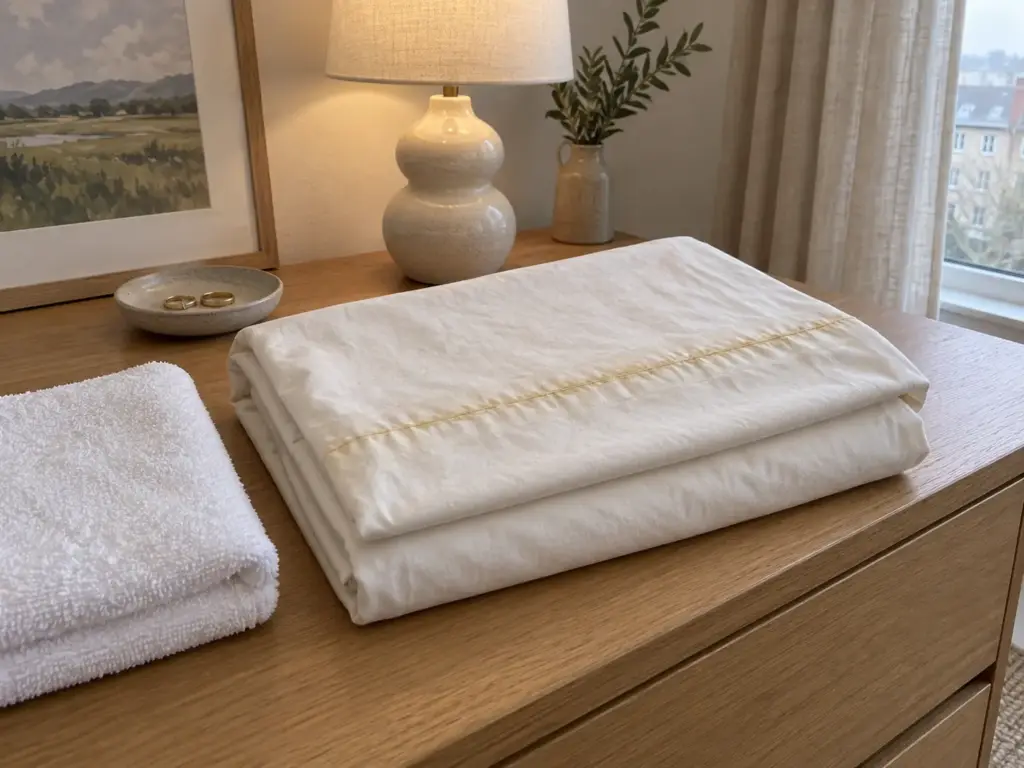
What Bleach Does to Yellow That’s Already There
Chlorine bleach is good at one thing: breaking down color in a fresh stain on plain cotton. Old yellow isn’t a fresh stain. It’s oil that has already reacted with the air, and chlorine doesn’t lift that out of the fiber so much as react with it again, which is how a set comes out of a bleach wash no whiter, or with the yellow sitting deeper. Apartment Therapy’s piece on whitening sheets goes further and lists chlorine bleach among the causes of yellowed sheets, right next to sweat and skincare.
Bleach gets recommended for whites everywhere, and I understand why. On a fresh stain on untreated cotton, it works. It stops working once the yellow has had time to set or the sheet carries a finish, and most dingy sheets have both.
It also costs you fiber. Repeated chlorine washes weaken cotton, and the set that looks whiter this year tends to be the set that tears at the fitted corners a year early, right where the elastic pulls hardest. The rule is the same on a pillow shell, which is why what lifts yellow out of a pillow and what makes it worse starts in the same place: leave the chlorine on the shelf.
The Finish That Holds Onto Chlorine
Cotton Incorporated calls chlorine “the unseen assailant,” and the reason sits in the finish rather than the fiber. Its bulletin describes chlorine being retained from wash water by many textile resin finishes, building slowly until it yellows and weakens the fabric. You never see it go in. You see it come out as a cast, months later.
A resin finish is what you’re buying when a package says wrinkle-free, easy care or no-iron. The label sells the ironing you’ll skip. The finish that makes that possible is also the thing holding on to chlorine from every bleached load, and no package mentions that part. On a white set, that one line on the packaging tells you more than the thread count printed above it.
Before any bleach goes near a white set, read the sewn label and the packaging for wrinkle-free, easy care or no-iron. Keep the packaging when you buy a set, because it’s often the only place that says it. Any of the three means a resin finish, and a resin finish means no chlorine, ever.
When the Yellow Is Actually Rust
A rust-colored cast from iron in the water is where bleach does the most damage. Kansas State University Extension’s stain-removal guidance is blunt about it: “Do NOT use a chlorine bleach to remove rust stains because it may intensify discoloration.” The American Cleaning Institute’s stain removal guide gives the same warning for sodium hypochlorite (the chemical name on the chlorine jug) under brown and yellow discoloration.
The fix for rusty water is a different product entirely. The ACI points to a rust remover made for fabrics; K-State recommends a non-precipitating water softener in both the wash and the rinse water. More bleach only darkens it. And if the towels are tinting too, look at the water before you blame the sheets.
The Recovery Wash, in the Order That Works
Most dingy sets come back with what’s already under the sink, as long as the steps go in the right order and two of the ingredients never meet. The whole thing fits a weekend: strip the bed Saturday morning, soak the set overnight, wash it Sunday, and have it on the line by early afternoon.
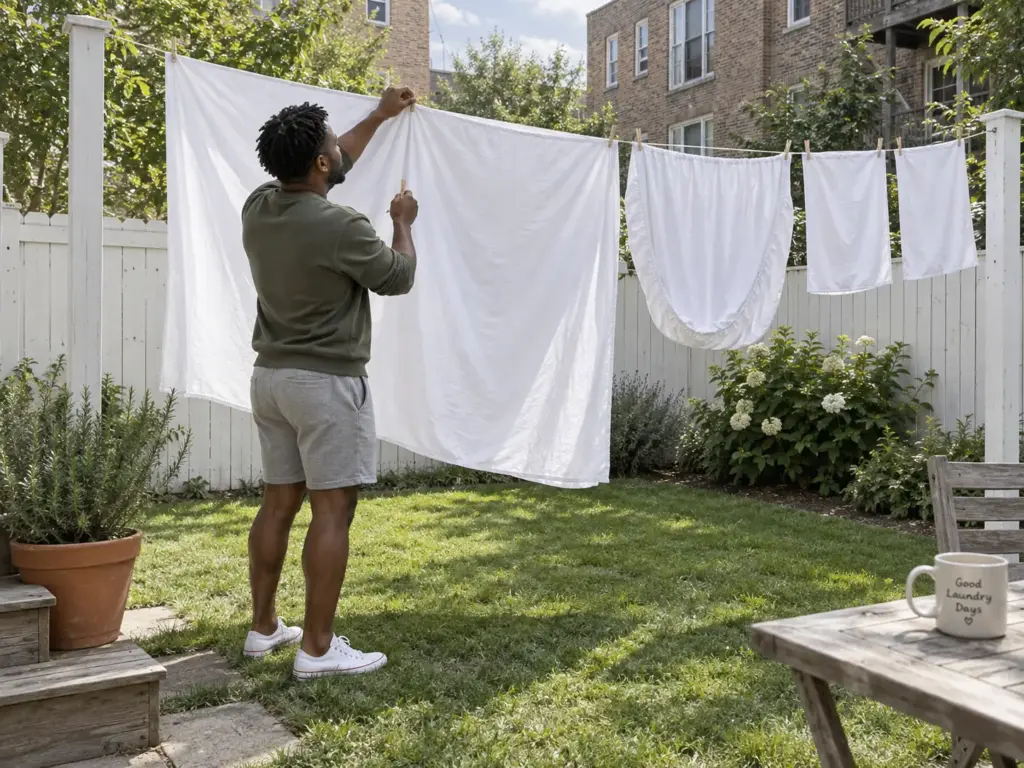
The Overnight Soak
The pre-soak does most of the work. Use a bathtub, or a top-loading machine set to soak. Fill it with warm water, dissolve an oxygen bleach in it first, and only then push the sheets under, all of them, nothing floating on top. Leave them overnight.
Oxygen bleach is sodium percarbonate, which releases hydrogen peroxide in water. It carries no chlorine, so there’s nothing for a resin finish to hold on to, and it works on the oxidized color slowly, which is why this is a night and not a quick dip.
A cold water wash gets recommended for everything now, and for a routine load of lightly used sheets that’s fine. For a recovery soak it isn’t. The same K-State guidance puts warm at 85 to 105°F and hot at 120 to 140°F, and says water below 60°F is too cold for detergents to work at all. Aim for warm, and let the care label set the ceiling: if it says warm, warm is the top.
If you need one, the OxiClean White Revive Whitener Laundry Liquid Additive is a water-activated liquid oxygen bleach with no chlorine in it, sold as a chlorine-bleach alternative, which is exactly the job this step needs. Its flaw is speed. It’s slower than chlorine, and on yellow that has been there a while the first soak rarely finishes the job, so plan on repeat rounds rather than expecting one night to undo months.
Two Agents, Two Compartments
Then run a normal wash on the warmest setting the label allows, with less detergent than you usually use. Put about half a cup of baking soda in the drum and fill the fabric-softener compartment with white vinegar.
The placement is the whole trick. Apartment Therapy’s version of this method warns that letting the two mix would leave each of them “no more useful than salt water,” because one neutralizes the other. The softener cup holds the vinegar back until the rinse, after the baking soda has drained away, so they never meet.
For a heavy load, a long-graying set, or hard water, borax is the step up from baking soda. The 20 Mule Team Borax Natural Laundry Booster is plain sodium borate powder that goes in the drum where the baking soda would. It’s alkaline, so it never shares a step with the vinegar, and undissolved powder can leave a white residue on the cotton; stir it into a jug of warm water until it’s fully dissolved before the sheets go in.
The first wash after a long softener habit can rinse out cloudy. That cloudiness is the residue leaving, and honestly, it’s the best sign you’ll get all weekend.
Check Them Wet, Then the Sun
Pull a sheet out wet and look at it before anything else happens to it. The American Cleaning Institute’s general rule is to keep anything out of the dryer until the stain is gone. Wet cotton hides nothing: hold it up to a window next to something truly white and whatever yellow is left will show. It’s the same miss behind why a pillow can come out of the wash still yellow: nobody looked before the heat went on.
If it passes, or nearly passes, it’s time for sun drying. Line drying outdoors lets sunlight bleach the last of the yellow at no cost.
No line? Air drying on a rack by a bright window still beats the tumble dryer, and if the dryer is the only option, run it on low and only once the wet check has passed. If it hasn’t, the sheet goes back in the tub, not into the dryer.
Keep one brand-new white pillowcase in its packaging as your reference. Hold the wet sheet beside it at the window. White against white is the only honest comparison; next to a cream wall or a beige carpet, almost anything looks clean.
When the First Round Isn’t Enough
One round brings most sets back. Not all of them. The set that comes out one shade lighter is the one that tempts you to just bleach it this time, and the second pass is where people reach for the wrong thing twice. So it helps to know what each option actually does before repeating anything.
Repeat the Soak Before Adding Anything New
The obvious move with a stubborn set is a stronger product. The better move is the same soak again. Oil that set over months comes out in layers, and a second overnight soak in oxygen bleach reaches what the first one loosened but didn’t carry away. If you change anything, change one thing: the water a little warmer, still within the label.
Then the same wash with baking soda and vinegar kept apart, the same wet check, the same sun. That’s round two. Two rounds is also the test the last section of this guide turns on, so keep an honest eye on the difference between them.
What Bluing Does and What It Doesn’t
Liquid bluing is one of the oldest tricks in laundry, and the most misunderstood. It adds a trace of blue pigment to the rinse, and blue cancels yellow to the eye, the same way a purple shampoo keeps blond hair from going brassy. It removes nothing. The oil is still there; the sheet just reads white.
That’s worth knowing whenever a product says “whitener,” because the word covers two different things: an agent that breaks down color, and a tint that hides it. Bluing is honest about being the second kind.
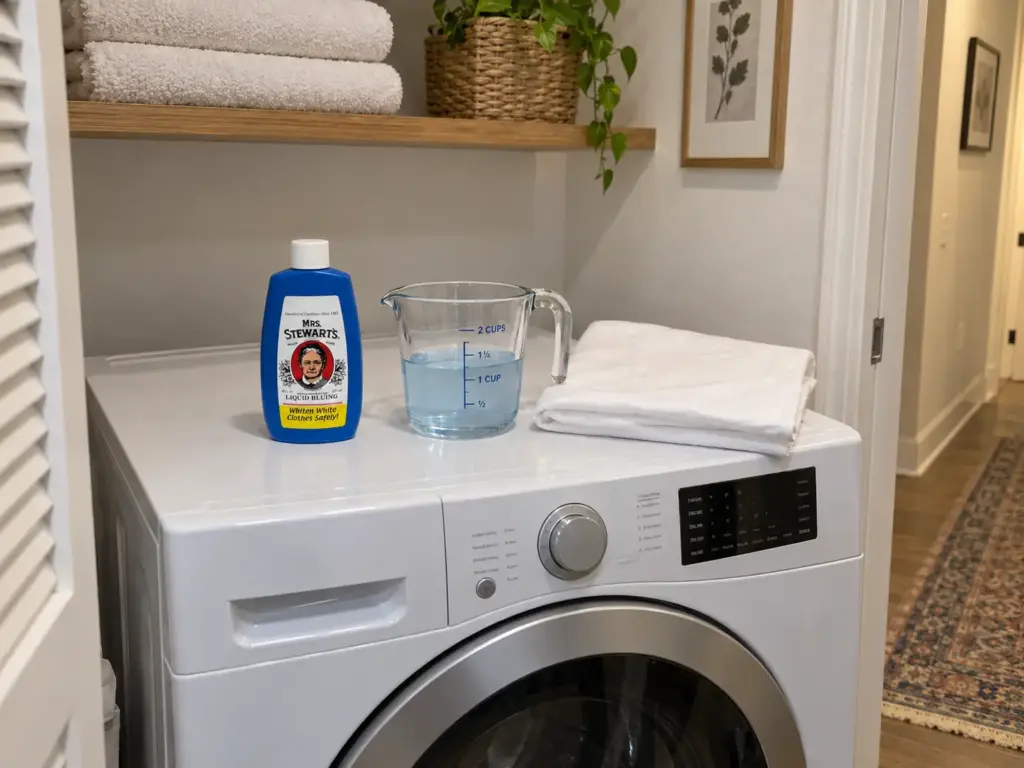
Where it earns its place is at the end, on a set that’s clean, passed the wet check, and still reads cream next to your white pillowcase. The Mrs. Stewart’s Concentrated Liquid Bluing is a concentrated liquid bluing on a formula that has been around since 1883, and it goes into water by the drop, not the capful. Its flaw is the whole next section: poured on neat or overdosed, it leaves blue spots where it lands.
Dilute It or It Stains
Bluing never touches fabric straight from the bottle. Stir it into a container of cool water first, then add that to the rinse, never onto sheets sitting dry in the drum. Neat bluing on cotton leaves blue patches that are harder to get out than the yellow was.
Start with less than you think. Too much and the set goes faintly blue-gray, which looks dingier than the cream you started with. Test your dilution on one pillowcase before the whole set; it’s the smallest piece and the one you’d miss least.
Why One Side of the Bed Goes Dingy First
Everything so far treats the set as one piece of cloth. On a shared bed it isn’t. One half has usually taken more sweat and more oil than the other, and it shows.
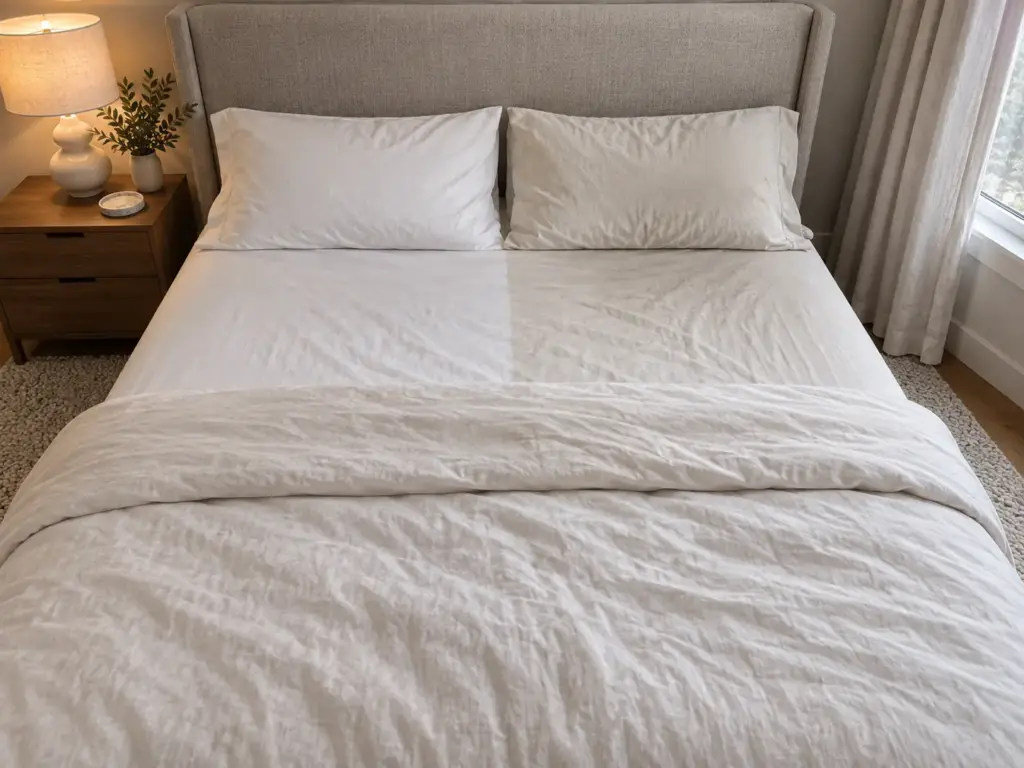
A thread on r/Bedding put it about as vividly as it gets. A woman described her husband as “the sweatiest sleeper I have ever known,” damp enough that she has to “dry my arm off with a towel” if she touches his side of the bed. He sleeps under a top sheet alone, with the air conditioning set cold, and it still happens. Her verdict on the laundry: “It’s stained my favorite pillowcases yellow.”
The Hot Sleeper’s Half
The mechanism is simple. The half of the bed that gets more sweat and more skin oil crosses the build-up threshold first. The pillowcase on that side goes before anything else, and the fitted sheet follows where that person’s shoulders lie.
It’s also why “why does my husband turn the sheets yellow” has a boring answer: nothing is wrong with anybody. Some people make more oil and sweat more than others, and a white sheet keeps a very honest record of it.
On a flat sheet, the band runs down one side only. On the fitted sheet you get a shoulder-shaped shadow under one pillow and a clean stretch under the other, with the dividing line roughly where the two of you stop rolling toward the middle. The pillowcases show it fastest. They take the face, the night cream and the hair product, all in a few square inches, and on the hot side they can go dingy while the rest of the set still looks fine.
That unevenness changes the verdict, too. A set that’s gray on one half is still half a good set, and the two-round test in the next section applies to the bad half, not to the whole thing. It’s easy to throw out a set like this, because the worst corner is the one you keep looking at.
One boundary, in passing. A sheet that yellows faster on one side is laundry. If one of you soaks the bed every night whatever is on it, even under a single sheet in a cold room, that’s a separate question about whether it’s the bed or something else, and past a point it’s a question for a doctor, not for a detergent.
Rotate the Set, Swap the Cases
You can’t wash half a sheet, so spread the load instead. Every wash, put the fitted sheet back on turned head-to-foot, so the shoulder zone moves to where your feet go, and flip the flat sheet side to side as well as end to end. Swap the pillowcases between the two sides each week.
None of this removes oil. It keeps one strip of cotton from reaching the point where it shows years before the rest of the set does.
The pillowcases on the hot side need their own schedule. Wash them twice a week instead of once; they’re small, they go in with a towel load, and they’re taking most of the oil. And on the nights the hot sleeper soaks through, washing bedding after a night sweat, in the right order matters more than any whitener you add later.
Two free habits cut what reaches the cotton in the first place. A shower before bed instead of in the morning takes the day’s oil off before it spends the night on the sheet, and letting night cream sink in for a while before you lie down keeps it on your face instead of on the pillowcase.
The r/Bedding poster was weighing new sets and balking at buying several just to test them. That’s the right instinct. When one side goes first, replace the cases before you replace the set.
Buy one extra pair of white pillowcases for the hot sleeper’s side and rotate them in with the originals. They wear out first, they’re the piece everyone sees, and replacing two cases costs a fraction of a new set.
When Dingy White Sheets Won’t Come Back
Every step above works on residue, and on oil that hasn’t finished its job. None of it rebuilds a fiber that has started to go. This is where replace or recover gets decided, and it’s worth knowing before you spend a third Saturday on the same set.
The Two-Round Test
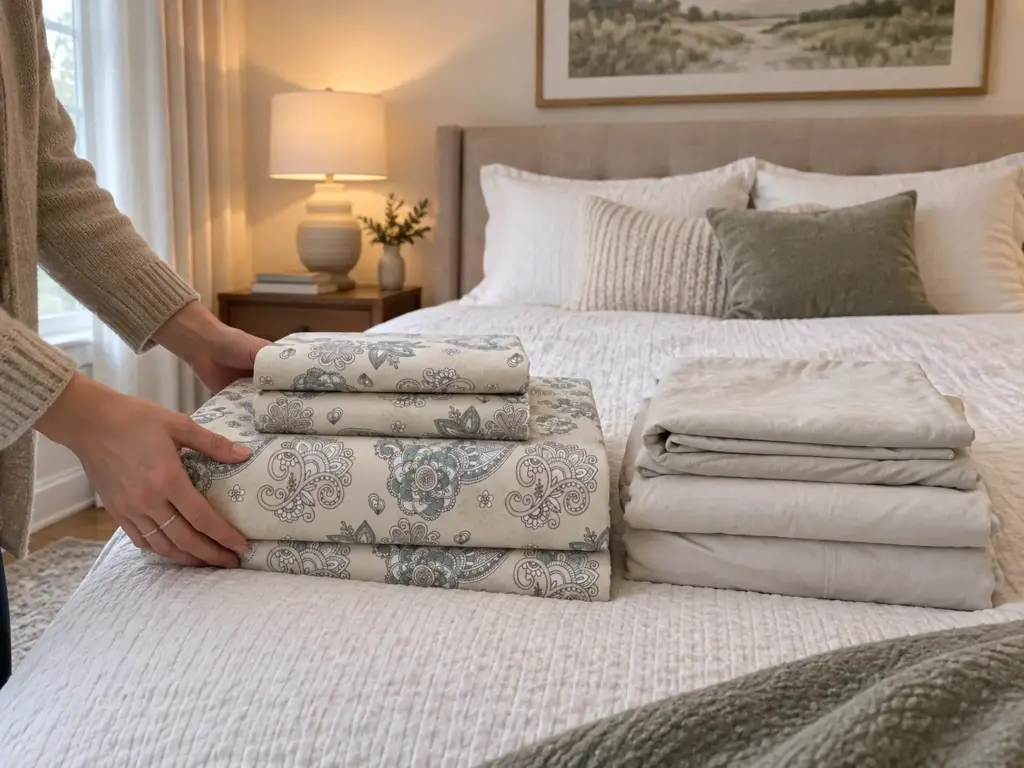
Two full recovery rounds, each one a soak, a wash and a day in the sun, then the white pillowcase beside the wet sheet at the window. If round two changed nothing you can see against that reference, the yellow is part of the fiber now, and a third round won’t change anything either. Cotton Incorporated puts it plainly: “In some cases, fabric yellowing indicates fabric degradation, in which instance; the fabric may not be able to be restored to its original condition.”
That’s the cotton industry’s own research organization saying some yellow does not come out. No soak changes that, and knowing it is what lets you stop.
The other trap is the round that looks like a win. Bright on Sunday, gray again a few weeks later: that sheet was only cleaned on the surface, and the oil underneath went back to work.
Week one lies. Judge a recovery by how the set looks after a month of ordinary washes, not the afternoon it came off the line. The first load almost always looks like a miracle; what matters is whether it holds.
On the day of the first recovery round, write the date on the care label with a laundry marker. If you find yourself back at the tub within a month, the label has already told you what the set is worth.
Signs the Fiber Itself Is Going
Hold the sheet up to a window again, this time looking for light instead of color. Yellow plus thin spots, where the daylight comes through brighter, is the cloth wearing out under you. So is a weave that has gone soft and loose where you lie, with the threads visibly farther apart than at the tucked-in edge, and fitted corners that are fraying or starting to split along the elastic. None of that is a stain, and no soak treats it.
Yellow set into the fold lines from storage that survives two rounds belongs to the same verdict. If mildew was part of it, the American Cleaning Institute’s guide is frank that badly mildewed fabrics may be damaged beyond repair. And a set that has been bleached for years often fails all three checks at once (yellow, thin, and tearing at the corners), which is the chlorine collecting its bill.
What to Put On the Bed Next — and Keep It White
The next set should be one that gives oil and residue a way out. My reasoning here comes from how the weaves are built, not from a lab result.
A plain cotton percale is one thread over, one under, which leaves a small open gap at every crossing, so wash water moves through the cloth instead of skating across it. A sateen floats one thread over several to make its smooth face, and that closes the gaps; a closed face is a denser one for residue to settle into and for rinse water to reach. Leave a resin finish off the cotton too, and there’s nothing on it holding chlorine or softener. So: plain percale, 100 percent cotton, and nothing on the packaging that says wrinkle-free or easy care.
The habits matter more than the set. Wash weekly, and use less detergent than the line on the cap, because a sheet load rarely needs the full dose and whatever doesn’t rinse out stays in the cotton.
Skip softener altogether. Keep separating lights and darks, since one stray dark shirt is all it takes for dye transfer to gray a white set in a single load. Dry them in the sun when you can. As for which detergent, a plain one without added dyes does the job; the dose matters more than the brand.
If you’re replacing, the Feather & Stitch 100% Cotton Percale Sheet Set is 100 percent cotton percale at 300 thread count, single-ply, with a 16-inch pocket, which is the plain construction described above. It will never feel like a sateen. It’s matte and crisp, it wrinkles, and it looks slept-in by morning; that’s the trade for a sheet that rinses clean.
The old set doesn’t have to go in the trash. Cut it into rags, keep it as a drop cloth for painting, or take it to a textile-recycling bin. If it’s torn, it isn’t a donation, whatever the bag says. And if the pillows under those cases are yellowing too, they’re their own case, covered in the rest of the yellowing guide.
Two Rounds and a White Pillowcase Decide It
Three things change how this goes. The gray is skin oil and wash residue inside the fiber, not dirt on top, so scrubbing harder and bleaching harder both work against you. The recovery is an oxygen-bleach soak, a wash with baking soda and vinegar kept apart, a wet check and the sun, with the free steps before any bottle. And two rounds is the test: if the second one changes nothing against a white reference, the fiber is the problem, and the fix is a new set.
Whatever goes on the bed next, look at it in daylight around wash twenty, right where the shoulders lie. If a band is starting there, cut the detergent and drop the softener before it sets.
Strip the bed Saturday morning. Soak the set overnight. Look at it wet on Sunday, next to something white. Then decide.
Frequently Asked Questions
01How can I get white sheets white again?
Soak them overnight in warm water with an oxygen bleach, then wash them with baking soda in the drum and white vinegar in the fabric-softener compartment. Check them wet against something white, dry them in the sun, and leave the chlorine bleach on the shelf.
02How do hotels keep white sheets white?
Industrial laundering runs far hotter than a home washer, with commercial chemistry, and hotels retire sheets on a schedule instead of trying to rescue them. The part you can copy at home is the retiring.
03Why does my partner’s side of the sheets turn yellow faster?
More sweat and skin oil lands on that half of the bed, so it reaches the point where yellow shows sooner than the other side does. Rotate the sheets head-to-foot each wash and wash that side’s pillowcases twice a week.
04How do you get yellowing out of white sheets?
An overnight oxygen-bleach soak in warm water lifts most of it, and a second round handles yellow that has been there longer. If two full rounds change nothing against a white reference, the yellow is in the fiber and won’t come out.
05Is it okay to wash white sheets with baking soda and vinegar?
Yes, as long as the two never meet: baking soda goes in the drum and vinegar goes in the fabric-softener compartment, so it releases at the rinse. Mixed in the same step, they cancel each other out and do almost nothing.





Tried it on your own bed?
No comments yet. Tell us what you changed, and what the sheet did after a few washes.