
What’s in here7 sections
Somebody stays loyal to the same expensive percale set for years, replaces it on a partner’s suggestion with a store-brand set at a fraction of what the old one cost, and then never goes back. That story is more common than the roundups let on, and it is not a story about getting lucky.
A plain weave is one thread over and one thread under. That alternation leaves small regular gaps across the whole cloth, and those gaps are the airflow. A loom does not weave them wider because the finished set is going to sell for more.
So the honest question about affordable bedding is not whether cheap can sleep cool. It is what the money above cheap is actually buying, and where the cheap tier really breaks.
Quick Answer
A set that genuinely sleeps cool costs far less than what any roundup calls affordable. The mechanism is a plain cotton percale weave at moderate weight with no synthetic finish, and that spec is printed on the back panel at every price tier. Everything charged above it buys color, hand-feel and service, not airflow.
The Spec That Buys Cooling Costs Nothing Extra
Two packages sit on the same shelf, one at roughly a third of the price of the other. You turn them over looking for the difference, and the front panels are no help at all: both are shouting about temperature, both have a word on them that sounds like a measurement and is not.
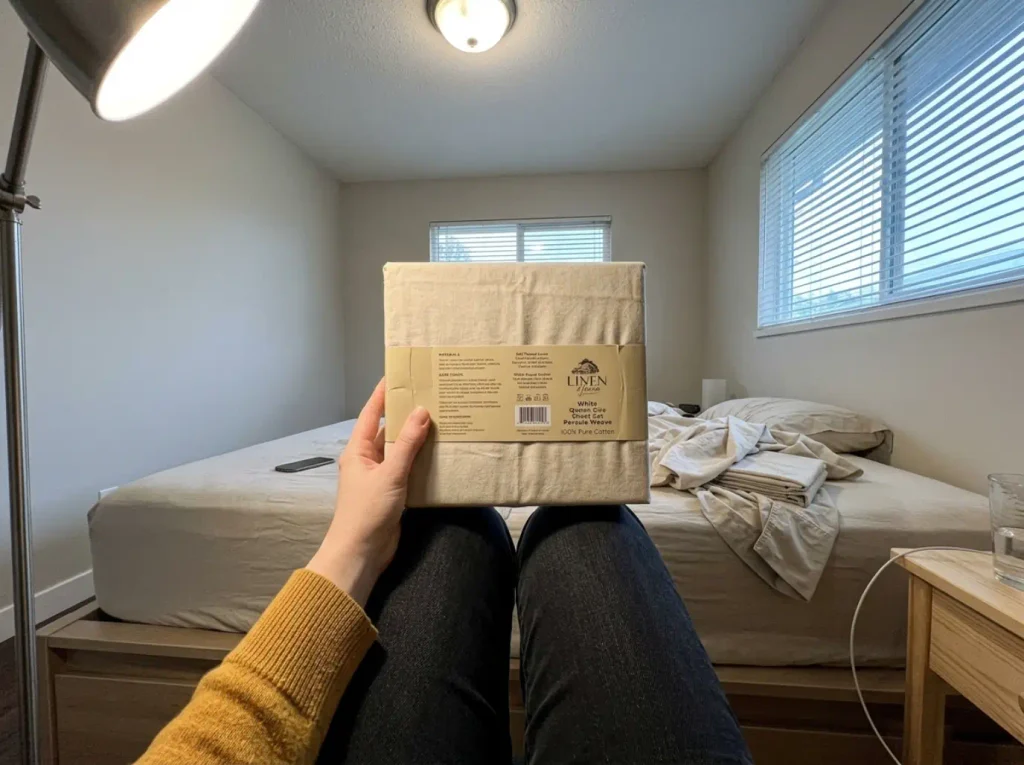
The back panels settle it in about eight seconds. Three lines decide the whole cooling question, and they cost nothing to read.
What the weave is doing while the price tag does nothing
Percale is not a material. It is a plain weave, one warp thread over and one weft thread under, repeated across the cloth, and that is worth saying plainly because half the shelf treats it as a fiber name. If you have been trying to line it up against a fiber and getting nowhere, one of those words is a fiber and the other is a weave and the confusion is doing real damage to people’s shopping.
The over-under alternation leaves the cloth flat and slightly open. Air moves through the crossings, warm humid air near your skin gets replaced by cooler drier air, and that exchange is the entire cooling mechanism of a sheet. It is structural. It belongs to the loom setup, not to the brand that ordered the fabric.
And a loom does not charge by the tier. Weaving plain cotton percale takes the same threading, the same picks per inch and the same machine time whether the finished set ends up in a discount aisle or a designer catalog. The mill’s cost difference between those two sets is in the cotton and in what happens after the weaving, which is a different conversation from airflow.
Read three lines on the back panel and ignore everything on the front: the fiber content, the weave name, and whether the thread count says single-ply. If all three are printed, the package has told you how it will sleep. If any of the three is missing on a set that talks about temperature on the front, the missing one is the one that would have hurt it.
The number on the front, and why a modest one is fine
A thread count is a count of threads in a square inch, which sounds unambiguous until you learn that a thread can be two thin yarns twisted together and counted twice. That is how a set arrives at a four-figure number without arriving at a finer cloth, and it is why what a thread count number is actually counting matters more than the number itself.
Single-ply in the two hundreds is a real cloth with nothing hidden in it. It is also, in percale, roughly where the weave sits comfortably: enough threads for a smooth flat surface, not so many that the crossings crowd shut and the airflow you came for goes away. A modest single-ply number on a percale label is a good sign wearing the costume of a poor one.
You will also find a certification mark on some cheap sets and not on some expensive ones, and it is worth knowing exactly what it means. An OEKO-TEX STANDARD 100 label means the finished textile was tested against more than a thousand substances, with bed linen sitting in the stricter class for direct skin contact. It is a safety result, not a quality or temperature result. A cheap certified set carries exactly the same lab outcome as an expensive certified one.
What the shop floor tells you, and why it is misleading
Here is the part nobody warns you about. A percale set out of the package is stiffer than it will ever be again, because it still carries its folding creases and a sizing that has not been washed out yet. What you are feeling in the aisle is partly starch on both sets, and by wash three it has left both of them.
The premium set wins that hand-test more often than it deserves to. Then it goes home, gets washed, and turns into what its weave and its cotton always were. Judging a set with your palm in a store is judging the finish, not the fabric.
One long-term owner who kept a cheap percale set and a set costing roughly five times more, side by side for a year, described them as being on the same level for softness. That is a person with both sets in the same laundry basket, which is worth more than any number of aisle impressions.
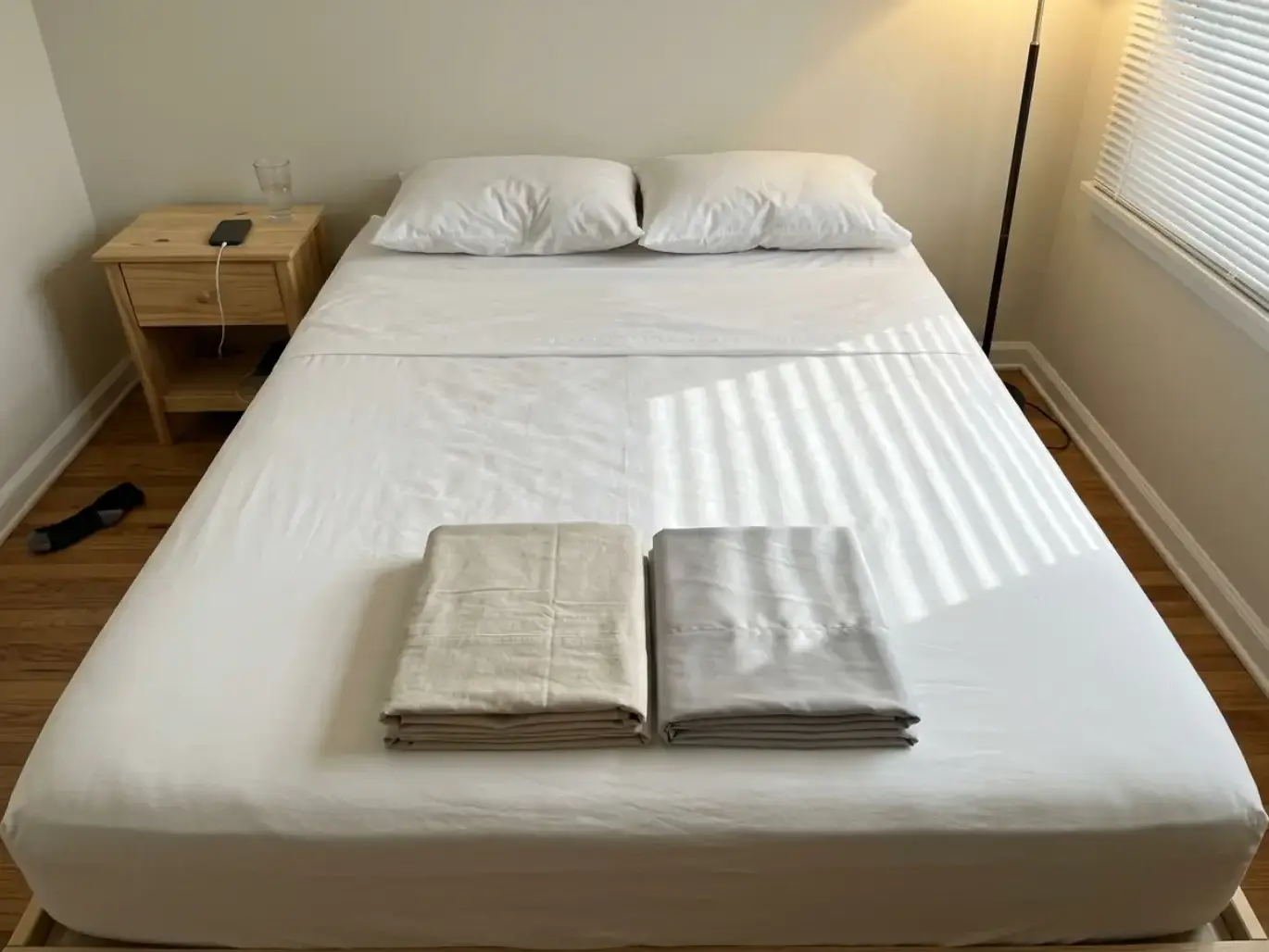
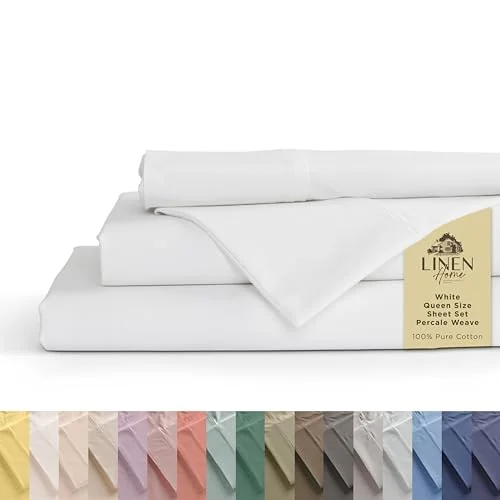
The set below carries exactly the spec this section has been describing, at the true bottom of the market rather than the bottom slot of somebody’s roundup.
What the Extra Money Actually Buys
The easy version of this article would be that expensive sheets are a scam. They are not, and saying so would leave you unable to spend your money well.
What a premium set buys is real. It is just none of it temperature, and once somebody itemizes the list you can decide whether you want the things on it.
Color, hand-feel and the hem: the honest list
Color range is the difference nobody argues with. The cheap tier is white, off-white, a gray, a taupe and a handful of others, chosen because they sell in volume. If you want a specific shade to sit in a specific room, that shade lives upmarket, and there is no cheaper route to it. That is a genuine reason to spend and it has nothing to do with how you sleep.
Hand-feel at wash one is genuinely better on the premium set. The cotton is likely a longer staple with fewer loose fiber ends per inch of yarn, and the finishing is more careful. What narrows that gap is time: over a season of washes the premium set relaxes toward its true hand and the cheap one softens up toward its own, and the distance between them closes far more than the receipts would suggest.
Cotton fiber comes off the plant in lengths, and that length is settled before anything else happens to it. Short fibers spun into yarn leave more loose ends poking out per inch of thread, and every loose end is somewhere friction can start rolling fiber into a ball. That is what the premium is buying in the cotton itself, and it is a durability argument rather than a temperature one: fewer ends means a surface that stays smooth longer, not a cloth that moves more air.
There is also a difference in what happens after the weaving. A premium finisher can afford more careful singeing and mercerizing, which is why the cloth looks even and takes dye cleanly. Those processes change how a fabric looks and how evenly it wears. They do not open the weave, and they cannot, because the weave was decided on the loom.
Then there is the stitching, which is where the money is genuinely visible if you look for it. Hems, seam allowances and the elastic casing on a fitted sheet are labor, and labor is what gets cut first at the bottom of the market. Remember that one, because it comes back as the whole of the next-but-one section.
Judge any set by its pillowcases, not its flat sheet. Pillowcases go through the wash most often and get handled every night, so whatever is going to happen to a set happens there first. A flat sheet looks presentable long after the pillowcases have told the truth, which is exactly why a set judged at the end of one summer by its flat sheet gets a better verdict than it earned.
The services you are also paying for
A longer warranty, a return window that stays open past the point where you know how the set sleeps, a phone number that a person answers. These cost the seller real money and they are worth real money to a buyer who wants the option to change their mind. Nobody should pretend otherwise.
They also have exactly zero effect on the temperature of a bed. That is the distinction the roundups never draw, because a roundup that drew it would have to explain why its Best Value pick still costs several times what the mechanism costs.
The reference point this whole niche keeps circling is Target’s Threshold 250 thread count organic percale set. It is the one genuinely cheap percale set that independent long-term testing keeps putting level with sets costing roughly five times more, and it deserves the credit. It is a store-exclusive line, so it is named here and nowhere linked.
The like-for-like behind it is the rare thing. One buyer who owned both for a year put a cheap percale set against a premium one and found the premium ahead on crispness and color range and level on softness, which is a comparison structure the roundups never run because they test each product alone for a handful of washes.
The two tiers, line by line
Set them beside each other and the pattern is not subtle. Every row where the premium wins is a row about looking, buying or being served. Not one is a row about heat.
| What you are comparing | Budget percale | Premium percale |
|---|---|---|
| Weave and airflow | Plain weave, gaps at every crossing | Plain weave, the same gaps |
| Color and pattern range | White, gray, oatmeal, a few more | The specific shade you had in mind |
| Hand-feel at wash one | Flatter, plainer, no sheen | Crisper, and it narrows over a season |
| Hem and seam finishing | Where the labor was cut | Double-turned, and it lasts |
| Warranty, returns, a person to call | Thin to nonexistent | Real, and it costs real money |
If what you want is the hard floor of the market rather than a tour of the whole tier, the same argument at a stricter price floor runs it at a single ceiling and reports what breaks under it.
The Synthetic Wearing the Cooling Word
You pick up a package of double-brushed microfiber, and the word cooling is on it in the same font it was on the cotton percale two shelves over. Same word, same shelf, roughly the same money. You assume it means the same thing.
It does not, and the reason it does not is that nobody certifies the word. There is no test behind it, no threshold a fabric has to clear, no organization issuing a result. It can be printed on anything, and it is.
Soft is a finish. Cool is a structure.
Brushed polyester genuinely feels soft, and that softness is real rather than a marketing claim. It comes from mechanically raising a nap on the surface of the fabric, breaking fine filaments up into a fuzz that your skin reads as plush. The process works. It is why people rate these sets highly and mean it.
But the brushing happens on top of the fiber and does nothing to what the fiber is. Polyester is a plastic filament, and moisture does not travel into it the way it travels into a cotton fiber. Sweat sits on the surface or in the gaps between filaments instead of being absorbed and released, which is why a set can feel wonderful at the moment you get into bed and be a problem three hours later.
Softness and heat movement are unrelated properties. The label puts them in the same sentence and lets you assume they are the same claim.
This is also why the ratings on these sets are not lying to you and still cannot be used the way you want to use them. People rate a sheet on how it felt when they got into bed, because that is the moment they noticed it, and by that measure a brushed microfiber set genuinely earns its stars. The temperature verdict happens four hours later in the dark, when nobody is composing a review. The category’s high ratings and its poor showing on a hot night are both true, and they are measuring different moments of the same night.
And the proprietary names make it harder. A fiber given a trademarked name that sounds like a cooling result rather than a material tells you nothing about what it is or how it was woven, and it is designed not to.
When a listing will name its fiber and its weave, you can reason about it. When it will only name its technology, the naming is the answer. That the weave decides, not the fiber holds just as firmly when the fiber in question is a synthetic one, and here the nap is closing the surface that a plain weave would have left open.
Why the nap is a genuine feature in the wrong month
Brushed microfiber does something plain cotton does not, and it is worth naming properly rather than dismissing. The raised nap holds a thin pocket of air against the surface of the cloth, which is why the spot where you were lying is still warm when you roll back into it a minute later.
In January that is the entire appeal, and it is a real one. In July it is the mechanism by which the cool side of the pillow stops existing. Same fabric, same property, opposite verdict, and the only thing that changed is the season.
Which is why the honest position here is not that microfiber is bad. It is a fine sheet in a cold room, in a guest bed, in a kid’s room where things get spilled and replaced, and when microfiber is the right call is a genuine question with genuine answers. None of those answers is a hot sleeper in summer.
The set below is the concrete instance. It is here as the worked example of a label doing two jobs, not as a pick and not as an accusation against a product that delivers exactly the softness it is rated for.
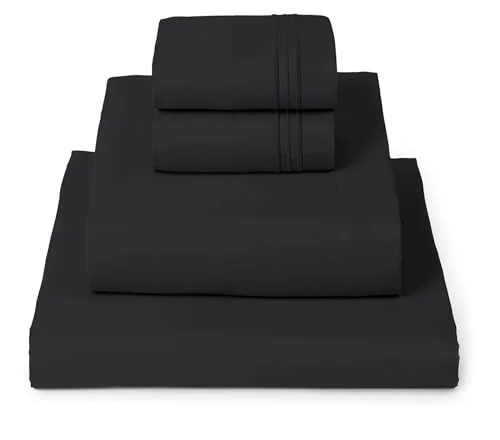
The buyer is never the villain in this story. The set arrives, it is soft, it is well made, it does what the reviews said. The word on the front was the only thing that was never earned.
Where the Cheap Tier Actually Fails
It is the end of a summer. The set has been washed most weeks since May. Something has changed, and it is worth knowing in advance what that something is going to be, because it is not what the roundups check for.
The weave body holds. The stitching is what goes.
A plain cotton weave is a plain cotton weave. It does not abrade faster for having been inexpensive, and the sheet body of a cheap percale set is not where the trouble starts. If your cotton set is sleeping hot, that is a weave problem rather than a price problem, and when the weave is wrong is the specific diagnosis for it.
What does go is the sewing. Hems, seams and the elastic casing are labor rather than material, and labor is the line item the bottom of the market cuts hardest. Cheap sets do not usually fail as fabric. They fail as construction, in the places two pieces of fabric were joined.
The one verified long-term account available on a cheap-tier percale set is a single person’s year with it, and it is worth stating as exactly that rather than dressing it up as a chorus.
No pilling. No fading. It softened with washing, as cotton does. The only visible wear after that year was fraying at the pillowcase hems, and the sheet body was fine.
One report is one report, and it should be weighed as one. But it is a full year with the set actually on a bed, which is more than any of the five-wash roundup tests can say, and the failure it names is the one the construction argument predicts.
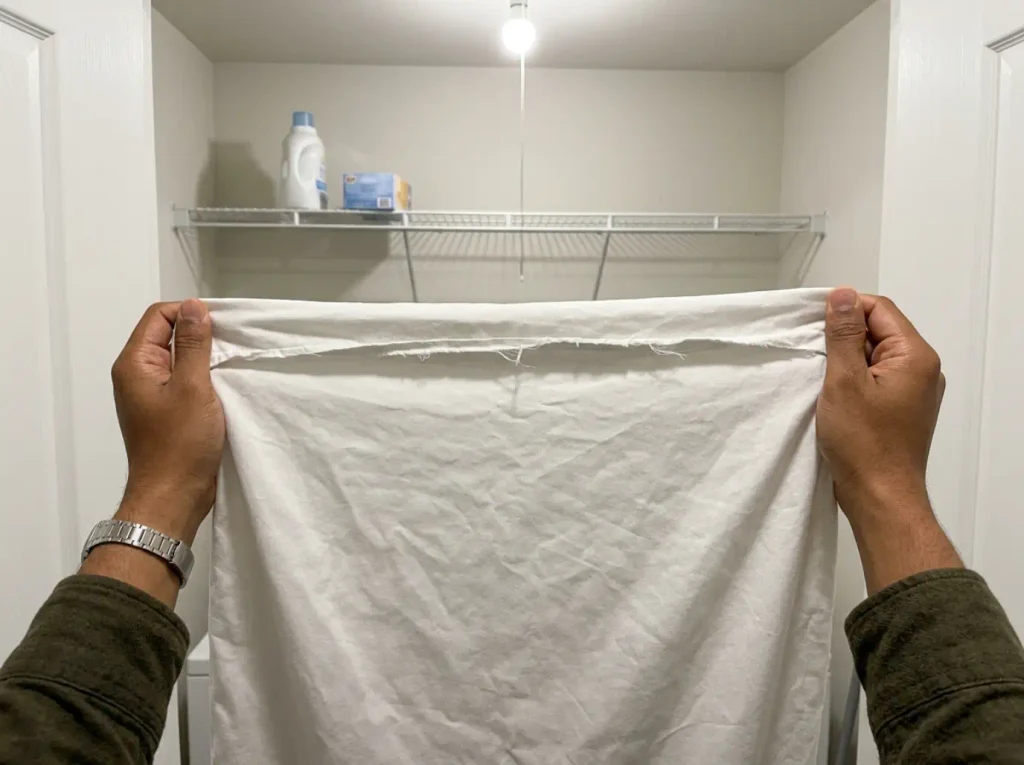
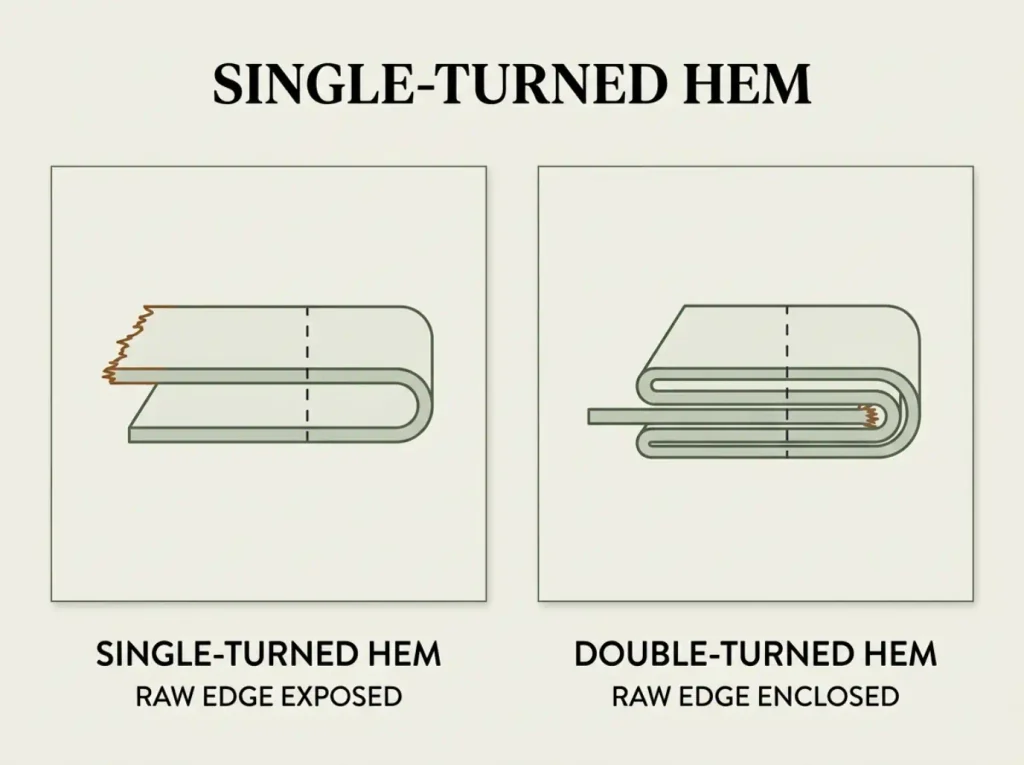
It is worth being precise about why hems fray rather than treating it as bad luck. A hem is a fold of fabric held down by a line of stitching, and the question is what happens to the raw cut edge inside that fold. Turn the fabric once and the raw edge sits there, exposed inside the seam, with nothing but the stitch line holding it. Every wash cycle drags it against everything else in the drum, threads work loose from the cut edge one at a time, and eventually enough of them have gone that the edge looks fuzzy from the outside.
Turn it twice and the raw edge is folded away inside itself before the stitching goes in. There is no exposed edge left to unravel. It takes a second fold, a second pass of the machine and a little more fabric, which is precisely the kind of small recurring cost that gets removed when a set has to hit a low number.
Turn a pillowcase inside out at the open end before you buy and look at the hem. A single folded seam leaves a raw fabric edge inside the stitch line, and that edge is what starts fraying. A double-turned hem has the raw edge folded away inside itself, so there is nothing exposed to unravel. It predicts how the set ages better than any number on the front of the package, and you can check it standing in the aisle.
The second place to look is the fitted sheet’s elastic. You are not checking whether it still stretches; you are checking whether the casing lies flat when the sheet is off the bed. A casing that has gone wavy and puckered instead of snapping straight has lost its elastic to heat, and that is a dryer problem as often as a quality one.
Two washes against one season
Here is the gap that explains why budget sets get recommended enthusiastically and then quietly regretted. The people writing the recommendations run two to five wash cycles. The thing that decides whether the set was a good buy takes a season.
Nobody in that testing window is lying. They simply stop measuring before the only failure mode that matters has had a chance to appear, and then a scoring table gets built on the part of the story that was always going to look fine.
The practical consequence is that you have to run the test yourself, and the good news is that it runs in the background. Put the set on the bed, wash it the way you actually wash things rather than the way the care label wishes you would, and look at the two failure points at the end of the season. You will know more about that set than any published review of it.
How you run those washes matters more on a cheap set than on an expensive one, and for a reason that has nothing to do with the fiber. A warm or hot wash temperature relaxes the stitching thread and the fabric around it at slightly different rates, and every cycle works the seam a little.
That is survivable on a double-turned hem with the raw edge folded away inside. On a single-turned one it is the thing doing the unravelling. A cool wash costs nothing and buys the cheap set most of the gap.
The dryer is the other half of it. Tumble dry on high and the heat plus the tumbling attacks exactly the places that were already the weak ones, the hems and the elastic casing, while leaving the flat weave in the middle of the sheet largely alone. Line dry a cheap percale set, or pull it out of the dryer while it is still a little damp and let it finish on the bed, and you have removed the single harshest thing that happens to it all week. It also comes out less creased that way, which is the closest a percale set ever gets to looking ironed.
The dryer deserves a mention here, because it changes the answer. Heat is what breaks down the elastic in a fitted sheet casing, and a set that would have lasted years on a low-heat cycle can go slack in a single summer of high heat. When a cheap set loses its grip early, the machine is at least as often responsible as the price was.
Building the Whole Bed at the Bottom of the Market
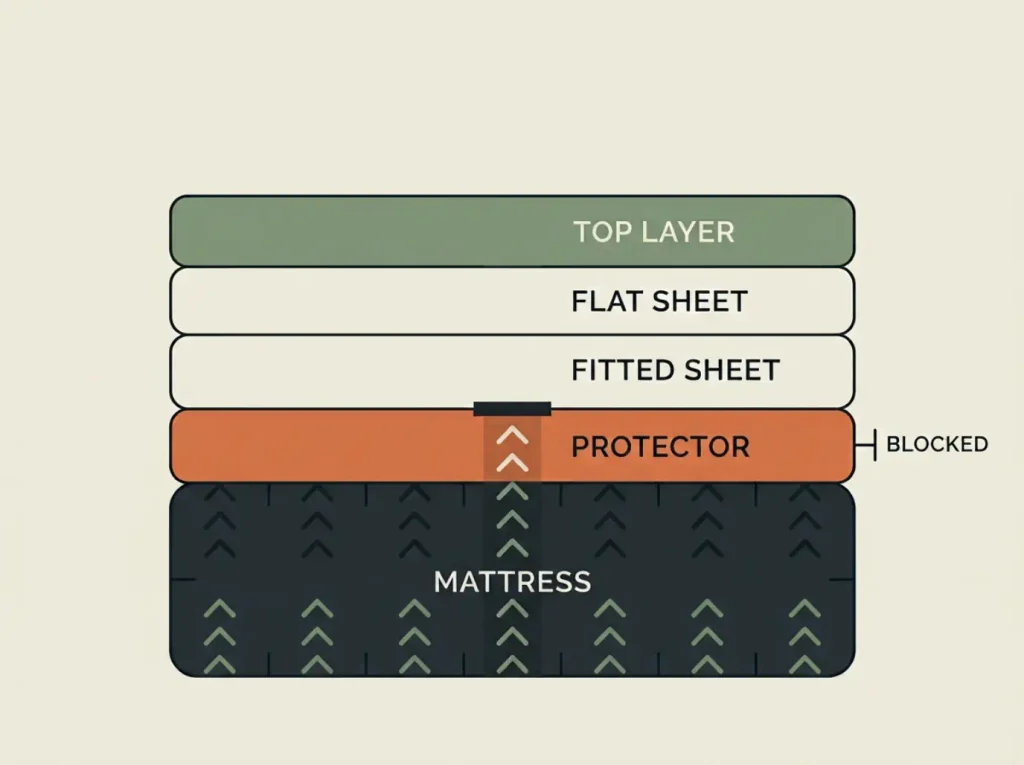
A bed is a stack, not a shopping list. Mattress, protector, fitted sheet, whatever goes over you, and heat has to get out through all of them in order. Any one layer can undo everything above it, which is why buying better sheets sometimes changes nothing at all. Bedding for hot sleepers, layer by layer is the full version of that idea; this section is its budget build.
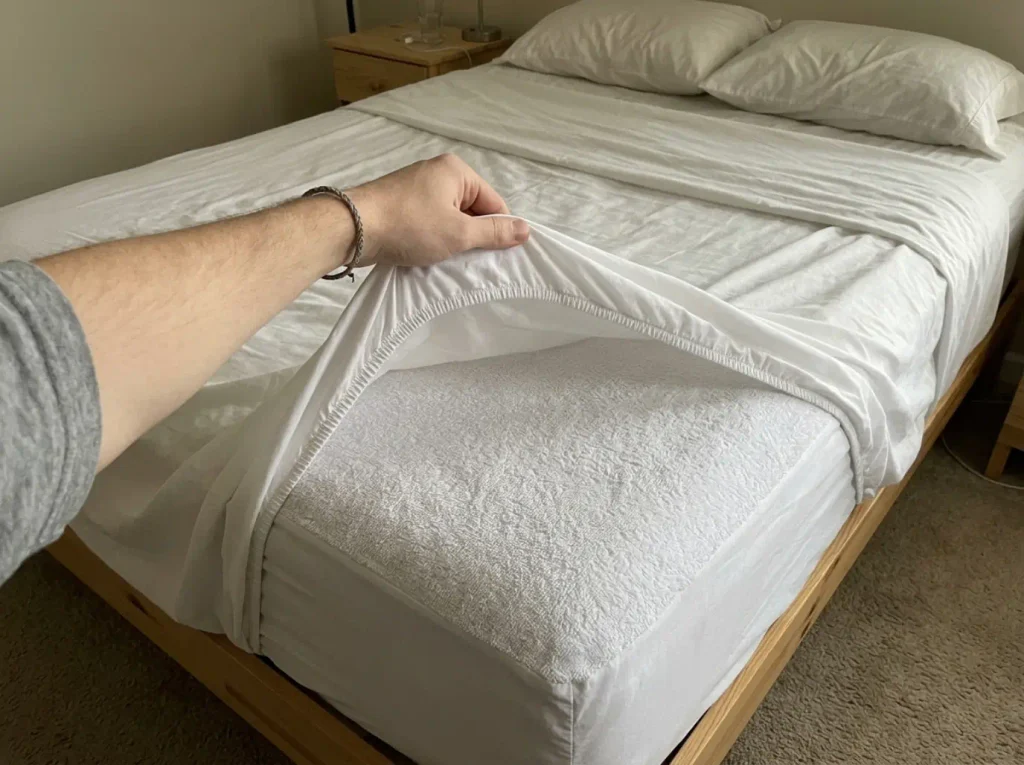
One measurement decides whether any of this works, and it is the one nobody takes before ordering. Run a tape down the side of your mattress with the topper already on it, because the topper counts. That figure is the pocket depth the fitted sheet has to clear.
A cheap set with a shallow pocket on a tall mattress will pop a corner every few nights no matter how good its weave is, and the deep-pocket version of the same set usually costs the same. It is free to get right and expensive to get wrong.
The first two moves in this section cost nothing, and they come first for that reason.
Take a layer off before you buy a layer
Strip the duvet and sleep under the flat sheet alone for a week. Or leave the duvet on and take the flat sheet, the top sheet, out of the stack instead. Most people have never once run their bed with a layer removed, which makes it the cheapest experiment available and the one with the largest single effect.
It also tells you something a purchase cannot. If one layer fewer fixes the night, the problem was insulation and you now know how much of it to remove. If it changes nothing, the problem is further down the stack and you have saved yourself from buying the wrong thing twice.
Look under the fitted sheet before you blame the sheet
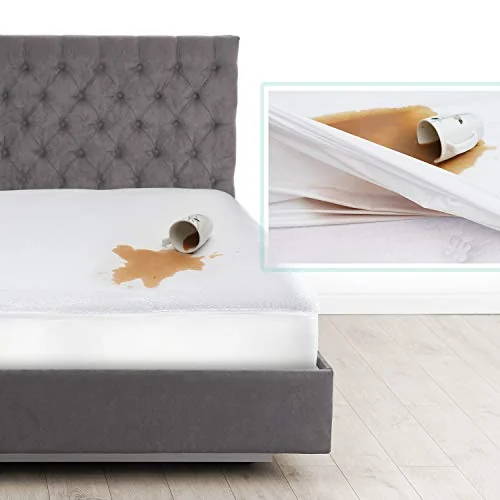
Now peel back a corner of the fitted sheet and put your hand on what is under it. If your fingers meet something that feels like a plastic bag, everything above it has been fighting a raincoat.
A vinyl-backed protector is a sealed film. It stops liquid, which is what it was bought for, and it stops air, which nobody mentioned at the till. It is also the layer that gets bought once and then forgotten for years, so the good sheets going on top of it are often losing to a plastic sheet nobody remembers owning.
Do the protector check with your ear as well as your hand. Press down on the mattress with the fitted sheet still on and listen. A crinkle means a film backing, and a film backing means the whole stack above it is sealed. It takes four seconds and it is the single most useful thing you can learn about your bed without spending anything.
If it turns out to be plastic-backed, that is the layer to replace, and the replacement is not a compromise. A cotton terry face over a TPU backing stays waterproof while still letting water vapor through, which is the whole trick, and which protectors actually breathe goes through the backing materials properly.
The top layer, where fill is the thing you are paying to remove
The usual advice is to buy a lighter summer duvet, and I would skip that step entirely. A summer duvet is still a filled duvet: a cased product with material inside it whose job is to hold a layer of still air against you. Making the fill lighter makes it hold less. It does not make it stop.
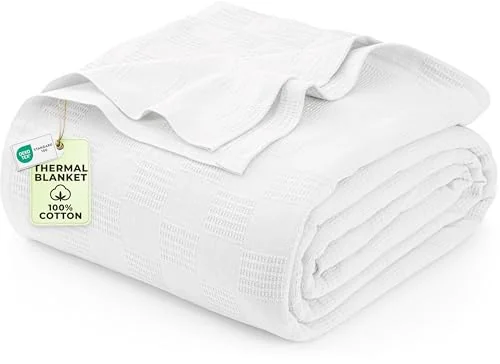
An open-weave cotton blanket has no fill at all. There is nothing inside it to trap air, so the heat rising off you passes through the weave instead of banking under it. That is a structural difference rather than a matter of degree, and it is why the blanket usually beats the lighter duvet you were about to buy.
The whole stack, and the case this article cannot answer
Assembled, the budget build is three things and two habits. A breathable protector if the corner check found plastic, the cotton percale set from the section above as the sheet layer, and an open-weave blanket instead of a filled top layer, with one layer removed as a standing experiment and the fitted sheet lifted before anything else gets blamed.
One situation this article genuinely cannot help with: two people in one bed, one hot and one cold, on a single budget. There was no live community source to draw a workaround from, and inventing one would be worse than admitting it. The bones of the answer are in our related guides, and the full stack, layer by layer is where the separate-layers approach gets built out properly.
Conclusion
Read three lines on the back panel, fiber, weave and ply, and the cooling question is settled before price has entered the conversation. Everything on the front of the package is a claim; those three lines are a specification.
What the premium buys is color range, a crisper hand at wash one, better hems and a company that answers the phone. Decide whether you want those things, because some of them are worth wanting. None of them is airflow.
And take a layer off the bed before you buy anything, then look at what is under the fitted sheet. Two free moves, and between them they solve more hot nights than the shopping does.
After a season of weekly washes, look at the pillowcase hems and the elastic casing on the fitted sheet. Not the flat sheet, which will look fine and tell you nothing. Those two spots are where a cheap set shows what it cost, and they are the only places it does.
Strip the duvet off tonight and sleep under the flat sheet alone. Give it a week. Then peel back a corner of the fitted sheet and feel what is under there. If you are still hot after both, the sheets are worth spending on, and you now know exactly which three lines to read.
Frequently Asked Questions
01What are the best affordable cooling sheets for hot sleepers?
A 100% cotton percale set, single-ply, with no synthetic finish on it. The plain weave is what moves the air, and weaving it costs the same at the bottom of the market as at the top. Check the fiber, the weave and the ply on the back panel and skip whatever the front says.
02What type of bedding is most comfortable for hot sleepers?
A plain-weave natural fiber next to the skin, with as few layers over it as the room allows. The layer under the sheet counts as much as the sheet itself, so check what your mattress protector is backed with before you judge any set on top of it.
03What type of comforter should I get if I’m a hot sleeper?
The lightest fill you can sleep under, or no fill at all. An open-weave cotton blanket sheds the heat a filled duvet holds, whatever its tog rating says, because there is nothing inside it to trap a layer of air against you.
04Does a mattress protector make you sleep hotter?
A vinyl-backed one does, noticeably. A cotton terry face over a TPU backing does not, because vapor still passes through it. It is the layer people forget they own, so peel back a corner and feel it before you spend anything on sheets.




Tried it on your own bed?
No comments yet. Tell us what you changed, and what the sheet did after a few washes.