Are Cooling Sheets Worth It? What the Label Adds
Above 300 threads the weave packs tighter and airflow drops. What "cooling" adds to a label, what it costs, and the one case where paying more earns it.
 Alfredo Ramses Textile engineer · 2 September 2026 · 19 min read
What’s in here 7 sections
“Cooling” is a word on a box, not a measurement. Nobody certifies it, so the same phrase can sit on a linen set and on a polyester one, and neither package has to explain itself. A percale goes one thread over, one thread under, and the small gaps that leaves are what let air move through the fabric. That is a mechanism you can point at, which is more than most labels will give you.
Somebody on r/Bedding put the problem better than any product page: they had done so much reading on percale versus bamboo that they somehow understood less than when they started. So here is the honest version of are cooling sheets worth it: what the word buys, what it does not, and the one condition where paying more actually earns its price.
Quick Answer
Usually not. A plain 200 to 300 thread count percale already does most of the cooling work, and it never needed the word on the box. Paying more earns it in one case: when the premium buys a different fiber, such as linen or Tencel, or a real weave or weight change, not a finish that washes out.
What “Cooling” Actually Means on a Sheet Label
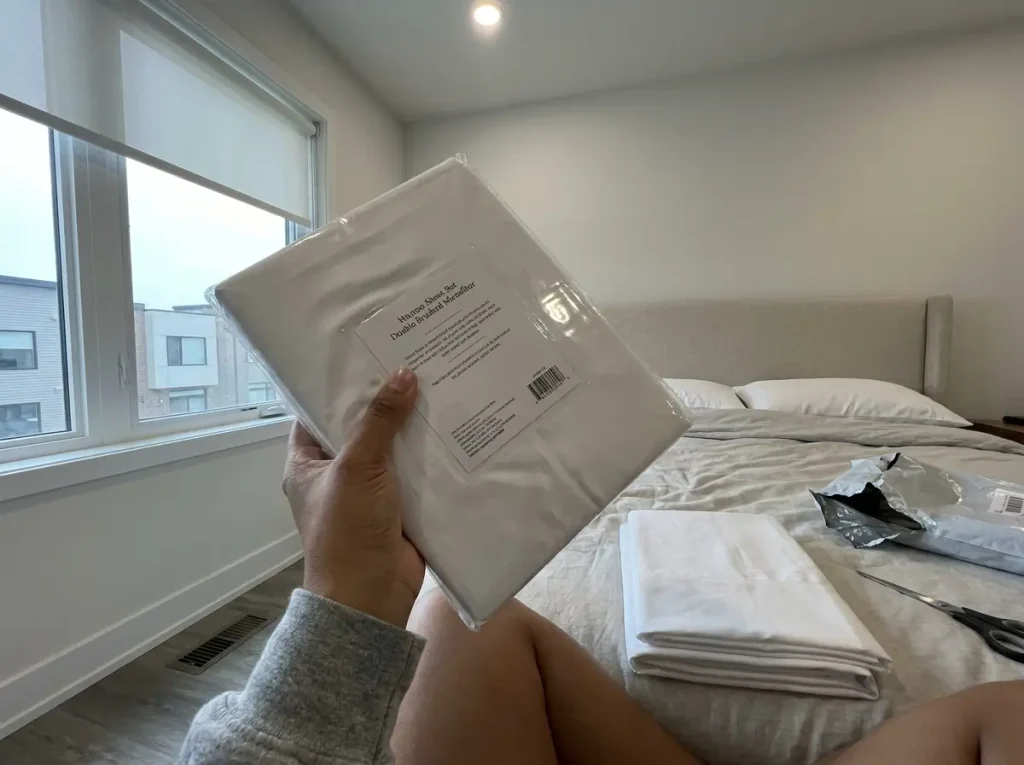
You are standing in front of two sets. One says “cooling technology” and costs less than the one next to it, which just says percale, 300 thread count, and leaves it there. The second package is telling you more, and it is doing it with fewer words.
There is no standard behind the word. The textile industry has a real instrument-based method for this: AATCC published a standardized moisture-wicking test the textile industry itself only just formalized in 2025, and almost no consumer sheet brand publishes a result against it.
Which means the claim on the front of the package is a sales phrase, not a spec. Nobody is checking it. Nobody has to.
Four things actually decide how hot a sheet sleeps, and none of them is the adjective. The fiber: does it take moisture in, the way flax and cotton do, or push it around on the surface, the way polyester and rayon do. The weave: are there gaps for air to move through, which is all breathability ever means.
Then the grammage, grams per square meter, which nobody prints on a package, so you judge it by lifting the set and feeling whether it has heft. And the finish: a coating or treatment that feels cool-to-the-touch in the store and leaves in the wash. Those are the four things that actually decide how hot a sheet sleeps, and every honest label gives you at least two of them.
Some finishes have real names, which makes them sound more substantial than they are. A phase-change material, or PCM, is a genuine technology that absorbs heat at a set temperature, and it does work — for as long as it stays bonded to the fabric. It is still a treatment sitting on a surface, so it is still cosmetic cooling in the sense that matters here: a coating that a hot wash and a few years of detergent will thin out. The fiber underneath is what you actually own.
Thread count is where the label pretends hardest. The usual advice is to buy the highest number you can afford. After reading enough threads about 1000-count sets that sleep like a plastic bag, the opposite rule holds up better: above roughly 300 to 400, the extra threads pack the weave tighter and choke the air gaps that were doing the cooling.
Cotton Incorporated’s own research on what actually drives moisture transport in a woven fabric puts it on fiber type, yarn structure, pore size and capillary path. Thread count is not on that list. It is worth knowing what thread count is actually counting before you let the number decide anything.
The origin words on the front are doing the same job. “Egyptian cotton” means the cotton was grown in Egypt, and sometimes not even that; what you are actually paying for is long-staple cotton, which is a property Pima has too and which plenty of sets carrying neither word also have. It is a marketing claim standing in for a spec, which is the polite definition of greenwashing applied to fiber instead of to the environment.
The weave case is the simplest one to see with your own hands. Percale is a plain weave, one over and one under, and it leaves the fabric less dense than a sateen, which floats four threads over one to get its sheen. Smoother, heavier, closed. Better in a photograph, worse in July.
Read the fiber line on the back of the package before you read anything on the front. If the back says a percentage and a fiber name, the front is decoration. If the back only repeats a brand name for a technology, the front is the whole product.
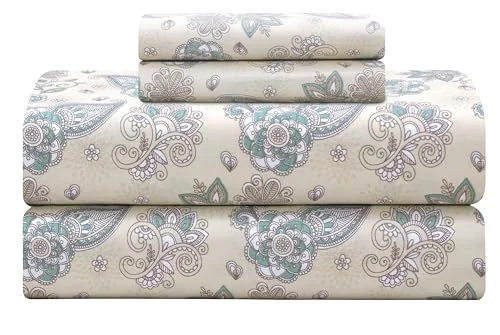
Now put a real one in your hands. The Mellanni Queen Sheet Set from the Iconic Collection is sold as cooling sheets over a double-brushed microfiber base, with a 16-inch pocket and no fiber-level cooling mechanism stated anywhere. The cool feeling is factory hand-feel, and reviewers report pilling in the high-wear areas from around six months of regular washing, right about when the finish stops covering for it.
This is not a recommendation; it is what the label problem looks like when you can actually pick it up. The set is doing exactly what it says on the box, and the box says almost nothing.
The community has its own vocabulary for the trap, and it is better than the industry’s. First-touch cooling is the cold-to-the-hand feeling in the first few seconds of contact. Sustained cooling is whether the effect is still there at three in the morning, which is when you actually care.
Every hand-feel test in a store measures the first one. A finish can fake the first one. Only the fiber and the weave produce the second.
The Real Math: A Plain Percale Against a “Cooling” Set
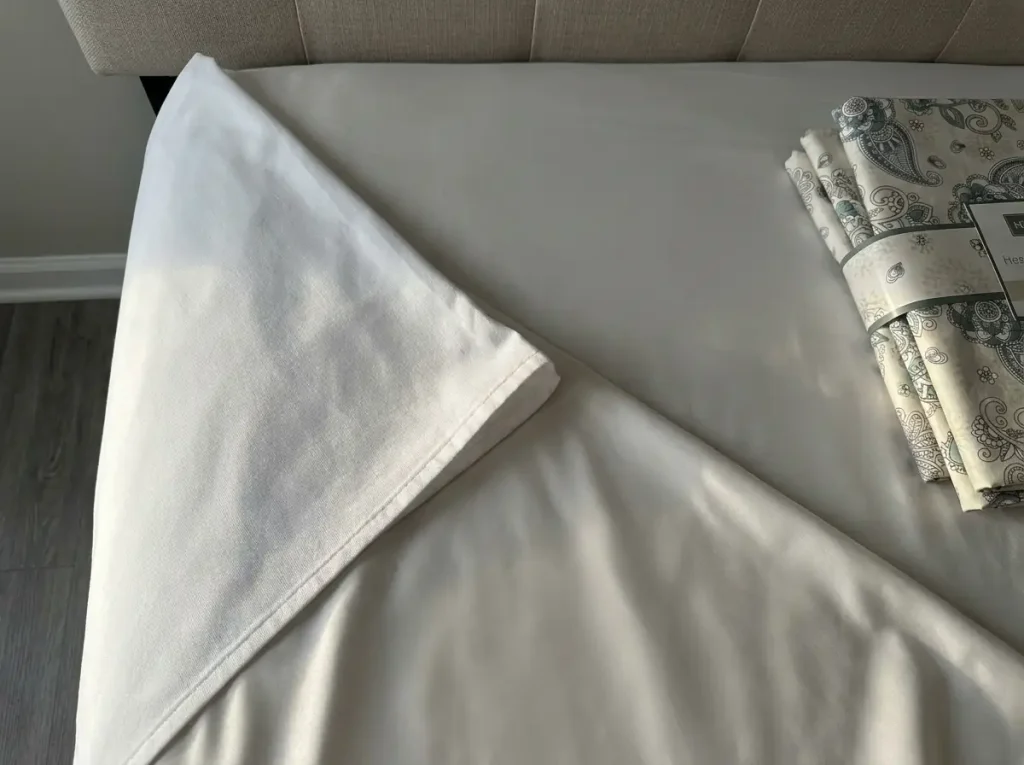
The honest version of this question is not whether cooling sheets work. It is whether this particular cooling set beats the plain percale you could buy instead, and nobody on page one of Google runs that comparison. So run it.
The baseline is a 200 to 300 thread count percale in a plain one-over-one weave. It is already doing the airflow work, it is the cheapest fabric in this article, and it never needed a word on the box to do any of it. That is the number the marketed set has to beat, and it is a lower bar to clear than the packaging implies. It is also why percale against sateen, which is the only weave comparison that changes anything settles more of this question than any brand comparison will.
That flatness is a real trade and not everyone can live with it, which is its own question. The percale-versus-softness trade-off is where crisp stops being a compliment for some sleepers.
So what does the premium buy when you step up? Usually three things: a brand name, a finishing process, and a softer first touch. What it rarely buys is a different fiber or a genuinely more open weave, which are the only two changes that survive a laundry cycle.
The Brooklinen Percale 4-Pc Sheet Set for Hot Sleepers is the honest version of that middle step: 100% cotton percale, 270 threads, OEKO-TEX certified, and it tells you all of that on the label instead of hiding behind a technology name. But at 270 threads it is not cooler than the 300-count percale above, and the price difference here buys the brand and the finishing, not a weave or grammage jump. That is not an accusation. It is just what the specs say when you line them up.
The other direction has a ceiling, and the community found it. A r/Bedding reviewer wrote up a set costing several times what the mid-tier ones do. Genuinely excellent fabric, held up fine through a cold and gentle wash routine, and they still concluded that a much less expensive set would probably have been the better call.
Durability and value are two separate questions. A set can pass the first and fail the second, and most of the expensive ones do.
Do the comparison with the fiber line covered. Write down what each set tells you: fiber, weave, thread count, weight, pocket depth. Leave the brand and the front-of-package phrase off the page. Whichever list is longer is the set that is actually telling you what you are buying.
One more thing about percale that the reviews never mention, because reviews get written in week one. That crispness a new percale arrives with is starch, not weave.
Judge it once the starch is gone and only the geometry is left, which happens to be the same moment a finish-based cooling set has already started moving in the other direction. Same two washes. Opposite results.
Where Paying More Actually Earns It
The answer is not never buy the expensive one. It is buy the expensive one when the money is going into a different fiber, not a different adjective. There are three cases where that is true, and they are the only three.
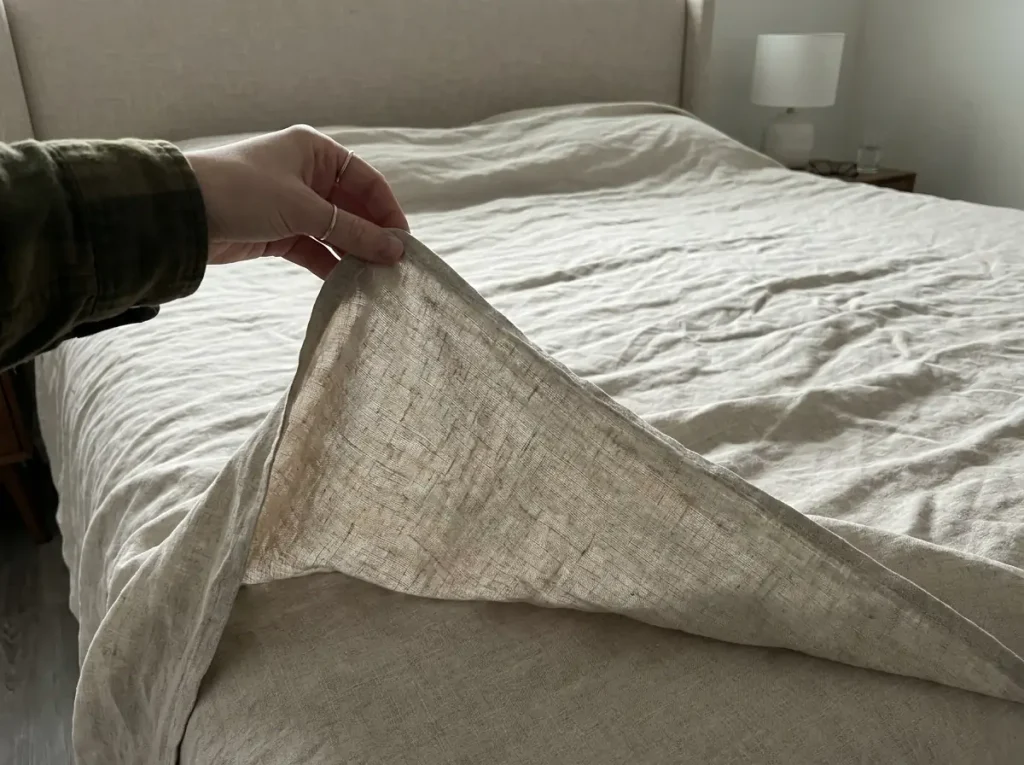
Linen is the clearest. The flax fiber is hollow, and it takes in roughly a fifth of its own weight in moisture before it starts to feel damp against you, then releases it faster than cotton does because the weave is open and uneven by nature. Nothing there is a coating. It is the shape of the fiber, and no wash cycle can remove the shape of a fiber. That is the difference between a property and a treatment, and it is worth reading linen against bamboo for a hot sleeper if you are choosing between the two structural options.
Tencel, or lyocell, is the second, and it earns it most in a humid climate, where what you need is a fiber that keeps moving moisture, not one that feels cold for the first ten seconds and then gives up. It is worth knowing that Tencel and eucalyptus, which are the same fiber under two names get sold at very different prices depending on which word the marketing team picked.
The third is a real grammage or weave jump, stated on the label in a number you can check. Not implied. Not described. Stated.
Which gives you the test to run in the store, and it is the community’s own advice because it filters almost everything: ask what fiber is inside. If the set will not name its fiber, its weave, or its weight, then the premium you are paying is buying the word, and the word is free to print.
There is a version of this for a shared bed, too, and it is the case nobody writes about. With two sleepers, one hot and one a genuine cold sleeper, no single set is right; it is wrong for both of you in opposite directions. A linen or lightweight percale flat sheet on the hot sleeper’s side under a shared duvet lets each of you run a different number of layers without negotiating over one blanket every night. The fabric change only has to work for the person who needs it.
A declared GSM is the honesty signal, not the number itself. Almost nobody prints grams per square meter, so a brand that does has decided to be measured on something. Two sets both claiming to be cool, one printing 170 GSM and one printing nothing: you already know which one has an answer ready.
Here is the set that passes the test you just learned.
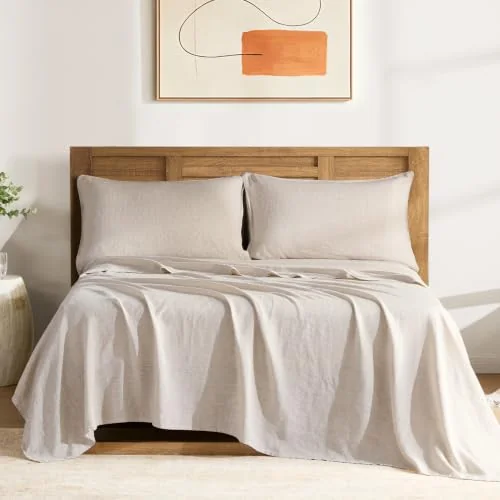
Whether that price clears over a full season is a longer argument than this section can hold, and it is worth reading whether linen earns its price over a season before committing to the fiber.
And a note on the arc, because it runs backwards from everything in the section above. Linen gets softer with every wash instead of crisper. The percale in the last section arrives crisp and settles down; linen arrives stiff and keeps improving for years. Decide now whether you can live with a bed that always looks slightly slept-in, because that is the trade the fiber makes and it does not negotiate.
The Wash-Twenty Test
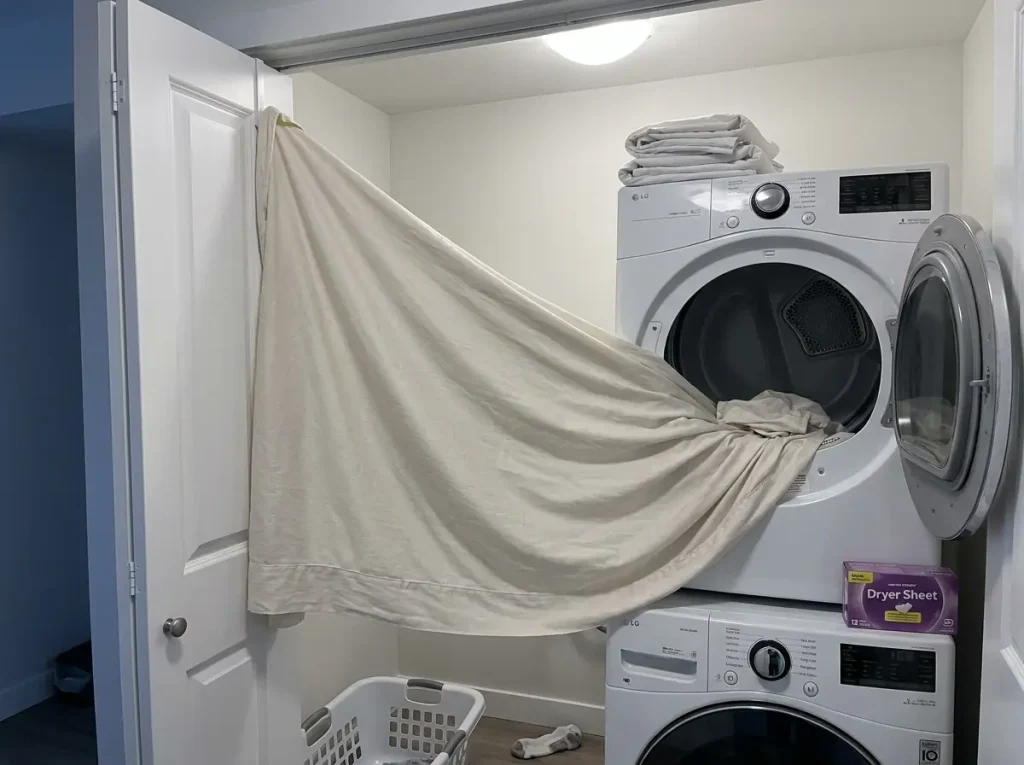
Everything feels good after the first wash. That is the whole problem with how sheets get reviewed: the set that is still cool in September is a different set from the one that was cool in the store, and only one of those was worth the money.
Here is the split that decides it. Structural cooling comes from the fiber and the weave — permanent, because it is the geometry of the fabric, and geometry survives a washing machine. Finish cooling comes from a coating or a treatment applied to the surface. Temporary, because a layer is a layer, and layers leave.
Every “cooling” claim on every package falls into one of those two buckets, and the label almost never tells you which.
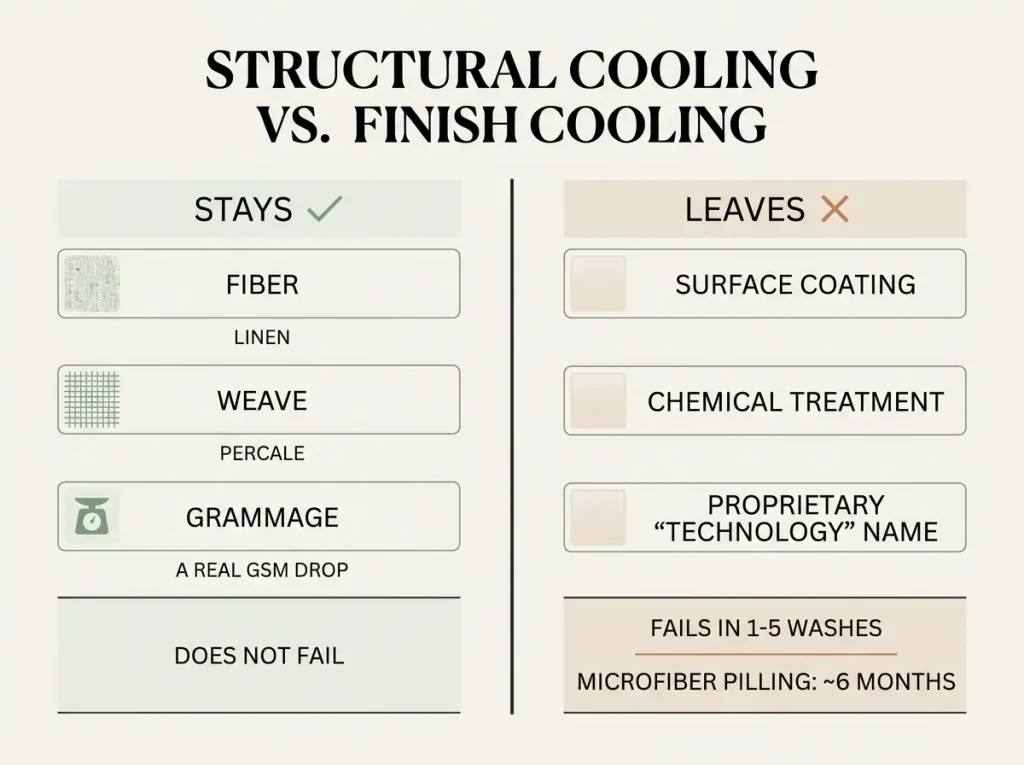
The numbers behind that split come from the only place in the whole search results that bothered to count. Wirecutter is one outlet that actually tracked what happened after five washes, and what they found is the most useful data in this niche: a bamboo-viscose sateen set that felt coolest brand new turned rougher, thinner and hotter to lie between by wash five, and shrank enough that the fitted sheet no longer fit the mattress it had fit on arrival. A synthetic set sold on a cooling finish lost its silkiness and went fuzzy and warm after a single wash. One cycle.
Read that as a mechanism rather than as a verdict on two brands, because the mechanism generalizes and the brands do not. A finish is a layer, and layers come off in hot water and detergent. Wash temperature is the variable doing most of that damage, which is why a cold wash buys a finish-based set more time than anything else you can do to it — and why buying one means accepting a laundry restriction along with it.
A weave is the arrangement of the threads, and the only thing that changes a weave is wearing a hole in it. A one-over-one-under percale does not care what temperature you wash it at.
The TOSMO Luxury Cooling Sheet Set, 100% bamboo viscose and OEKO-TEX certified, puts a name and a fiber to that category. It is at its coolest out of the bag and starts losing ground from there, the same arc Wirecutter documented on a comparable set: rougher, thinner and warmer by around wash five, with enough shrinkage that the fitted sheet stops fitting.
That is the shape of the claim, not a verdict on this one box. Recognize the shape and you can read any label in the aisle. The fuller version of that question lives in whether bamboo cooling sheets hold up.
Budget microfiber fails on a slower clock but it still fails. The pilling shows up in the high-wear areas at around six months of regular washing, later than the finish failures, and still well inside the window any buyer should be judging by. Nobody returns a sheet set at month six. That is exactly why the arc gets missed.
Write the purchase date on the care tag in laundry marker the day the set comes out of the bag. You will not remember whether you are at wash six or wash twenty-five when the sheet starts feeling different, and that number is the only thing that tells you whether you bought a fabric or a finish.
Sometimes the cooling does not even survive the night, never mind the laundry. A r/Bedding poster comparing two competing cooling brands found both were built on the same spandex and nylon base. Two technology names, one fabric.
They said of one of them that it does feel really cool to touch but it definitely heats up after a while. No wash involved. It faded between climbing in and falling asleep.
The failure also hides on one half of the bed, which is why it takes so long to notice. The side that gets slept on pills first, and a sateen goes slippery before it goes shiny, so you can run a hand over the unused half, find it perfectly smooth, and conclude the set is fine.
It is not fine. You are touching the wrong half. Which weave holds out longer under that kind of wear is its own question, covered in which weave survives the laundry better.
When It Isn’t the Sheets at All
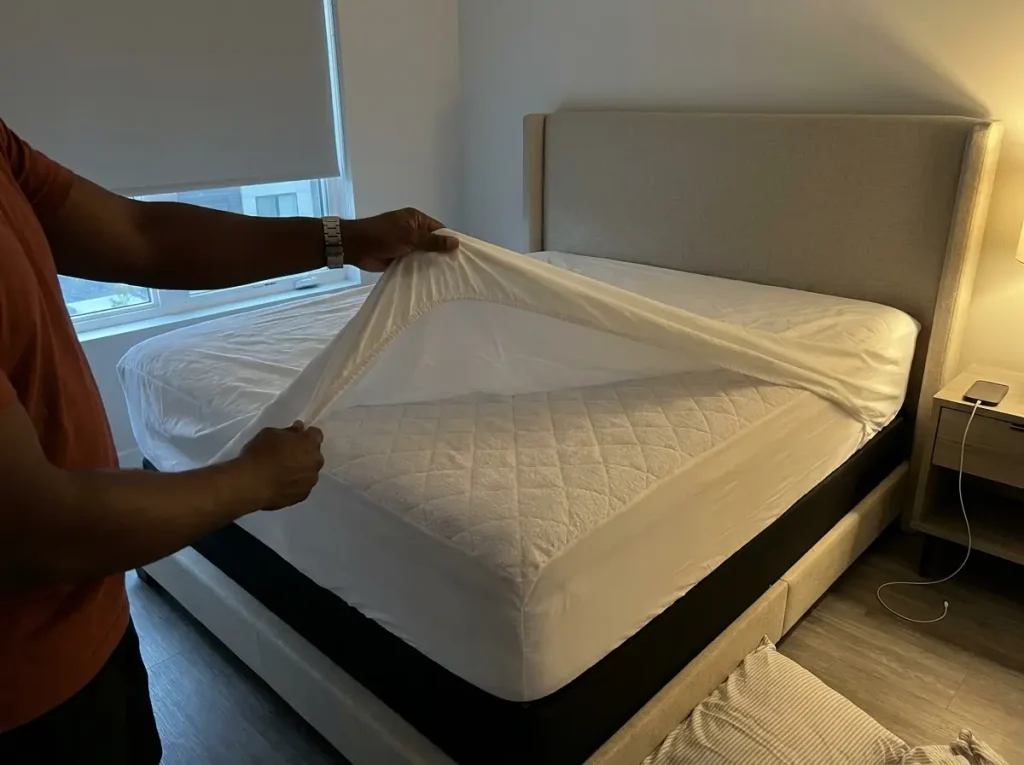
The layer nobody looks at is the one directly underneath the sheet, and a surprising number of damp mornings trace back to it rather than to the fabric that got blamed and returned.
Start with the free move, because it costs nothing and it outperforms most purchases. Take the top sheet off and sleep under the duvet cover alone for a week. That top sheet is the layer that gets kicked to the floor at two in the morning, and removing it deliberately, before you spend anything, tells you how much of your problem was ever about fabric. For a lot of hot sleepers it does more than a whole new set would have.
Then look under the sheet. A fully synthetic mattress protector is a raincoat — it will trap heat and moisture under the best sheet money can buy, and it does it silently, because nobody strips the bed to the mattress to investigate a warm night.
If yours is a plastic-backed one, the Nestl Premium Cotton Terry Mattress Protector swaps the sealed face for cotton terry so moisture can move through it instead of sitting against you; the TPU backing is still a layer of plastic between the mattress and the sheet, breathable for what it is, but not as cool as no protector at all, which is the price of protecting the mattress. If you can live without one entirely, that is cooler still. Which of them actually let air through is worth checking against which mattress protectors actually breathe.
The room and the mattress set a ceiling that no fabric argues with. A foam mattress holds heat that no sheet can fix, and a bedroom running warm fights every layer on the bed all night; around 65°F is the range most commonly cited as sleep-friendly.
And there is a volume problem people underestimate: an average adult puts out something on the order of half a liter to a liter of moisture overnight. That has to go somewhere. It goes into the sheet, then the protector, then the mattress, and if any layer in that stack is sealed, it stops there and stays against you.
Then there is the failure that gets misdiagnosed as a fabric problem more than any other. If the pocket is shallower than the mattress plus whatever is stacked on top of it, the corners pop, the sheet balls up, and the set gets returned for being bad sheets when it was never a fabric question at all.
A mattress topper is the usual culprit, because it adds two or three inches nobody accounts for when they order. Measure the mattress with the topper on. Add two inches. That is the minimum pocket depth.
A deep-pocket mattress needs the label checked twice, though, because “fits up to 18 inches” means the elastic will reach 18, not that it will stay there. Getting a pocket deep enough to stay on the mattress right is not optional if you want any of the rest to matter.
You find out the pocket is wrong the first morning you wake with the corner balled up under your shoulder. That is not weak elastic. That is two inches of mattress the sheet was never sized for.
And if you have worked through the sheet, the protector, the room and the fit and the bed is still too warm, look up. Whether the layer above the sheet is doing more of the damage is the next thing to check, and a heavy synthetic comforter beats a sheet for trapped heat every time.
The Verdict
The word on the box is not a spec. Ask what fiber is inside, and if the label will not say, then the premium is buying the adjective and nothing else.
A plain, correctly-specified percale is already most of the answer, and it is the cheapest fabric mentioned anywhere in this article. Paying more earns it for a different fiber: linen, Tencel, a genuine grammage jump you can read as a number. For nothing else.
Look at whatever you buy again after a season of washing. If it is rougher, thinner and warmer than the day it arrived, you bought a finish. If it is softer and still moves air, you bought fabric. That is the entire test, and it takes about three months to run.
Before any of that, though: take the top sheet off tonight and sleep under the cover alone for a week. It costs nothing, it tells you how much of the problem was ever the sheet, and it is the first thing to try among the rest of what a hot sleeper can change.
Frequently Asked Questions
01What are the best cooling sheets that actually work?
The ones that cool by fiber and weave rather than by a finish: linen, Tencel, or a plain cotton percale at 200 to 300 threads. Finish-based sets fail because a coating is a layer, and layers wash off, sometimes within a single cycle.
02Do bamboo cooling sheets actually work?
Bamboo viscose feels coolest brand new and commonly loses ground with washing. One tracked set turned rougher, thinner and warmer by around wash five. The weave matters more than the plant, and most bamboo sheets are woven as sateen, which is the closed one.
03Are there 100% cotton cooling sheets?
Yes, and they are usually just called percale. A plain one-over-one cotton weave leaves gaps that move air, which is a cooling sheet that never needed the word on the box or the price that comes with it.
04What is the difference between first-touch cooling and staying cool all night?
First-touch cooling is the cold-to-the-hand feeling in the first seconds after you lie down. Sustained cooling is whether it is still there at three in the morning. A surface finish can fake the first and never delivers the second, and store hand-feel tests only ever measure the first.
05Is a higher thread count cooler?
No. Above roughly 300 to 400 the weave packs tighter and airflow drops, so an 800-count sateen can sleep hotter than a 250-count percale. Moisture transport depends on fiber, yarn structure and pore size, not on the number printed on the box.
Leave a comment
Slept on something we got wrong, or found a set that held up? Say so here. Your email stays private.