







What’s in here7 sections
Every list answers this with a flat number. Three sets, always, sometimes four if you live somewhere with real winters, and not one of them says where the number came from.
The count is not a number at all: it is the wash-cycle floor multiplied by how many fabric seasons your bed actually runs. A flannel set that works four months a year does not wear at the rate a percale set washed every week does. So the honest answer to how many sets of sheets you need starts with arithmetic nobody writes down. Below: the formula, what fabric weight does to a seasonal rotation, what a shared bed does to it, how to store the half that is off duty, and the point where buying another set stops helping.
Quick Answer
Two sets per bed is the floor: one on, one in the wash. Multiply that by the fabric seasons your bed runs, usually two, warm and cold, which puts most households at four. Add one if you sweat or wash on a slow cycle.
The Real Formula: Sets Per Season, Not Sets Total
Two numbers decide this, and almost nobody separates them. One is how many sets a bed needs to keep running while a set is in the machine. The other is how many different weights that bed wants across a year. Multiply them and you have your answer; skip either one and you get the flat number every roundup prints.
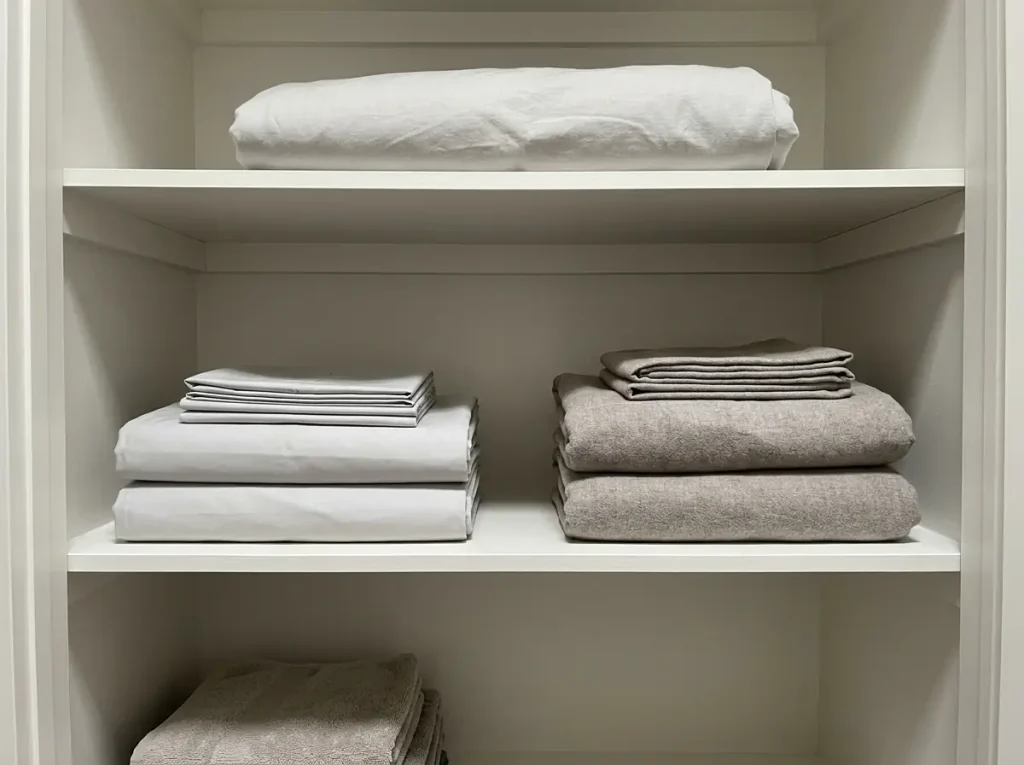
A note on the unit before the math starts. A set here means the flat sheet, the fitted sheet and the cases together, because that is what actually goes on a bed on a Tuesday night. Counting loose pieces is how a closet ends up full and a bed ends up mismatched.
Start With the Floor: One On, One in the Wash
Before any season enters the math, the community already settled the minimum. The top comment on a r/Bedding thread asking how many sets people actually own is two words long: “Two. One is always available while the other is being washed.” The rule people repeat is one on one in the wash. Forty-two people agreed with it.
That is the floor, and it is the right floor, because it is the only number that comes from a mechanism instead of a preference. A bed cannot be bare while its sheets are in the machine.
Everything past two is a reason, not a rule. And the reasons are where every roundup stops explaining.
Multiply by the Seasons Your Bed Actually Runs
Here is the arithmetic: the wash-cycle floor times the number of fabric seasons your bed runs. Not lifestyle personas, not climate zones. Fabric seasons: the number of distinct weights you actually put on that mattress across a year.
Most US bedrooms run two. Summer bedding and winter bedding, which is the whole premise behind seasonal bedding being a weight problem, not a fabric one. Two times two is four, and that is where a household with a real winter lands.
Some bedrooms genuinely run one. A mild climate, a well-insulated apartment, a sleeper who never changes anything: one fabric season, two sets, done. Say it out loud, because if your bed has never wanted a different weight in January than it wants in July, you do not need four sets and nobody should sell you four.
Count your fabric seasons by looking at what you did last year, not at the weather forecast. If you never once wanted something heavier in February, your bed runs one season and your answer is two sets, not four. The closet does not care what climate zone the map says you live in.
The same thread has a household reporting the multiplication without ever naming it: “We probably have 6 sets for our main bed (three colors/styles of winter flannel, three percale for warm weather).” Twenty-eight upvotes. Three per season, two seasons, six. Nobody in that thread does the math out loud. They just report the number they arrived at after enough Novembers.
Why “Three Sets” Answers a Different Question
Three universal sets is a laundry answer. It solves the problem of a slow wash cycle, a shared machine, a week where nothing gets folded. It is a good answer to that question. Two-plus-two is a season answer, and it solves a completely different problem: waking up in October on a sheet that was chosen for August.
The failure of a three-set closet is never the set in the wash. It is the one on the shelf.
You strip the bed on the coldest morning of the year, reach for the spare set, and it turns out to be a summer percale. Technically clean, technically a spare, and exactly the wrong weight for the month you needed it. The spare has to be the right spare, and “three sets” never specifies which three.
Weight Decides Wear Rate, and Wear Rate Decides the Count
The formula treats every set as one unit, which is convenient and slightly wrong. A percale washed every week and a flannel washed every third week are not the same asset, and they do not reach the end of their lives on the same schedule.
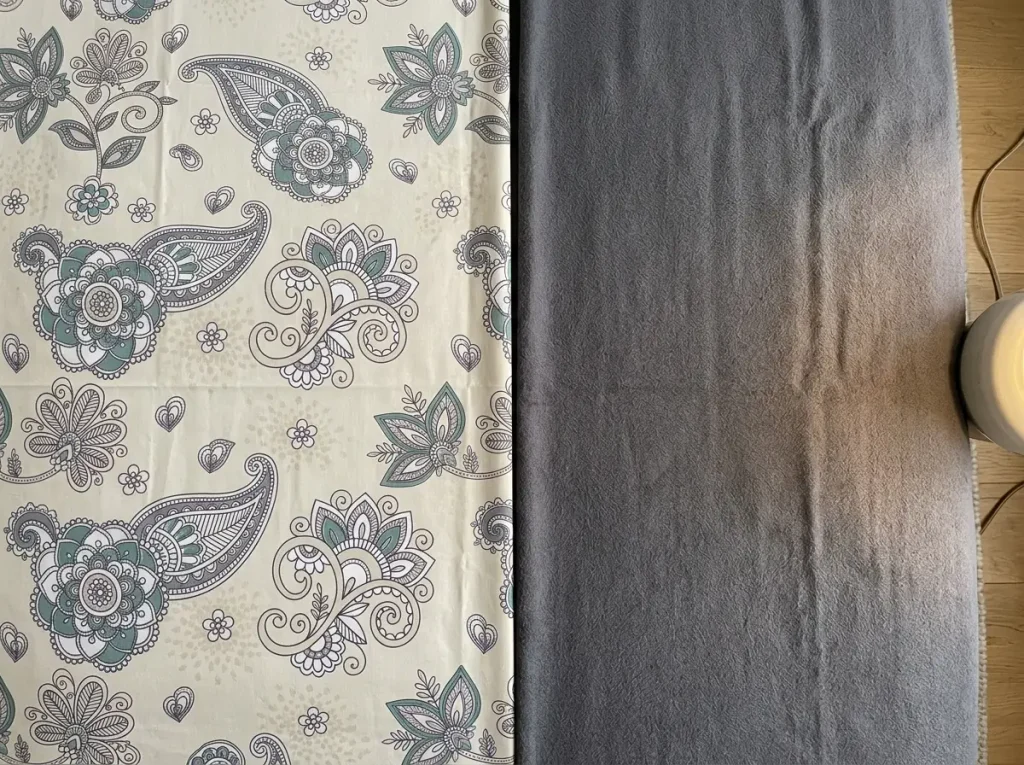
That difference is what turns the arithmetic from a shopping list into a plan. It decides which of your two sets needs a partner first, and it is the reason a household can own four sets and still only be replacing one of them every few years.
What Fifty Washes Actually Look Like
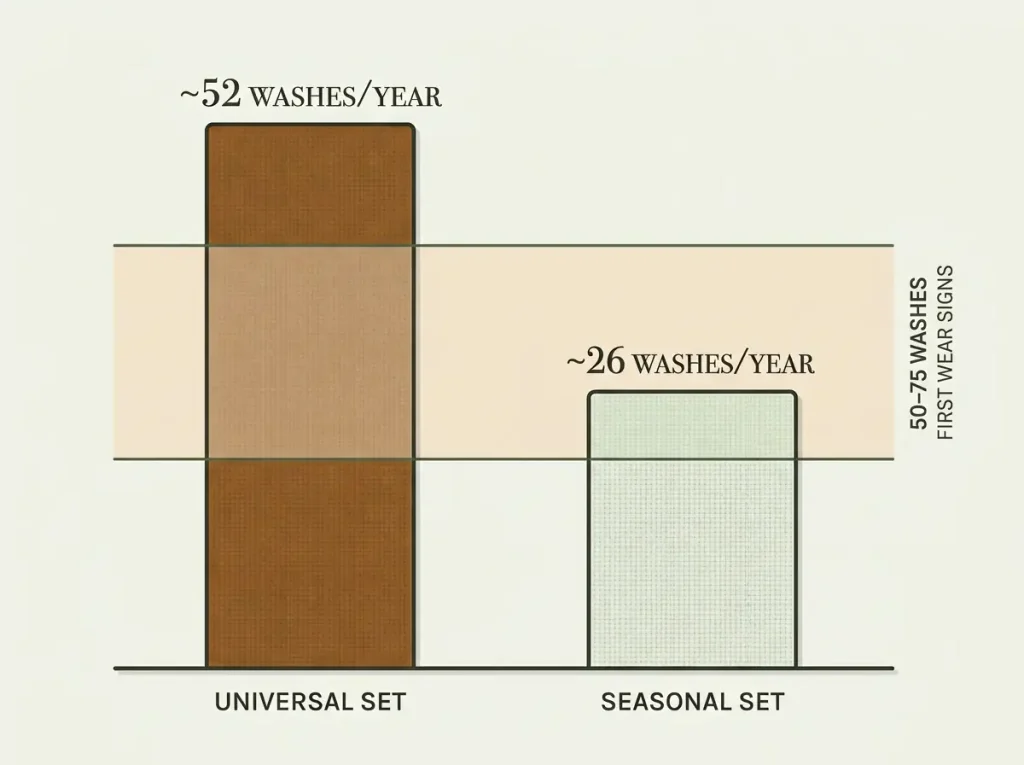
Cotton bedding starts showing its first wear signs somewhere between 50 and 75 washes, and no thread count on the package changes that band. Linen runs the opposite arc, improving until roughly a hundred washes and then holding steady for years, which is one of several reasons which weave actually lasts longer in the wash is not the question people think it is.
Now do the multiplication in the other direction. A single universal set, stripped and washed every week, does something over fifty washes in a year. It hits the bottom of that 50-to-75 band inside twelve months. A seasonal set doing the same weekly wash across a four-month active window does about twenty-six washes a year, and then it sits out the other eight months doing nothing at all.
Same threshold, roughly twice the calendar to reach it. That is house arithmetic derived from the wash-count range, not a statistic anybody published. But it is the whole reason two seasonal sets outlive one universal set instead of costing twice as much to own.
A commenter on that same thread arrived at the mechanism without the numbers: three sets in rotation, “making sure that you’re resting/rotating the fabric helps it last longer.” Resting the fabric is the correct phrase for it. Wear does not accumulate on a set that is folded on a shelf.
And the wear and tear, when it shows, does not show as a hole. The fitted sheet loses the snap in its elastic and the flat sheet goes quietly limp. The set still fits, still washes, still works, so nobody retires it. It just stops being the set you reach for.
Before you buy a second set, count what your current one actually does in a year. A household that strips the bed every ten days rather than every seven is running roughly thirty-six washes annually, not fifty-two, and is nowhere near the threshold. That laundry cadence, not household size, is what decides whether a rotation partner is due. It needs to keep washing.
Percale Does the Heavy Laundry Half
Percale is one thread over, one under. Plain, matte, gapped, and because nothing floats across the surface, the fastest-drying construction in a cotton closet.
That matters twice over: it turns around quickly in the heavy-laundry half of the year, and it is the more forgiving of the two to put away later. The Feather & Stitch 100% Cotton Percale Sheet Set is a 300-count single-ply with a 16-inch pocket, which is the spec that makes it the warm-season workhorse rather than the special-occasion set. Its flaw, stated plainly: a single-ply percale starts showing pilling under weekly use before it reaches seventy-five washes. It is not the set to stretch past its life just because it still fits the bed.
Flannel Earns Its Own Set by Doing Less
Flannel is not a different weave. It is brushed cotton, the nap raised off the surface so it traps air against you instead of moving it, which is the whole story of when flannel sheets are worth it and when they are too much. What makes it worth counting as its own set is not the warmth. It is the wash cadence: four months on the bed, eight months off it.
The Pointehaven 180 GSM 100% Cotton Flannel Sheet Set is double-brushed at 180 GSM, a weight that earns its place in a cold room rather than just feeling fuzzy in the store. Its flaw is not in the weaving at all: stored without being fully dried and aired, a brushed flannel like this one is exactly the set that comes out smelling like a closed box in November. That is the storage, not the fabric, and it is the next section.
The Shared Bed Changes the Count
Everything above assumes one sleeper deciding one temperature. Put two people on that mattress who disagree about it, and the question splits in half.
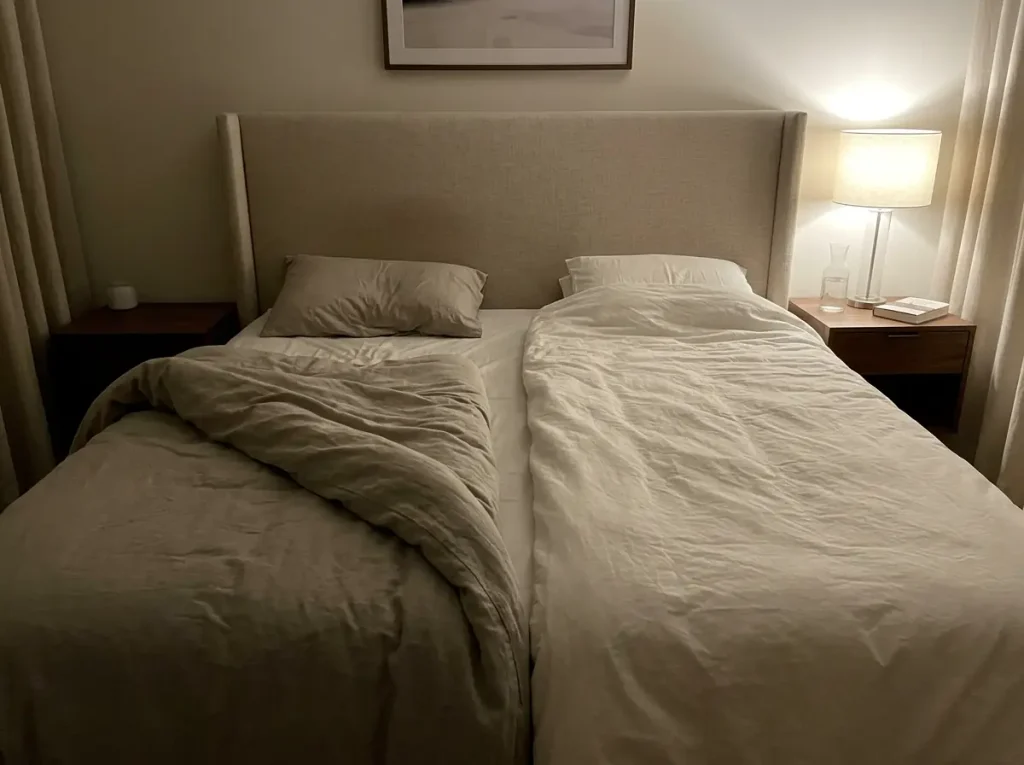
The good news is that it splits unevenly, and the smaller half is the expensive one. Most of what changes in a two-person bed is not the sheets at all.
Two Duvets Means Two Covers, Not Two Sets of Sheets
One of you throws the duvet off at two in the morning and the other pulls it back at three. Every persona list in this search result splits the count by kids, pets, allergies and laundromat access, and not one of them splits a bed by temperature. Which is strange, because the moment a bed has two sleepers on two thermostats, “how many sets” stops being one question.
Two duvets on one bed is the standard fix, and the order a winter set goes on the bed is what decides which weight goes where. What it does to the arithmetic is smaller than people fear. Two duvets need two covers, laundered and rotated separately, though the duvet insert inside each one only sees a wash once or twice a year. They do not need two sets of sheets: the fitted sheet and the flat sheet are still one set per bed, because there is still one mattress under both of you.
So the shared bed moves the cover half of the count and leaves the sheet half alone. This is the blog’s own arithmetic rather than anything the community reported: the r/Bedding discussion covers guest beds and kids’ rooms, and never once a couple on different thermostats.
In a two-duvet bed, buy the spare cover for the hot sleeper’s duvet, not for both. Theirs comes off and goes in the wash more often, because a lighter duvet spends more nights in direct contact with skin instead of under a top sheet. Duvet covers are the piece that runs out first in these households, and they run out unevenly.
When Each of You Changes Season on a Different Week
The piece that runs out first in a two-duvet household is never the sheets. It is the covers, because each one is now doing the work a single shared cover used to do, and they come off the bed on different schedules.
That staggering turns out to help. A couple running two weights also runs two calendars: one of you moves to the lighter duvet in March, the other holds out until May.
That stretches the rotation instead of adding to it, because the two swaps never land on the same laundry day. A household running one fabric across both seasons has the opposite problem. The layer underneath does not change either way, incidentally, since a mattress protector stays on the bed through both seasons and never enters the set count. Whether one fabric can cover both depends on the GSM, which is the real subject of whether a linen set survives a real winter, and the answer changes the season count in the formula above.
Storing the Off-Season Set Without Ruining It
Here is where the arithmetic quietly fails. You can own exactly the right number of sets and still get to November with nothing usable on the shelf, because the set that spent eight months in a box came out smelling like the box.
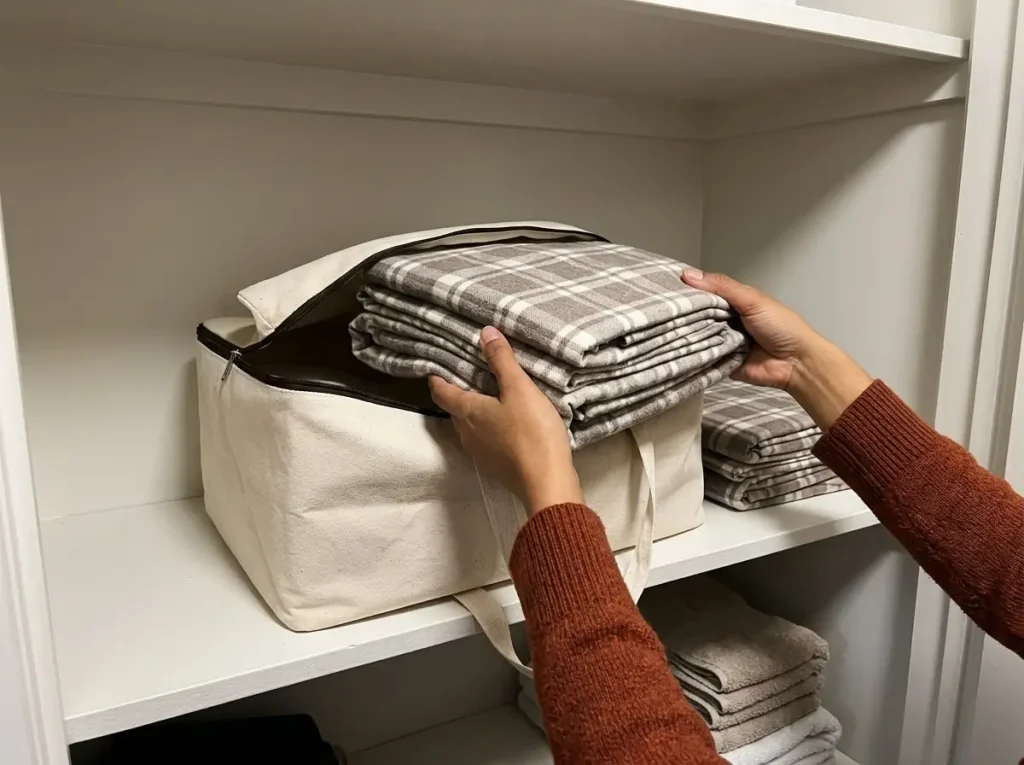
Every competitor covers this in one line: wash it, dry it, do not use plastic. That advice is correct and it is not enough, because none of them says what is actually happening in there. The mechanism is worth two minutes, since it is the difference between a rotation and a pile of sheets you end up rewashing before you can use them.
What Actually Makes a Stored Set Smell
You pull the flannel out of the bin in November and it smells like the inside of a closed box. The set was fine in March. Nothing happened to it except eight months of being sealed.
The failure is not abstract moisture. It is two named variables, and both of them happen before the set ever goes in the container.
The first is finish and detergent residue that was never fully rinsed out. A crisp new percale carries sizing, and every wash leaves a little detergent behind if the cycle is short. The second is fabric put away at what fabric-care writers call “air-dried feel” rather than actually bone dry. Either one alone is enough.
The mechanism has a standard behind it, which is the part nobody mentions. The AATCC’s own mildew-resistance test method works by incubating fabric at roughly 28 °C and above 90% humidity for seven days. A sealed bin in a warm closet is a slower version of that same test, running for eight months instead of one week. The industry has a protocol for producing exactly the result you are trying to avoid, and a plastic tub reproduces it by accident.
Airflow Beats Compression
Which makes the rule airflow, not compression. Consumer Reports’ own storage advice specifically warns against vacuum-sealed bags and points to a breathable blanket bag or an open basket instead, with cedar or lavender added after the set is washed and fully dried. The sequence in that sentence is the whole instruction: scent goes in last, on a set that is already clean and dry, never as a cover for one that is not.
The free fix comes first, and off-season storage done properly costs nothing. Run a full cycle with an extra rinse until the spin water runs clear, then dry the set past the point where it feels dry. Then put it in whatever breathable thing you already own: a spare pillowcase, a cotton laundry bag, an open basket on a high shelf. That is the entire mechanism satisfied.
The tidy version is a proper breathable storage bag. The 2 Pack Cotton Storage Bags for Duvets, Blankets is 10oz cotton canvas with a three-zip opening, king and queen sized, dust-proof without being airtight, which is exactly what a vacuum bag is not. The flaw is in the name: it is two bags, not one per set. A household storing percale and flannel at the same time needs a second pack.
For the odor half of the same advice, HOUNDSBAY Cedar Blocks for Clothes Storage is the version Consumer Reports names: twelve pieces of natural cedar with none of the chemical smell mothballs leave behind. Their flaw is that cedar is not permanent: the scent fades over the months, and with it the effect. The blocks have to be sanded back or replaced. They are not fit-and-forget, and they will not rescue a set that went into the bag damp.
Store It as a Set, Not as Pieces
Group the flat, the fitted and the cases together so pulling out a clean set in November is one grab rather than a scavenger hunt across three shelves. Consumer Reports makes the point as a closet storage tip; it is also the practical reason a “set” is the right unit to count in the first place. Counting in sets only works if the closet is arranged in sets.
Store the off-season set on a high shelf rather than under the bed. Under-bed is the coolest, least ventilated air in the room and it sits directly above a floor that gets mopped, the two conditions the mildew test method is built to reproduce. Height buys you warmer, drier, moving air for free.
Notice how the musty complaint gets reported. In the reviews it reads as a fabric problem, “started smelling after a few months,” and almost never names the container. It was a drying-and-airflow problem that happened months before the smell did.
When to Stop Buying
Every section so far has been a reason to own another set. This one is the brake, and an article about how many sets you need is dishonest without it.
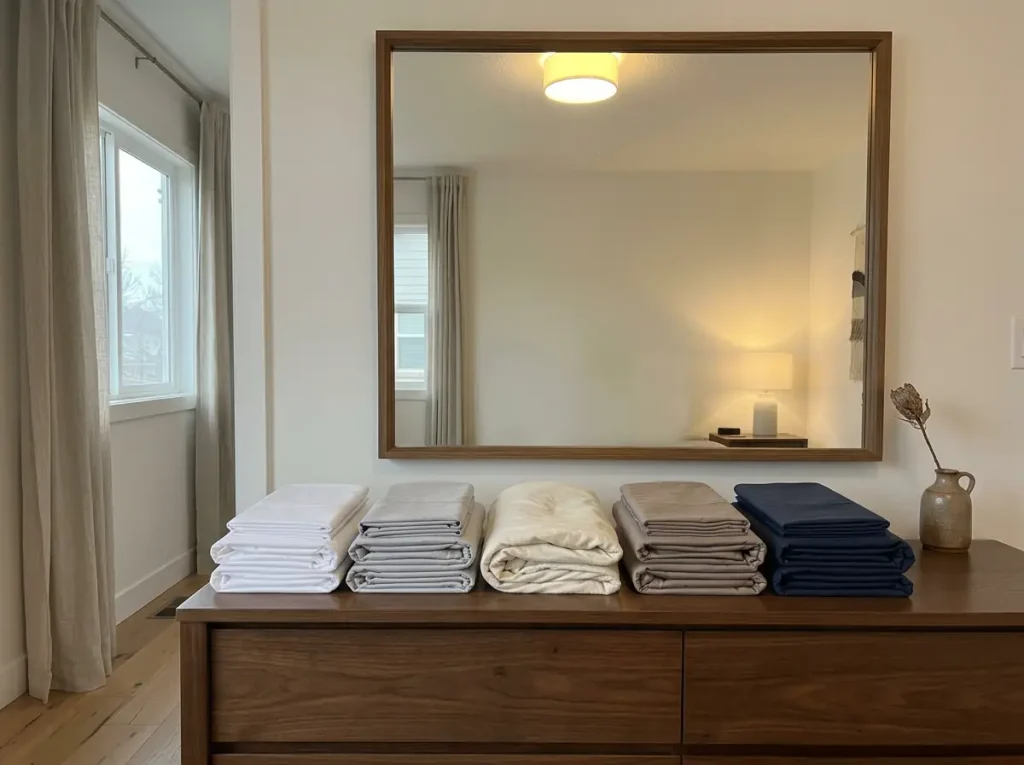
There is a point past which more sets stop protecting the ones you have and start being storage. It arrives earlier than most closets suggest.
The Ceiling Nobody Names
Somebody else should say this part, so here is a professional organizer quoted by Consumer Reports: “Linens just kind of accumulate because there’s a fear of not having something when you need it. The next thing you know, you have five sets of sheets.” Her recommendation is to pare down to one or two per bed and replace on condition: stained, torn, worn out.
That reads like a contradiction of everything above until you put the unit back in. One or two per bed per season is the same instruction as the formula, not an argument against it. What she is warning about is sets with no job.
A Set With No Job Is Inventory
The test is a sentence you should be able to finish: this set is for this bed, in these months. If you cannot name both, it is not part of a rotation. It is inventory, and it is taking up storage space a working set could use.
And extra sets stop paying for themselves past a point. Resting the fabric works up to about three in a rotation; beyond that each set gets so little wear that age retires it before washing does. Elastic goes brittle sitting in a closet just as reliably as it goes slack on a bed. Buying more sets to protect the ones you have stops working somewhere around the fourth.
The set nobody uses is usually the one that was almost right. A color that never matched, a pocket an inch too shallow once a topper went on.
It stays for years because throwing away something functional feels wasteful, and that is exactly the set the count should never have included. The good news is that replacing on condition is cheap when the spec you need is a plain percale rather than a marketing claim. What a percale set actually has to cost is less than most people budget, which is the reason a two-season rotation is affordable at all.
Conclusion
Count the floor first, two per bed, then multiply by the fabric seasons your bed actually runs. That is the whole formula, and it is the part every roundup skips on its way to a flat number.
The heavy-laundry set and the four-months-a-year set do not wear at the same rate, so they do not need the same number of partners. And the half that is off duty is the half that fails, because it fails in storage rather than on the bed.
Around wash twenty, look at the fitted sheet’s elastic and the hand of the flat sheet before you look at the color. A set goes limp long before it goes threadbare, and limp is what tells you the rotation needs a new member.
Before buying anything, count what you own by season instead of by number. If every set on the shelf can name the months it is for, you already have enough.
Frequently Asked Questions
01How many bedding sets should I have?
Two per bed as a floor, multiplied by the fabric seasons your bed runs, so four for a household with a separate summer and winter set. Add one if your laundry cycle is slow or you sweat through sheets faster than a week.
02How many sets of sheets does the average person have?
Most people land between two and six without doing any arithmetic at all. Community reports cluster at three per bed, and at six for households running separate flannel and percale rotations.
03What bedding does the 4 seasons use?
Most US bedrooms run two fabric seasons, not four — a warm-weather set and a cold-weather set. Spring and fall get handled by changing the duvet weight, not the sheets, which is why the set count rarely needs to go past four.
04Is it okay to change bedsheets once a month?
It stretches a set’s life, since fewer washes means slower wear, but it is a long gap between changes. If that is your cadence, two sets per season is plenty and a third would sit unused.
05Can I store bedding in a vacuum-sealed bag?
Better not to. Compression traps residual humidity and finish residue against the fabric, which is what makes a stored set smell musty. A breathable cotton bag or an open basket is the safer choice.





Tried it on your own bed?
No comments yet. Tell us what you changed, and what the sheet did after a few washes.