


What’s in here8 sections
- What a Feather or Wool Label Actually Tells You
- Thickness Decides More Than the Fill
- Heat and Damp: What Each Fill Does With the Night
- The First Night Versus Month Three
- The Shake-and-Air Test and the Care Each Fill Needs
- Which Fill Goes on Which Bed
- Choose by the Bed, Then Check the Layer at Month Three
- Frequently Asked Questions
You lie down and your shoulder finds the mattress through everything on top of it, or the bed is still warm under your hip long after the room has cooled, and two listings sit open on your phone: one says feather, one says wool. In the feather vs wool mattress topper question, the word on the tag is the weakest evidence on the page, because “feather” can hide a mix of feather and down and “wool” can mean a flat sheet or a deep pile. Both fills work by holding air, wool in the crimp of the fiber and feather in the loft of the pile, and a sleeper’s weight squeezes that air out, so how tall the layer stands and what is inside it settle more than the fiber’s name. The order below follows that: the tag, the thickness, the heat, the months, a test on a layer you already own, and the bed each fill suits.
Read across a row of the table first, then use the sections for the reason behind each cell.
| What you compare | Feather | Wool |
|---|---|---|
| Feel on the first night | Plush, and the fill gives under the shoulder | Firm and even, a low layer that smooths the surface without softening it |
| Warmth and damp | Holds air in its loft, so it insulates; sellers disagree on whether it holds heat or holds moisture | Takes up moisture vapor and lets it go; leans warmer as the pile gets deeper |
| Height at month three | Flattens where you lie, the hollow showing at the hip line first | Compacts into hollows; one owner saw it at about 18 months |
| What keeps it a topper | Regular shaking and a tight cover so the shafts stay in | Airing in the sun and spot cleaning, unless the label says it washes |
| Where it goes wrong | Under two inches it barely changes the bed | A deep pile does not soften a bed, and it smells of sheep when new |
| Fits a bed that is | Too firm and wants softness, with a layer tall enough to matter | Already comfortable but runs hot or damp, so the job is a low, flat layer |
What a Feather or Wool Label Actually Tells You
The table compares two words, and each word covers layers far enough apart to change the answer, so the first job is reading the tag. The full account of every filling lives in what each topper material is actually made of; this piece only chooses between these two, and the choice starts with what the label is allowed to mean.
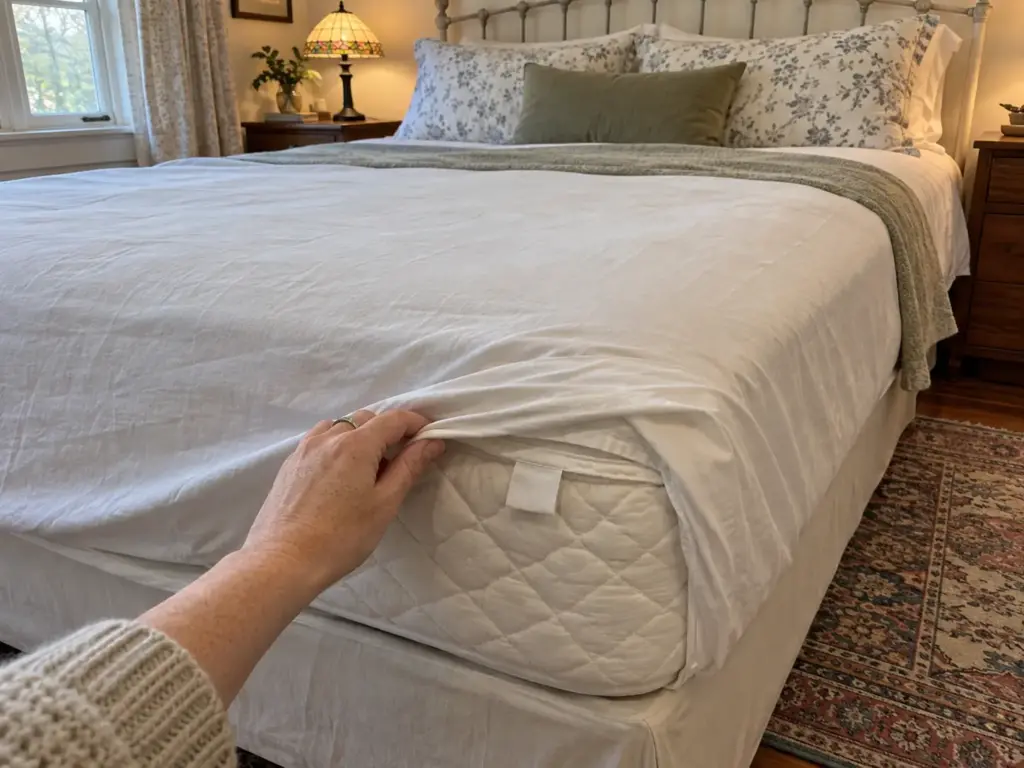
Featherbed can mean any mix of feather and down
A featherbed can be any combination of feathers and down, and the comfort and the insulation shift with the fill power, the fill weight and the feather-to-down ratio. So two listings that both say feather can sit a long way apart: one mostly coarser feather, one a down topper in everything but the name, under the same word. They look identical in the photos and part ways on the fill weight line, which most listings print last.
Height comes before fill, too. Tom’s Guide notes that most feather toppers are under two inches, a loft too small to alter a mattress’s surface, so a tag that gives a thin layer has already answered most of the question.
Line two listings up by the numbers on the tag, in this order: the height of the layer, then the weight of the fill. A listing that prints the height and leaves out the fill weight has told you half of what you need, and it goes second on the list.
Wool topper, wool pad and wool batt are not the same layer
The three words differ by how much wool is inside and how it is held. A batt is loose carded wool, usually quilted between two covers. A felted or needle-punched layer is wool locked into a sheet, so it stays flat and does not shift the way loose batting can.
Pad and topper tend to differ by the amount of wool inside, so a wool mattress pad can be thinner or thicker than a topper with the same name on it. That is why the listing worth trusting prints the weight of the wool, in pounds or in grams per square meter (GSM). A listing that gives only a thickness has told you the height and nothing about what fills it.
Where down alternative sits as the third option
The third listing in the same search is usually down alternative, which is polyester fiberfill made to act like down. It is a different material, not a midpoint between the two, and the numbers that judge it are the same two. The arithmetic of fill power and fill weight is worked out for down against down alternative in a duvet, and the same figures are what to look for on a topper tag.
Thickness Decides More Than the Fill
The fill is the part everyone argues about, and it is the second decision. The first is how much layer there is. A firm bed needs something between the shoulder and the mattress, a layer that is too low gives nothing, and a deep soft pile compresses under the heavy parts of the sleeper until the mattress carries the weight again. What follows is built from the mechanism and from owners’ reports, and it is this article’s position, not a measured result.
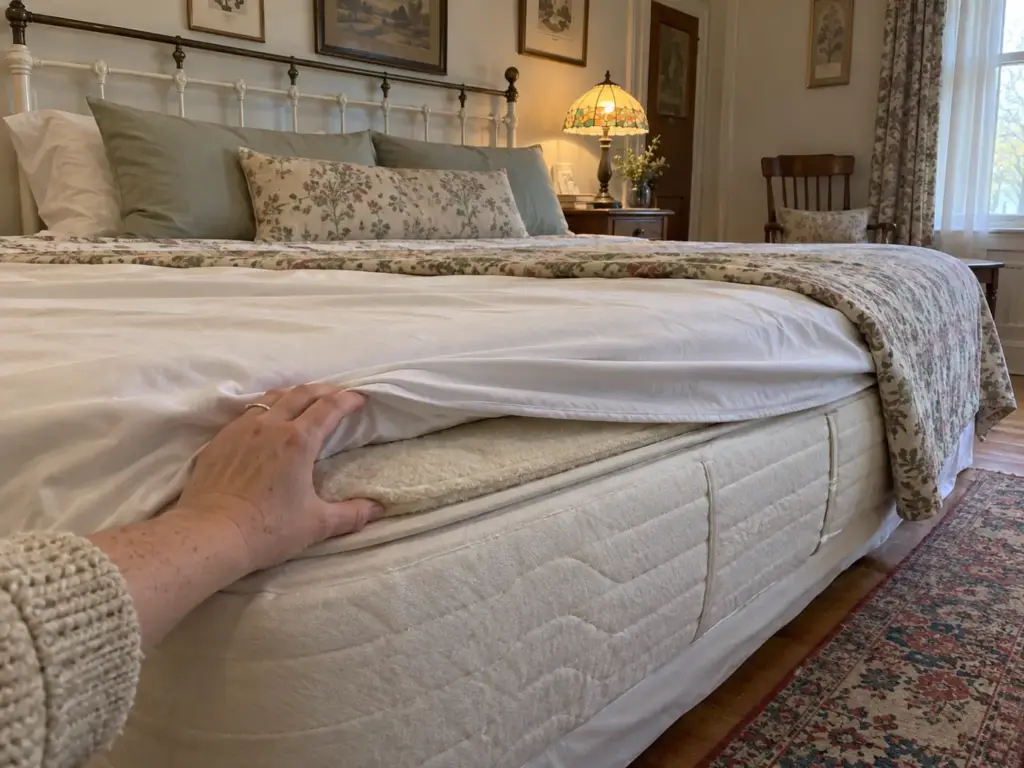
A thin feather layer barely changes the surface
The advice for a firm bed is to add feather, and it holds only as far as the height does. Tom’s Guide says most feather toppers are under two inches, a loft too small to alter the mattress surface, and the same page points to between two and four inches for a topper that does change firmness. So one word covers a layer that does nothing and a layer that does the job, and the inches are what separate them. A firm bed with a one-inch feather layer on it is still a firm bed, plus a shaking chore.
Go taller and you meet the opposite problem, the one set out in how a topper can sink you instead of holding you, where the layer is so deep that the sleeper goes through it.
Deep wool pile versus a flat wool layer
Wool carries the reverse reputation, and the owners’ reports run the same way. A deep wool pile does not provide much of a softening layer, and the better choice is a flat topper, something like a thin wool blanket. Wool works in both directions on temperature, and thicker layers and higher concentrations of wool have more of an insulating effect. Together these point the same way: a layer meant to sit on top of the mattress should not be a deep wool pile, which is the one choice that is neither soft nor cool. It does not soften the bed, and the depth pushes it toward warmth.
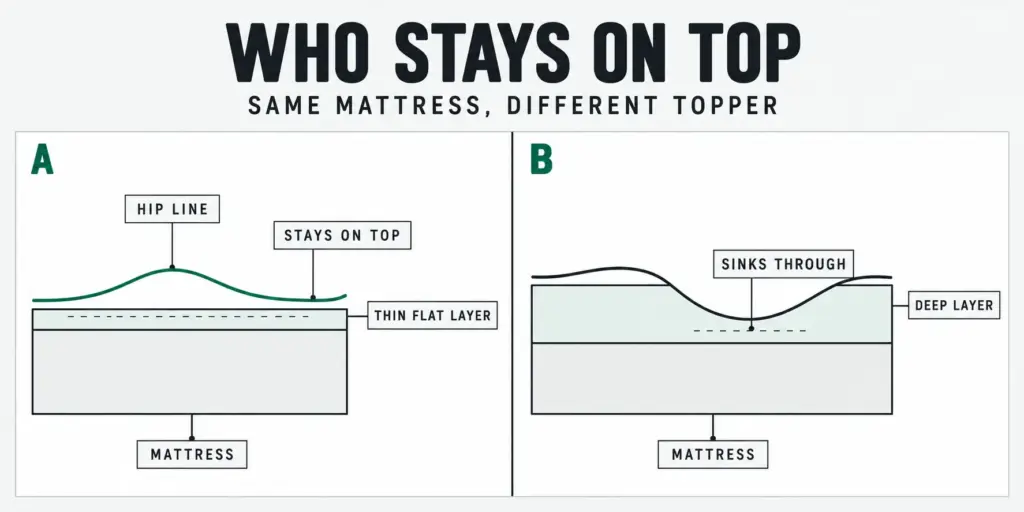
The picture to hold is simple. A thin, flat layer sits on top of the mattress: the weight of the hip lands on the layer, and a low pile height leaves little room to give. A deep layer lets the sleeper sink through its fill toward the mattress below, so the shoulder ends up resting on the mattress anyway, with a thicker and warmer sandwich in between.
A stiff backing keeps you on top
A wool layer with a stiff backing on a memory foam mattress can keep you on top instead of sunk in, and it can run cooler. That is one bed and one report, not a rule, but it fits the mechanism: a backing that does not fold gives the fill a floor, so the layer behaves as a surface rather than as a pile. Whether the height of a layer sets how cool it sleeps has no measured answer behind it. That part is this article’s position, and the palm test below is how to check it on your own mattress, by feeling whether the shoulder line and the hip line meet the mattress or stop short of it.
With the sheet off, press a flat palm into the layer where your hip lies and note how far it travels before the mattress pushes back, then repeat at the shoulder. If your hand meets the mattress almost at once, the layer is carrying very little of you, whatever its fill is called.
Heat and Damp: What Each Fill Does With the Night
Once the height is settled, the fiber decides how the layer treats warmth and damp, and the answers on feather are less consistent than the ones on wool. The one authority used here tests wool in clothing, not in toppers, and each use says so.

Wool takes moisture up and lets it go
Woolmark’s breathability fact sheet, which tests wool in garments rather than in toppers, puts it plainly: “Wool can absorb up to 35% of its weight before feeling wet and clinging to the skin.” The same sheet reports that, in hot, dry conditions, wool fabrics move more moisture away from the wearer than polyester fabrics do, and that the crimp of the fiber holds pockets of still air.
On a bed those are the two jobs of a topper fill: take up the night’s sweat and moisture vapor without going clammy, and hold air so the layer insulates. Wool is a natural fiber that does both without a finish, which is the argument for it on a damp bed. The second job is the same one behind the fact that trapped air, not weight, is what holds warmth in a wool blanket.
The Spruce describes wool as cool in summer and warm in winter, with a mild sheep odor when new, which is a new-topper complaint and not a flaw in the fill. Wool is the obvious pick for a hot sleeper, and it holds only while the pile stays low: a deep layer leans toward insulation, and then the fill that was meant to be the cooler one becomes the warmer one. A cold sleeper can use that to advantage: the same depth that fails a hot sleeper is the point of the layer for someone who wakes cold.
Feather holds loft and air, and does badly when damp
Feather insulates the way wool does, by holding air, and its air lives in the loft, the height the fill springs back to. Under a sleeper’s weight that loft is the first thing to go (the months are covered further down), and a flattened patch holds less air, so it insulates less where you lie and more where the layer is still tall.
Damp is the harder case. A 2013 Mattress Underground reply boiled it down to “down + damp = mildew.” That is one reply and not a finding, but it points the right way for any fill that keeps moisture instead of moving it: it needs a dry layer around it.
A damp morning does not prove the fill is the cause. A mattress protector with a plastic backing holds moisture against whatever sits above it, and the sheet, the protector and the topper each deserve a touch before the fill gets the blame.
The next time the sheet feels clammy, lift each layer in turn and touch the one beneath it. If the topper is dry and the protector next to it is clammy, the fill was never the problem.
What the sources disagree on, in the open
Ask three sellers whether feather holds heat and you get three answers: it does not retain heat, it is the warmest fill there is, it holds moisture rather than moving it. Those cannot all be true of one layer, and the likelier explanation is that they describe different layers: a thin all-feather mat, a tall featherbed with down in it, and one that has gone damp.
I would not pick between them from a tag. I would pick from the height and the fill weight line, then watch the layer through a warm week. If the heat is coming from a foam layer instead, heat from a foam topper is a different problem with its own answer. To place any topper among everything else on the mattress, the layers of a hot sleeper’s bed lays out the order.
The First Night Versus Month Three
Both fills feel right on the first night, feather plush and wool firm and even, so the first night proves nothing. The split comes later and at the place where the sleeper lies: a feather layer flattens, a wool layer compacts, and neither change shows on the cover.
Feather goes flat where you lie
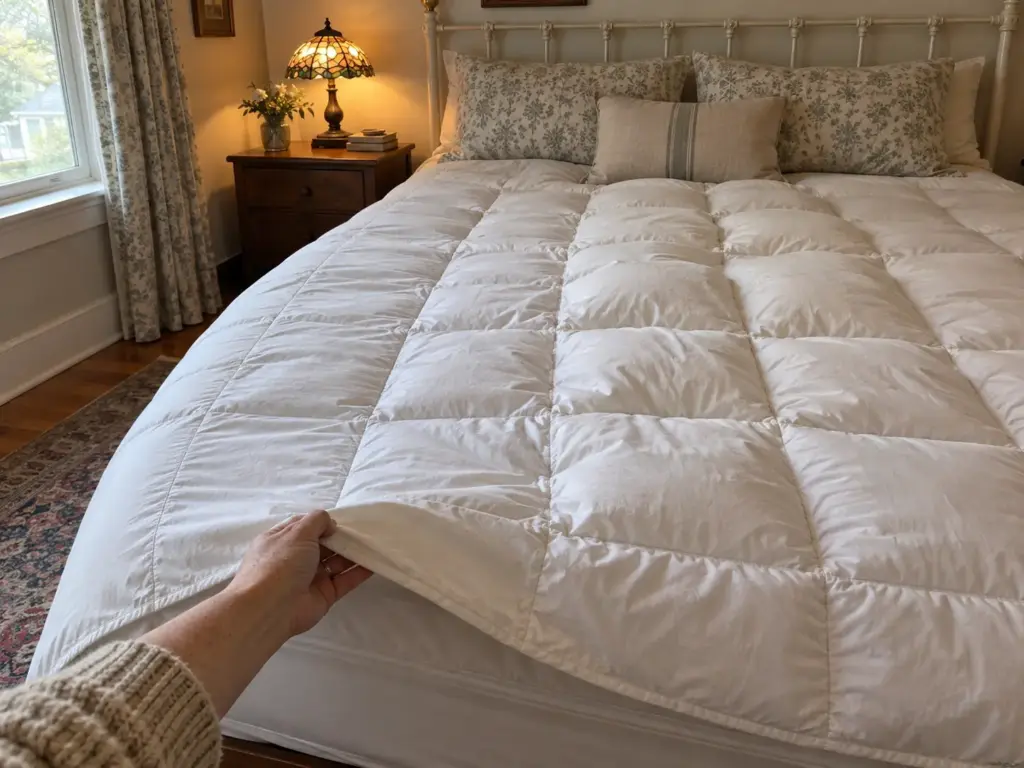
Tom’s Guide lists, among feather’s drawbacks, “losing their loft and fluffiness when compressed (in other words, when you sleep on them.)” The Spruce adds that feather tends to compress over time and needs periodic shaking, and that feather shafts can poke through the fabric. A feather duvet can feel a little flat when you sleep on it, which is a hint at the pattern and not a topper report, since a duvet is not a topper. The first place to look is the hip line, where the hollow shows while the rest of the layer still looks plump.
Wool compacts into hollows
A wool layer can be loved for a while and then compact, and it can be difficult or impossible to wash. The hollows it leaves are a common reason to replace one, though nobody has counted how often. What these accounts share is the hollow, and a compacted wool layer has less air held in its crimp, which is the thing that insulated and cushioned in the first place.
The years on the page do not agree
Tom’s Guide says feather layers need replacing every one to two years; Beloit Mattress Company, which sells them, says three to five. For wool, one says up to ten years and the other five to ten. Neither range comes from a measurement, and I would not choose between them by the year.
The lifespan depends on the sleeper’s weight and the layer’s height, and a heavier sleeper on a low layer is likelier to see the hollow early. The years are argued properly, in inches, in how long toppers last, measured in inches; here the only question is whether yours still stands.
The Shake-and-Air Test and the Care Each Fill Needs
The advice is to shake a feather layer and air a wool one, and it stops before saying how to tell whether either worked. So this section proposes a test. The proposal is this article’s own, and it has not been run against a measured result, so it is a way to look and not a rule.
Shake a feather layer and see if it comes back within the hour
Strip the sheet and measure the layer’s height at the center, where you lie, and at an edge, where you do not; the difference is the hollow. Shake out the layer hard, give it an hour to settle and measure the center again. If the center has come most of the way back to the edge, the layer is still a topper. If it sits where it started, the test says it is finished, whatever the years on the label say.
Beloit’s advice is to fluff the topper regularly to keep its loft, and The Spruce says periodic shaking; the test is how you see whether that shaking is buying anything.
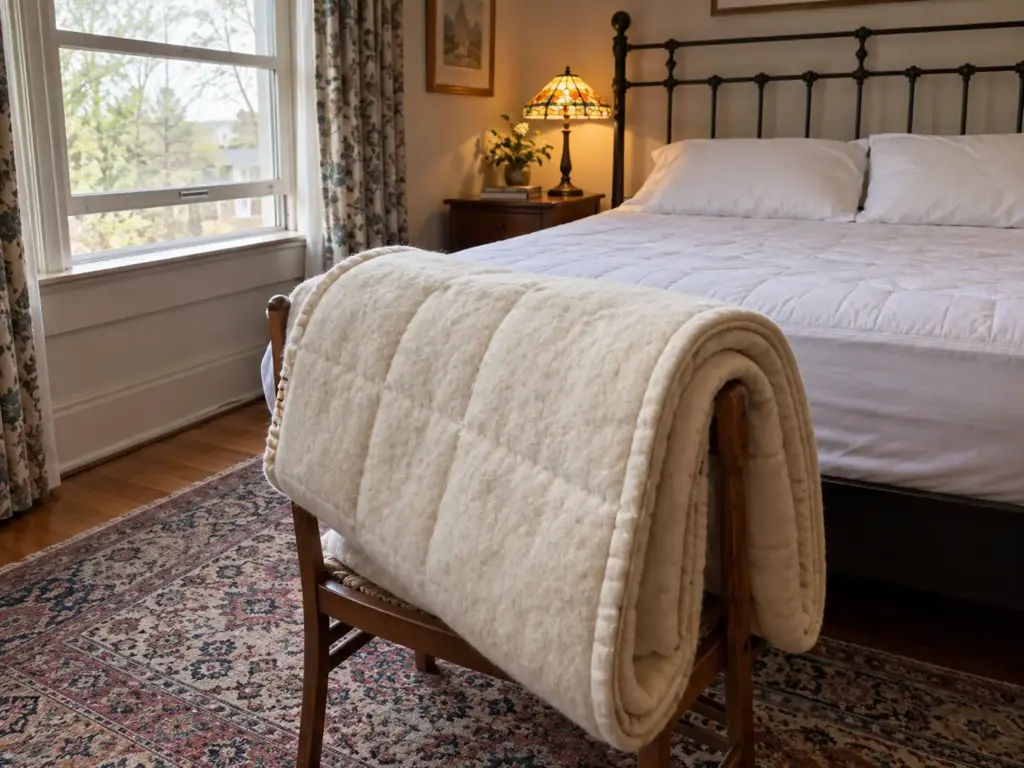
Air a wool layer in the sun for a day
For wool the same measurement works on a longer clock. Hang the layer over a chair or a line in the sun for the day, bring it in and measure the center against the edge again.
Wool that comes back is compacting less than it looks. Wool that does not is telling you the hollow is permanent. Whether airing can lift a layer that has truly compacted has no measured answer, which is the reason to take the measurement.
Spot cleaning, dry cleaning, and the label that rules
Neither fill is machine-washable as a rule. Wool is spot cleaned and aired, feather sometimes goes to a professional cleaner, and the care label overrules every general statement on this page. A wool topper that washes at home exists and is the exception: the label has to say so in plain words before any water goes near it. There is no wash routine here for that reason, because the label owns that decision.
Will the fitted sheet still fit over it
The pocket depth of the fitted sheet has to cover the mattress plus the layer, with room left to tuck. A fitted sheet that stays on at mattress plus two inches is the standard to shop by: measure the mattress depth, add the layer at its full height, add the two inches and compare the total with the pocket on the label. The corner that starts to lift in the morning is the sign the layer is taller than the pocket allows.
Measure a feather layer right after shaking, when it stands tallest, and buy the sheet for that height. A pocket chosen for the flattened layer will pull at the corners on the morning after a good shake.
Which Fill Goes on Which Bed
The decision comes down to the bed you have, and the move worth making before either listing goes in the cart is free: run the shake-and-air test on whatever layer is already on the mattress, and take the top layer off for a night to see what the bed does without it.
A firm bed that needs softening
Feather is the fill that adds softness, as long as the layer is tall enough to matter. The two-to-four-inch range from the thickness section is the zone, and a layer under two inches will leave a firm bed firm. The trade is the flattening described under month three, so a feather layer comes with a tape measure and a regular shake. Choose one with a tight cover, because the shafts stay in a snug cover, and with the fill weight printed on the tag.
A bed that is right but runs hot or damp
Here the better pick is a low-loft wool layer that sits on top of the mattress, and the reason is that it does not soften the bed: the mattress is already right, and the layer’s job is to handle moisture and stay out of the way. A felted or needle-punched layer, or one with a stiff backing, behaves that way; a deep batt does not. The layer a hot sleeper throws off in the night is the one on top, and the topper is the one that cannot be thrown off, which is why its height and fill matter more than its marketing. Two sleepers who want opposite things need a different answer, and gel against latex when two sleepers want different things takes it up.
When it is not the topper at all
If an itch or skin reaction keeps coming back after a wool layer goes on, or arm numbness or nerve pain does not change when the topper or the pillow changes, that is a doctor’s question and not a fill’s. Back to the bed: if the layer is the right height, the sheet fits, the hip line is the only hollow and the bed still does not work, then the layer has done what a layer can, and the next question is the mattress underneath it.
Choose by the Bed, Then Check the Layer at Month Three
Three things carry the decision. Thickness comes before fiber: under two inches a feather layer barely changes a firm bed, and a deep wool pile does not soften one either. Feather softens and then flattens, while a low wool layer stays on top and then compacts. And the layer already on your bed can be tested before anything is bought.
When the layer has had a few months of nights, measure the center against the edge again and set it beside the first reading. That gap is the number no tag prints, and it says more than the years on the page.
Tonight, take the sheet off, shake the feather layer or air the wool one, and measure the height before and after. Notice whether your shoulder still finds the mattress when you lie down, and whether the fitted sheet sits flat at the corners.
Frequently Asked Questions
01Is a wool topper too hot for someone who sleeps hot?
Not usually, if the layer is flat and low, because wool takes up moisture and lets it go, while a deep pile leans warmer. One owner reported it did not sleep hot 99% of the times, which is one bed, not a measurement.
02Does a feather topper go flat, and how fast?
Yes, under a sleeper’s weight the fill loses loft, and it needs regular shaking to come back to its height, though not always all the way. The printed years disagree, so measure the center against the edge instead.
03Can you wash a wool topper at home?
Usually not, because most wool toppers are spot cleaned and aired rather than machine washed, and the care label is the rule. A washable wool topper is the exception, and the label has to say so in plain words.
04Does a wool topper compact in a year or two?
It can, because owners report wool compacting into hollows, with one saying it happened after about 18 months of use. That is a report, not a measurement, so air the layer in the sun for a day and see whether the height comes back.
05Is a feather or wool mattress topper better for a firm bed?
Feather softens a firm bed when the layer is thick enough, while a flat wool layer barely changes the feel. Thickness decides first: under two inches a feather layer is too low to alter the surface, and a deep wool pile does not soften it either.




Tried it on your own bed?
No comments yet. Tell us what you changed, and what the sheet did after a few washes.