


What’s in here5 sections
The cooling pillow for back pain you bought for the heat does its job in the first minute, and in that same minute your chin is pointing a little at the ceiling. That is the label taken apart: “cooling” describes a surface, and the number your neck reads is the loft, which the box either leaves out or prints where a shopper never looks. The cool part is a gel pad on a face, gel mixed through the fill, or a treated cover, a thin layer wrapped around a core of foam, and the core is what holds your head up. A back sleeper who wants a pillow that stays cool and sits right is asking for two things at once, which is two purchases hiding inside one search.
So the order here is height first (and the way to measure the gap first is the towel test on the back-pain guide), then the cooling claim read line by line, then what the pillow does as the night goes on.
Quick Answer
A cooling pillow helps a back sleeper only once its height puts the head and neck in line with the spine. The cool feel is the second test and says nothing about height. The lowest loft any cooling pick prints is 4.5 inches, so ask first whether that is the height your gap needs.
Cooling Pillows Ship at a Height You Did Not Choose
The cooling feature is what the box leads with and the loft is what the neck meets, and the two are chosen separately even though they arrive in one object. A gel layer can be excellent and the pillow still wrong for a back sleeper, or the other way around. This section takes the height first and the cool second, because that is the order in which a bed teaches it.
What “cooling” is made of
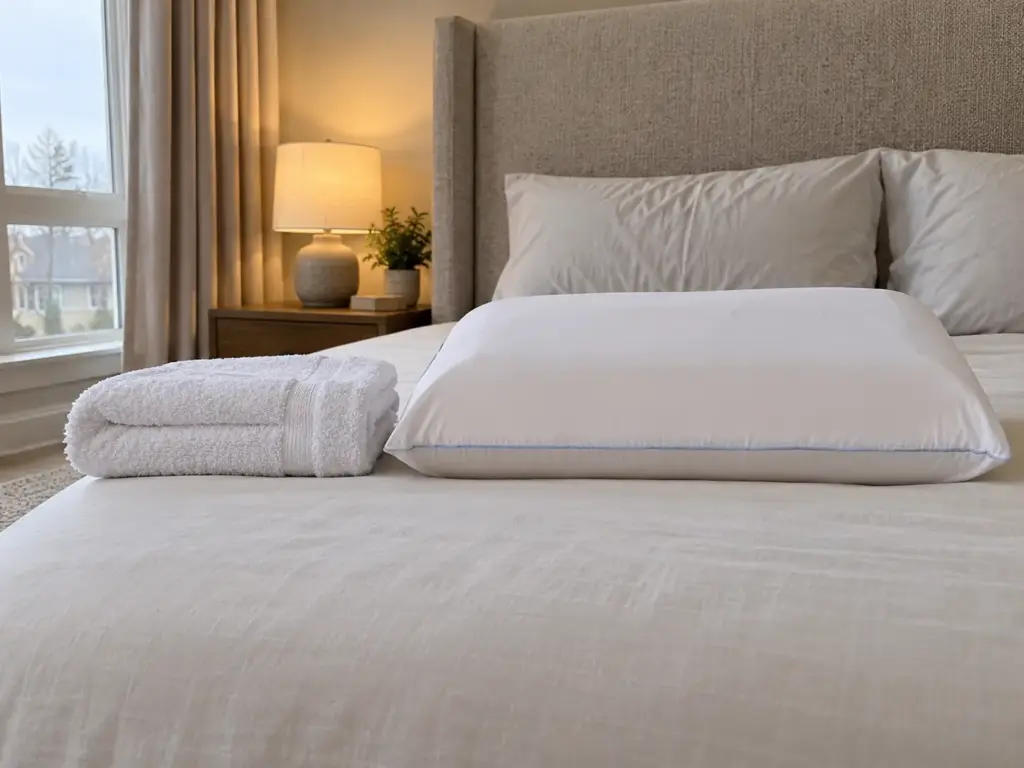
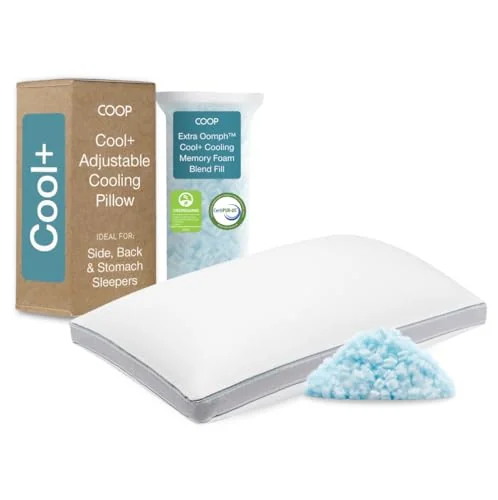
Three different objects share the word. On the solid-core pick, cooling is a gel pad on either side of one molded block of memory foam, which is how Mattress Clarity describes the Dual Breeze version of the Tempur pillow. On the adjustable Coop Cool+, the listing puts it in the fill: gel-infused memory foam pieces shaped for what it calls 50% more airflow, plus a heat-wicking liner and a phase change gel layer. And on plenty of other pillows the cool is the cover alone, a slick knit or a treated fabric over an ordinary core.
No standard sits behind any of the three. Nothing certifies how much heat a gel pad pulls out or for how long, so each brand picks a feature, names it, and prints the name.
What each one does physically is easy to say. A gel pad or a phase-change layer absorbs heat from the skin side until it has warmed to roughly the temperature of your head, which is why the first minutes feel cool and the later hours do not feel like much. A treated cover does the same job in a thinner coat. Airflow through shredded pieces depends on gaps that the weight of a head partly closes.
Every one of these acts on the surface or the first inch under it. None of them acts on how tall the pillow stands.
The cover-only version is the cheapest way to put the word on a box. A cool-touch knit feels cold because it pulls heat off the skin faster than cotton does, and it feels that way for the same few minutes a gel pad does, the way a hand laid on a metal rail reads colder than the wood beside it without either one being colder. It does nothing to the loft either.
The height on the box, and the height you need
Lie down on a new cooling pillow and the order of events is always the same: the height arrives first. Before the surface has had time to feel cool or warm, the head is already tilted, and if the pillow is taller than the gap between your head and the mattress, the chin tips toward the chest. The temperature is something you work out over the next ten minutes. The height you feel at once.
When the box prints a height at all, it prints a profile. Among the cooling picks in the reviews, the lowest printed loft is 4.5 inches, from a brand sold only on its own site, and the rest climb through 5 and 6 inches to 8 for a latex pillow. The adjustable Coop prints no loft whatsoever, because its height is whatever fill you leave inside.
Loft is also only half the description of a pillow: loft and firmness are two numbers, height and how the pillow gives under weight, and a cooling listing leans on the second one (medium, adjustable) while the first is what sets the neck. A back sleeper’s gap is the smaller one, since there is no shoulder to span (a side sleeper’s pillow has to fill that span), which makes the tall end of that range the risky end.
A printed profile is also the height of the pillow at rest, with nothing on it. Foam under a head gives, and memory foam gives more as it warms, so the working height is lower than the printed one by an amount the box does not publish, and the amount differs between a solid block and shreds. A tall block that compresses a lot can land where a stiffer, lower pillow does. That is the number that depends: the printed height and the working height are two readings, and only the second one meets your neck, which is why it has to be judged at the bed with a head on it.
The tallest cooling core read here is the TEMPUR-Cloud Dual Cooling: a single molded block, a 6.4-inch profile, about seven pounds in a queen. Mattress Clarity’s reviewer says that profile “might be too high for some back and stomach sleepers,” and adds that some reviews say the cooling does not last overnight.
Whether 6.4 inches is too high is not a property of the pillow. It depends on your gap, and your gap depends on your mattress, because the same pillow is a different height on a firm bed and on one your shoulders sink into. The towel test on the back-pain guide settles it before any money moves.
The advice a hot sleeper gets is to buy whichever pillow feels coldest in the first minute, and for a back sleeper that call fails in a specific way. The chill peaks in that first minute and then fades, while the height stays exactly what it was, and only one of the two can be changed for free. A pillow that fits the gap and feels only neutral can be helped with a lighter case or a fan in the room; a cold pillow at the wrong height can only be helped by being replaced. Treat the cool as the tie-breaker between pillows that already fit, never as the reason to pick one that does not.
Take fill out before you spend anything
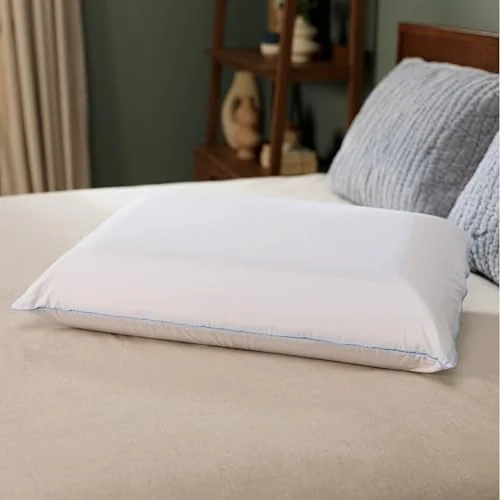
The free fix comes before the purchase, and in this line it is built into the box. An adjustable cooling pillow has a zipper and an extra bag of fill, and the bag looks like a way to make the pillow fuller. The reviews use the zipper in the other direction: one reviewer took fill out of two pillows and another took out some, and that is the reason to buy an adjustable pillow in the first place.
The Layla Sleep Adjustable Fill Kapok Pillow shows the pattern most clearly. It is shredded memory foam mixed with kapok, sold on Amazon under a cooling title, with fill you can add or remove. At factory fill it ran tall: Sleep Foundation’s testers who slept on their back took out about a third of it “to avoid excessive elevation,” so a back sleeper who unpacks it and leaves it zipped is sleeping on the height the box chose. The reviewed size is the King, and the same logic holds for any pillow with a zipper.
Take fill out in small handfuls and keep the extra bag. The zipper lets you undo a mistake, and ten minutes flat on your back with the case on is a quicker test of the chin angle than any measurement you can do standing at the bed.
Taking fill out has a second effect, and it is worth stating as reasoning rather than as a measurement: less foam under the head is less material to hold heat there. No cooling pillow thinner than 4.5 inches turned up in the reviews, so nothing checks this against a thermometer. It is an inference from how foam behaves. It does mean that a lower loft is a different cooling product from a taller one, and for a back sleeper the lower one is the version that fits the gap.
One caution on the zipper, and it is reasoning too. Taking fill out does not give you a smaller copy of the same pillow: the pieces that remain have more room to move, so a half-emptied shredded pillow shifts more under a turning head than a full one does. If the height is right but the pillow feels loose, the answer is the fluffing routine further down, not putting the fill back.
If a zipper is not what you want, pillows for back sleepers that hold their height covers the sleepers who need a stable height without any cooling feature at all.
The Cooling Claim, Read Line by Line
With the loft settled, the cool part still has to be taken apart, because the listing, the reviewers and the spec tables do not describe it the same way. This section sets each source’s own words side by side and says where they sit.
What the listing says and what it shows
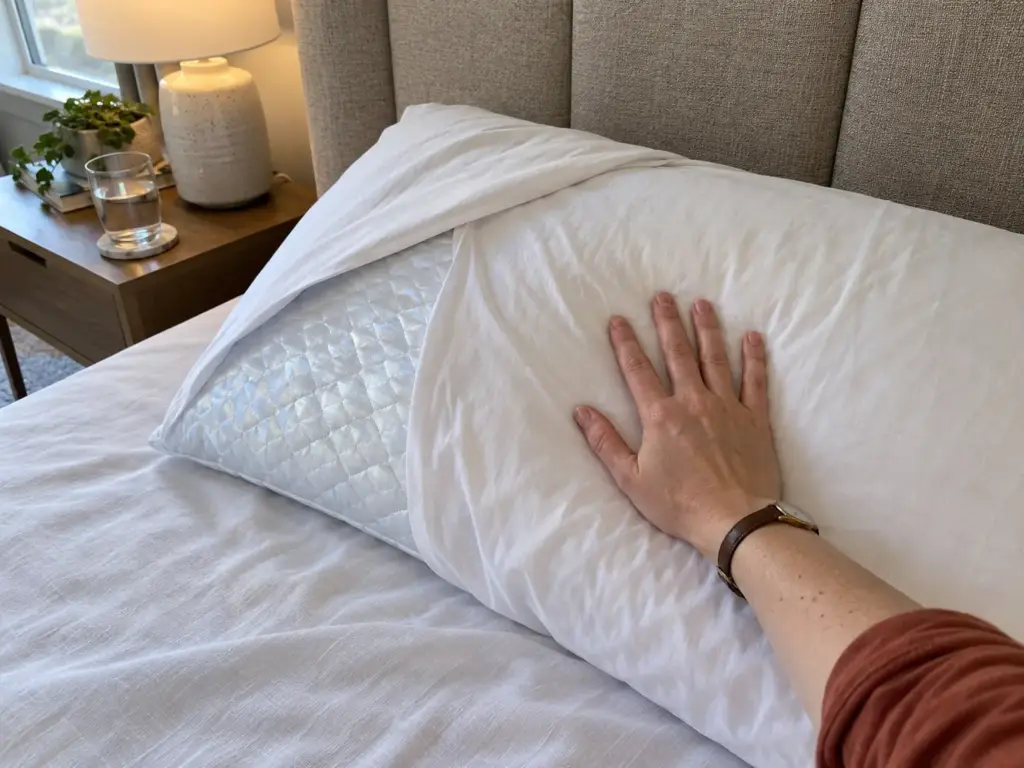
The Coop Cool+ listing makes its cooling case in a few lines. The fill is “gel-infused” and shaped “for 50% more airflow.” The pillow “dissipates excess heat.” There is a “heat-wicking liner & phase change gel layer.”
What the listing never shows is a thermometer: no reading, no test setup, no temperature at any minute of the night. The airflow line does not say 50% more than what, so the number floats free of any comparison.
Take the claims one at a time and each is believable as a mechanism. Gel mixed into foam can pull heat from the skin. Shaped pieces leave gaps. A liner can move moisture.
What a listing cannot tell you is the size of the effect on a head that is lying on it for hours, and that is what a hot sleeper is buying. A phase-change layer buys minutes of cool by absorbing heat, and once it is at skin temperature it is done until the room has cooled it back down.
The cool you feel in the store lasts as long as the layer has capacity left, and then the pillow is as warm as its core.
What the reviewers felt
A Tom’s Guide tester slept on the same pillow, which that review calls the EdenCool+, and the verdict is mild: “it didn’t trap body heat either,” but it “wasn’t quite as actively cooling as we would have expected.” Warm nights, no overheating reported, no active chill. That is a feel, and a temperature-neutral pillow and a cooling pillow are not the same thing, though only one of them is sold as cooling.
The same review describes where the gel sits, and the description changes what you are buying. One side of the pillow has the heat-wicking, phase change gel memory foam layer, and it is the firmer side. The other side has only the cover and a liner between the foam fill and your head, and it is the softer one.
So a cooling layer on one face means the pillow has a cool side and a plain side, and which one is under your head sets both the temperature and the height. Flip it and you have changed two things at once.
Amazon’s own summary of the reviews, generated by Amazon and not a reviewer’s words, splits the same way: some say it stays cool throughout the night, others find it not very cooling. The Tempur gets the same treatment across sites. Mattress Nerd, covering the Tempur-Cloud Breeze line, says it maintains its cool feel over the course of the night, while Mattress Clarity says some reviews report that the cooling does not last overnight. Two sites, one pillow line, two answers, and no thermometer in either.
Set the Tempur’s solid block beside shredded fills and the heat question changes shape again, because shredded versus solid foam differ in where the air can move and in how each one softens as it warms. A block has no gaps to close under a head, and shreds have plenty.
A slick cooling case slides, and one Amazon reviewer’s answer was to pin percale pillowcases shut over it. A matte percale weave has more grip than a smooth cover, and the pin at the open end keeps the case from riding off the pillow when you turn.
The case is part of why the pillow feels cool and part of why it ends up on the floor: one 4-star reviewer wrote that the pillow fell off the back of the bed twice in a single night.
The layers between your head and the gel are rarely counted. A zippered protector under the case, or a thick case over it, adds a layer the cool has to work through, and whether that helps or hurts is not something any review of these pillows tests. As a mechanism, each added layer is one more thing the heat has to cross before the gel can take it.
The picks side by side
Any cooling listing can be put through the same four questions, and a page that answers fewer than four has told you what it prefers you not to look at.
- Where does the cool sit: on a face, in the fill or in the cover?
- How long does it last, and does any source give a time?
- What height does it print, and can you change it?
- What does the badge on the page certify?
The fourth is a label worth taking apart. CertiPUR-US and GREENGUARD Gold both appear on these listings. CertiPUR-US is a certification about the foam, what it is made without and how much it gives off, and GREENGUARD Gold is an emissions standard. Neither says anything about temperature or height, so both answer a different question from the one a hot back sleeper is asking.
Four pillows, read through what each source describes rather than through what a brand would like it to say. The height column is the one that matters for a back sleeper, and the last column says whether you can change it.
| Pillow | Core | Where the cooling sits | Height | Adjustable fill |
|---|---|---|---|---|
| Coop Cool+ Adjustable | Plus-shaped gel memory foam and microfiber | Gel in the fill; a gel layer on one face, per one reviewer | Set by the fill you keep, not printed | Yes |
| TEMPUR-Cloud Dual Cooling | One solid molded memory foam block | A gel pad on each face | 6.4-inch profile | No |
| Layla Kapok Adjustable | Shredded memory foam with kapok | Sold under a cooling title; no mechanism described | Set by the fill you keep, not printed | Yes |
| QUTOOL Cooling Pillow | Shredded memory foam, set of 2 | Listing title only; product page not read | Not printed | Yes, per the title |
Two fills move heat differently from every foam in that table, and they are not this article’s subject: latex and buckwheat have their own page, and the temperature answer there is about where the air goes, not about gel.
Whether the Core Holds Its Height Through the Night
The table above describes how these pillows are sold, and that is the first minute. A cooling pillow is judged cold in the first minute and flat in the last hour, and the reviews cover the first far better than the second. This section is about what happens after the pillow has been slept on, what costs nothing to correct, and where the pillow stops being the explanation.
What reviewers saw overnight
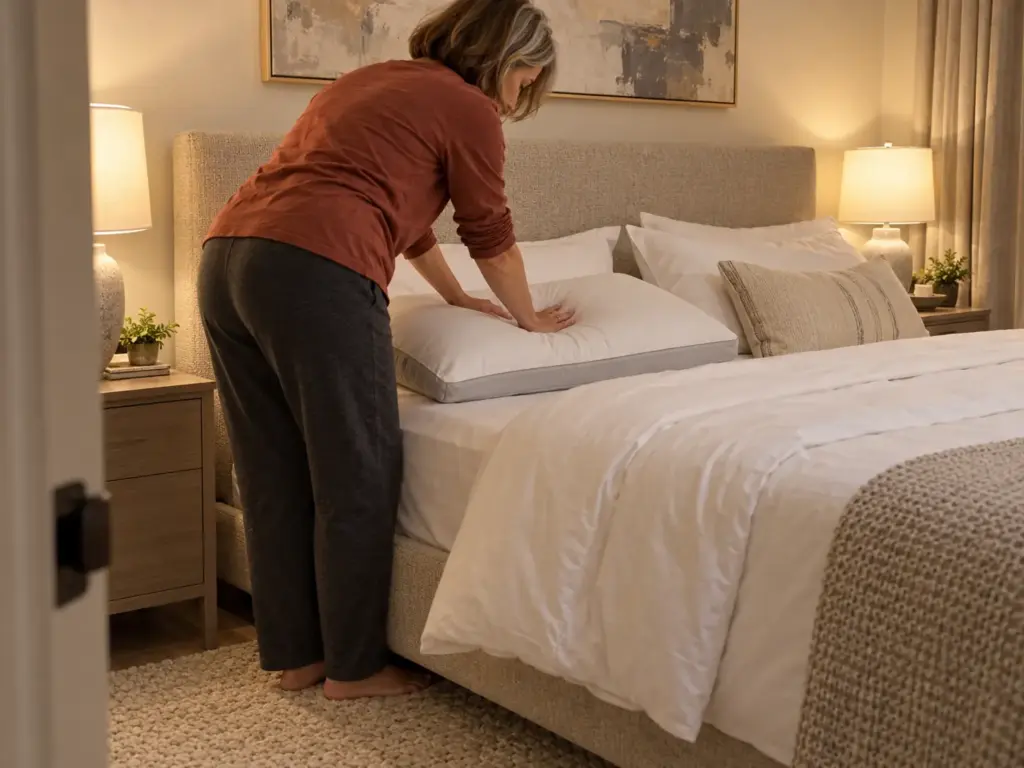
The flattening report comes from a few places and does not agree with itself. The Tom’s Guide tester says the adjustable Coop “does tend to flatten a bit throughout the night if you keep your head in the same spot,” and fluffed it in the middle of the night. A 3-star Amazon reviewer, dated May 2026, writes that “the loft of the pillow varies throughout the night, so that the neck support it offers isn’t consistent,” with the fill moving toward the back edge under the head.
Against that, a 5-star reviewer who bought three of them in 2020 says plainly that “shredded memory foam pillows don’t go flat. It’s just not a thing.” Same reviewer, same pillow family, same page: a 5 to 8 second fluff brings the height back, and the first pillow lasted years with no change in texture. One reviewer’s account is not a test, but it does explain the disagreement, since a pillow you fluff and a pillow you leave alone will report different heights.
Here the hypothesis goes in with its label on. Memory foam softens as it warms, and a core that stays cooler should therefore soften less and lose less height over a night. That is reasoning, and none of the pillows’ reviews checks it.
They give feelings and fixes. None gives a measured height at hour four or at month three, and none gives a temperature at either.
You wake with the middle of the pillow dished and the edges standing, and it looks flat.
Press the middle with the flat of your hand: if a few seconds of fluffing brings it back, the height was in the fill all along and had only moved, and if it stays down, the support is gone, which is a different problem with a different answer. A spec sheet cannot give hour four, but you can approximate it.
Stand a hardcover book on edge beside the pillow at bedtime, level with the top of the fluffed middle, and look at the same spot first thing in the morning before you touch anything. The gap between the book’s top edge and the pillow is what the night took. It is not a reading of height under a head, because foam rebounds slowly once the head is gone, but it is a repeatable reading on your own pillow, and a week of them says more than a review can.
Fluff, fold and pin before you replace
When the middle drops, the cheapest move is also the oldest: lift the pillow, break up the fill with both hands, and set it back down for five to eight seconds’ worth of work. How often fluffing works, and with which fills is its own question, because shredded fills and solid cores respond to it differently, and a block of foam cannot be fluffed at all. For a core that still reads flat after fluffing, fold it before you replace it: the fold test tells you whether the support is gone or only the surface has settled.
The case comes next. If it slides, pin it. A percale case pinned at the open end held the pillow in place for the reviewer who tried it, and a slipping case is the reason a pillow ends the night half off the bed and the head back at the mattress height.
A new foam pillow also smells, and the free fix is air. One reviewer aired the pillow for 48 hours before the first night, because new foam arrives smelling of the bag it was compressed in, and another reported that the smell dissipated over time.
The cover washes; the foam core does not go in the machine. One review site says that is why it is “not a forever pillow,” and another reviewer says the exterior cover washes. The care label on your pillow is the authority over every one of these accounts.
You wash it, you fluff it, and the middle is where it goes first. That is the sequence reviewers describe for shredded cores, and it is why the first thing to check at month three is the height under the spot where your head lands.
Turn the pillow end for end a few nights a week. The flattening report came with a condition, a head that stays in the same spot, and rotating the pillow removes the condition for free.
The budget version, and the cooling you can’t verify
The cheaper route to a shredded cooling pillow is the QUTOOL Cooling Pillow, sold as a set of two in CertiPUR-US shredded memory foam, with adjustable firmness for side and back sleepers according to its listing title. Against the Coop it trades the bag of extra fill for a second pillow, which is one answer to a pair of sleepers who both want to experiment with height.
A set of two and a bag of spare fill answer different problems. If you already know your gap, two pillows of the same height make a matched pair, and a second one is there to test against or to hand to a partner whose gap is different from yours. If you do not know it yet, the bag is the better teacher, because one pillow can be tried at several heights before you decide it is the wrong one.
What can be said about it stops at that title. Its cooling is unverified here, and so is whether it holds its height, because no review of it is quoted in this article and no repeated complaint came up. That is a limit of this page, not a clean bill. A pillow whose cool cannot be checked from a listing is the pillow a return window exists for, and what a return can’t test is its own conversation: the cool is the part a short trial reveals, and months of use is the part it does not.
When it isn’t the pillow
Once the height is right, a pillow has done what a pillow can do. Pain that has not moved after that is not a reason to buy another one. According to Mayo Clinic’s back pain guidance, “Call your healthcare professional if your back pain hasn’t improved after a week of home treatment.” That is a doctor’s question, and no fill, gel or cover answers it.
Back to the bed. If the pillow is the right height and the night is still hot, the layers underneath it are the next place to look: the mattress that holds heat, the room, the case on the pillow.
What to Check Tonight, and Again at Month Three
Three things carry over from the sections above. Judge a cooling pillow by its loft before its chill: measure the gap, then take fill out or pick a core whose printed height fits it. Read the cool claim as a word on the box until a source shows a number, because none of the pages for these pillows shows a temperature. And expect the middle of a shredded core to go first, which makes the repair a few seconds of fluffing and a case that stays put.
The check for later is a comparison with the first week. At three months, lie on your back with your head where it falls and compare the height under it with the height you set at the start: the same spot, the same chin angle, and a case that is still on the pillow rather than on the floor. If the height has drifted and fluffing does not bring it back, the fold test is next and a replacement after it.
Tonight’s free change takes five minutes. If your pillow has a zipper, take out a handful of fill, close it, and lie on your back until your head sits level with the line of your shoulders instead of tipped up; repeat with a smaller handful if it is still tall. If it is a solid block, spend the same five minutes on the towel test and let the result decide whether it stays inside the return window. Then notice the next morning whether you went looking for the cool side of the pillow or for the height you had before.
Frequently Asked Questions
01Is there a cooling pillow that actually works?
Some cooling pillows feel cooler on the surface for the first minutes, but the reviews of these pillows report feelings, not measured temperatures. For a back sleeper the feature that decides the night is the height, so check the loft against your gap first and use the table above to compare the rest.
02What is the number one rated cooling pillow?
No single pillow holds that title for a back sleeper, because ratings measure how cool a pillow feels and say nothing about the height your gap needs. The pillows above are chosen by loft and by flaw, so none of them is ranked.
03Can a cooling pillow for back pain be too tall?
Yes, a cooling pillow can be too tall for a back sleeper, because the cool layer does nothing about the loft underneath it. The solid-core Tempur here has a 6.4-inch profile and its reviewer calls that high for some back sleepers. An adjustable pillow lets you take fill out.
04Does a cooling shredded foam pillow go flat overnight?
Reviewers disagree: one says a shredded cooling pillow flattens if you keep your head in the same spot, and another says it never goes flat. Fluffing for a few seconds brings the height back, and none of the reviews gives a measured height at hour four.
05Can you wash a cooling pillow?
The cover can usually be washed, while the reviews describe the foam core as something you air out and spot-clean rather than machine wash. The care label on your pillow is the authority, so follow it over any review, this one included.




Tried it on your own bed?
No comments yet. Tell us what you changed, and what the sheet did after a few washes.