


What’s in here5 sections
A listing that calls a pillow affordable has told you one thing, and it is about the checkout. It says nothing about how high that pillow sits under your head after a night, and the box only prints the height at rest. A listing states the number lying on a shelf; a head finds out the real one by morning. So the only test you control with affordable pillows for back pain is time inside the return window, and this guide is built around that: how a window is set, which lines of a listing to read before it closes, and where a window stops being the right tool.
Quick Answer
An affordable pillow is worth buying for back pain only if two things hold: you can measure its height lying down, and the return window outlasts your reading of it. The price settles neither. Count the nights you actually sleep on it, then compare that count with the return line on the page where you pay.
A Return Window Only Tests What Fits Inside It
A trial length shows up on a listing as one figure, and a figure looks like a promise. What it counts is days on the seller’s calendar. What you need to count is nights on the pillow, and the two only line up by accident.
The window is the seller’s number, not yours
The deadline is something a seller chose, and it ends on a date, not on the night anything settles. According to the Federal Trade Commission’s guidance on return deadlines, “Many stores will not take returns or exchanges after a certain time, like 30 or 90 days.” Read the line before the order goes through, not on the last day. Brands that call the longer ones a sleep trial or a trial period are still naming a calendar the seller set.
The count also starts earlier than your first night. Whether a page counts from the order or from delivery is in its own wording, and the pillow may already have spent a day or two of the window in transit before a head touches it.
A 30-day line can be a few nights shorter than it reads.
The day the pillow arrives, write two dates where you will see them: the day the return line started and the last day it can go back. Beside them, keep a running count of the nights you have actually slept on it. The distance between those two counts is your real window, and it shrinks every time a night goes to something other than the reading.
One pillow can carry two of these numbers at once. The Coop Queen further down is exactly that case: its Amazon listing and the brand’s own page print different return lines, and the next section sets them side by side.
What a short window can and cannot read
There is no figure to size a window from. How many nights a new height needs before a morning can be read is your count to keep, and a seller cannot print it for you.
What can be said is structural. The first nights go to getting the height right, which can take a few nights, and the reading starts after that. A window that closes before a night-by-night reading is possible is a purchase with a receipt, not a trial.
Some things a short window reads well, because they show on day one: the smell when the bag opens, the size against your bed, whether the height is plainly wrong when you lie on your back. What it cannot read is the fill after repeated nights, whether the height you set on night three is the one you still have later. That is a question about how the fill settles, and a return line is the wrong tool for it.
So the one test that needs no number is this: can the pillow still go back while your reading is unfinished? If the answer is no, you bought it, whatever the page called it.
The measurement below reads the pillow, not you. On the first night, lie on your back with the pillow as it arrived and measure the gap between your head and the mattress. Measure it again once the first adjustments have settled, and a third time in the last week of the window.
If the three numbers match, the fill held. If the last one has dropped, the window just told you the one thing a box can never print, and it told you while the pillow could still be returned.
The free test to run before the box arrives
Before any order, take the one measurement that costs nothing, on the pillow already on your bed. Lie on your back and measure the gap between your head and the mattress, measured lying down, as the back guide describes. That gap, and not the loft printed at rest on a box, is the number you carry into every listing after this.
And if the pillow you own is simply flat, fold it before you replace it. A pillow that comes back to height after a fold and a fluff was never the problem, and you have saved the purchase.
Read the Listing Before the Window Starts
The window is only as useful as the pillow it covers, and some pillows can be changed from the inside. So the lines worth reading on a listing are the ones that say what you can do to the pillow during the days it can still go back.
The return line, and whose it is
The Coop Home Goods Original Adjustable Pillow in Queen shows both kinds of number. On its Amazon listing, sold by Coop Sleep Goods and shipped by Amazon, the returns line reads 30-day refund or replacement. On the brand’s own page the same pillow carries a 100-Night Sleep Better Guarantee and a five-year warranty. Neither page ties the brand’s 100 nights to an order placed on Amazon, so the line that counts is the one on the page where you pay.
That Amazon line was read on October 20, 2026, from a delivery address outside the U.S., so read it again from your own session before you rely on it. The obvious pick is the longer number, and it is the right pick only when it sits under the order you are making. A long promise on a page you did not buy from tells you about the brand, not about your return.
Screenshot the returns line on the page you pay on, with the date showing, before you place the order. Listings get edited, and the line you read at checkout is the one you will want in hand if the pillow has to go back.
The fill that can be changed inside the window
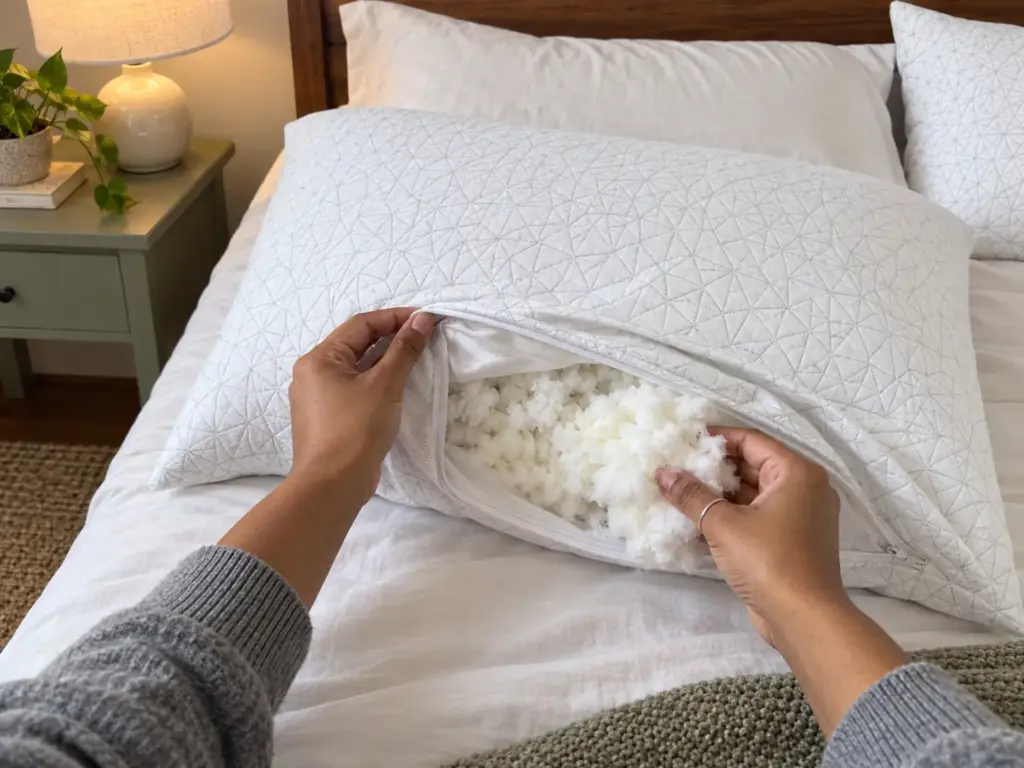
The listing prints the fill as a cross-cut memory foam and microfiber blend, 76% visco polyurethane foam and 24% polyester gel fiber. Read that as two parts, foam and fiber, in one adjustable pillow, with removable fill you can take out and put back. What each of those fills does over the months is in what each fill does by month six, so here only one line matters: the listing marks Extra Fill Included for the Queen, and the brand’s page lists extra pillow fill in the box.
That spare bag is the test kit. On the first night you pull out a handful of fill, set it in the spare bag, and count the nights before any of it goes back in. The same idea in plain terms is an adjustable pillow, where you can pull out or add fill.
The height stops being a number you accept from a box and becomes something you change on purpose, one handful at a time, while the window is still open. A fixed fill cannot offer that. After a few nights the spare bag also becomes a record: whatever sits in it is the difference between the pillow that arrived and the one you are sleeping on, and it is what you put back, or leave out, when the height drifts.
The maker also expects the height to drop. Its FAQ says that if the pillow starts going flat, ten minutes in the dryer will fluff the fill. That is a test too.
A pillow that comes back after a fluff is a different result from one that does not, and both are worth knowing before the line expires. What happens after the line expires is the clock that starts when the window ends, and it counts by fill rather than by year.
What the box does not say
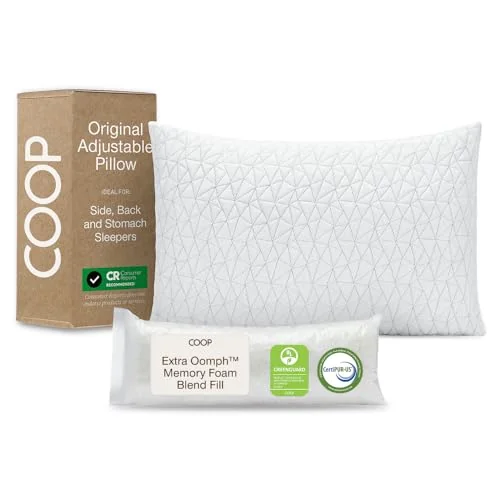
A size is a footprint. The listing’s Queen column prints 19 by 29 inches, which says how much of the bed the pillow covers and nothing about the height under your head. The certifications named on the listing, CertiPUR-US and GREENGUARD Gold, are the listing’s claims about the materials, and neither one says anything about height either.
The two catches are the ones the card carries. The pillow goes flat, by the maker’s own account, and the listing’s review summary says several customers report an awful smell, with an Odor topic at 3.7K mentions.
For a budget buyer the two cost different things: a smell can be judged when the pillow comes out of the bag, while a flat pillow costs nights of the window, which is why the spare fill matters. What a lower-cost pillow gives up more generally is spelled out in what you give up on a side sleeper’s pillow.
Keep the box and the spare-fill bag until you have decided. A pillow that has to go back should go back the way it arrived, with the fill that came in it, and a bag you threw out in week one is a return you now have to argue about.
Where the Window Stops and the Doctor Starts
A return window settles one question: whether a pillow suits a bed. Whatever else is going on in your back is a different question, and a return line was never built to answer it.

The mattress is the limit a pillow cannot pass
The bed is two layers, and the pillow is the cheaper one to change. All a pillow can do is change the gap between the head and the mattress, the same gap the back guide measures. A soft or sagging mattress sits outside what any return window tests.
A pillow will not do much on its own, and the mattress is the place to look. For the pillow side of that same gap, the back sleeper’s pillow by height is where to compare.
Pain that does not move with the bed
When the pain does not move with the bed, a doctor reads it and the bed does not. The threshold below is Mayo Clinic’s, quoted as written and left uninterpreted, and its list goes on past the three signs shown here. According to Mayo Clinic’s guide to when back pain needs a doctor, “Call your healthcare professional if your back pain hasn’t improved after a week of home treatment or if your back pain:”
- “Is constant or intense, especially at night or when lying down.”
- “Spreads down one or both legs, especially if it extends below the knee.”
- “Causes weakness, numbness or tingling in one or both legs.”
That is where this page stops. Send the pillow back if it did not help. The return line runs on its own calendar, and the other question should neither wait for it nor be set by it.
Read the Return Line First, Then Measure the Gap Tonight
Three things carry over from all of this:
- The return line is the budget decision, and it belongs to the page you pay on, not to the brand’s page.
- What the fill allows inside the window matters more than what the box says at rest: a pillow whose height you can change and re-measure gives the window something to test.
- The mattress and the doctor both sit outside any return line.
Once the window has closed, lie on your back again and take the same measurement you took before buying; a pillow that has settled lower than that first number is telling you about its fill, and from there the replacement clock is yours.
The free step comes first, and it is tonight’s. Measure the head-to-mattress gap on the pillow you already own, write the number next to today’s date, and notice whether the pillow comes back to it after a fold and a fluff. Whatever you order next has to be read against that number, and the return line has to outlast the reading.
Frequently Asked Questions
01What is the best pillow to sleep on for back pain?
The best pillow is the one whose height you can measure lying down and that you can still send back. No pillow treats pain. The back guide gives the head-to-mattress gap and the loft numbers behind it.
02What kind of pillow is best for back pain?
Choose by height and fill rather than by a label such as orthopedic or cervical; the height under your head after a night is what labels leave out. Loft and firmness are two separate numbers, explained in why a pillow needs two numbers, not one.
03Is an affordable pillow worth it for back pain?
It is worth it when you can measure its height lying down and the return window outlasts your reading of it. The price settles neither. A cheap pillow you cannot send back is a guess; one you can send back is a trial.
04How long is the return window on an affordable pillow?
It is the seller’s number, and it can differ by page: the same Coop Queen shows a 30-day refund or replacement on its Amazon listing and a 100-night guarantee on the brand’s own page. Read the line on the page where you pay.
05Can an affordable pillow go flat before the window closes?
It can, and the maker of the Coop Original plans for it: its own FAQ suggests ten minutes in the dryer to fluff a pillow that feels flat. With adjustable fill you can also add back what you took out. Replacement timing is in how often to replace pillows, by fill.





Tried it on your own bed?
No comments yet. Tell us what you changed, and what the sheet did after a few washes.