



What’s in here7 sections
- What One Pillow Trial Measured, and What It Could Not Explain
- Where the Pillow Presses and When the Ache Arrives
- Which Fills Hold Their Shape (and the Fold Test)
- A Fair Test: One Pillow, One Change, One Week
- When It Isn’t the Bed: Signs to Bring to a Doctor
- What to Change Tonight, and What to Look At in a Month
- Frequently Asked Questions
You wake with your head hurting in the spot where it rested, and the pillow is the first thing you blame. Migraine sufferers often describe the same picture: throbbing pain that arrives with pressure from the pillow on the back of the head, right at the base of the skull. Pillow headaches have one careful trial behind them, a 2010 study that linked pillow type to waking headache and then admitted it could not say why. This article reads that trial plainly, turns your mornings into a short log, sets up a fair test of one week per pillow, and ends with the signs that send you to a doctor before any pillow gets bought.
Quick Answer
Yes, a pillow can be part of a morning headache. The one careful trial linked pillow type to waking headache and could not say why, so you settle it in your own bed: one change at a time, about a week of nights each. Any sign on the list in the last section is not a pillow question.
What One Pillow Trial Measured, and What It Could Not Explain
One measured trial sits under the whole question of pillows and morning headaches, so it comes first: how much it shows, who it measured, and what its authors say they could not explain.
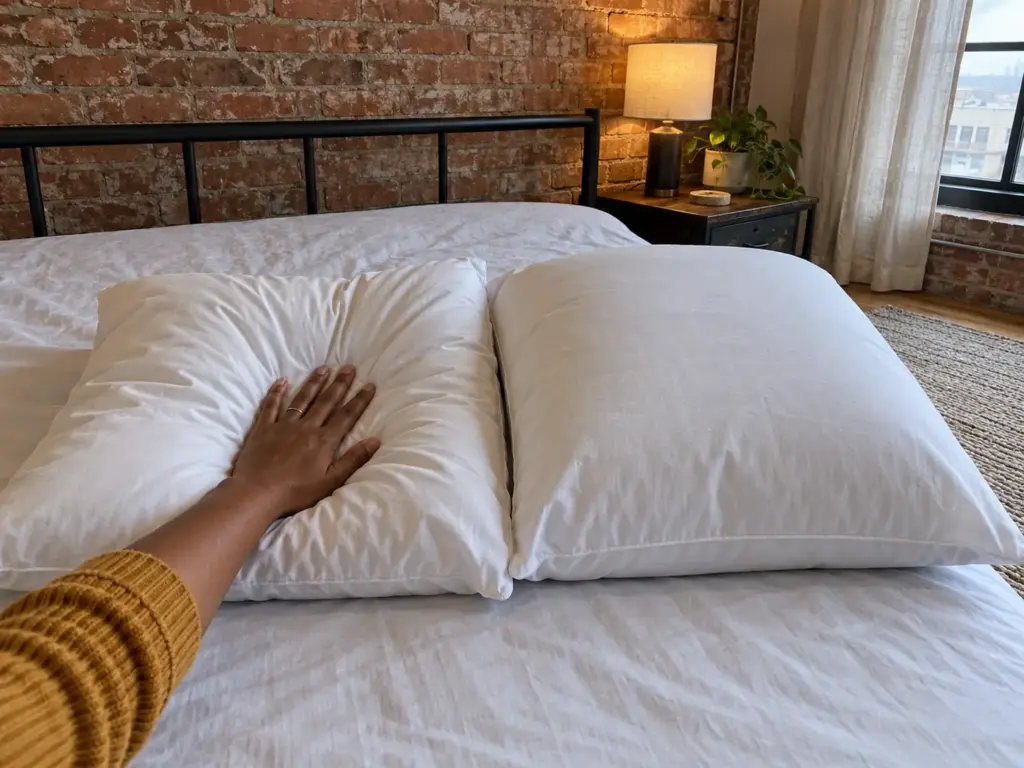
What the Trial Did
The study is a 2010 field trial by Gordon, Grimmer-Somers and Trott in the Journal of Pain Research. Healthy side sleepers, none with a recent spine injury and none seeking treatment, slept on five trial pillows in turn, among them polyester, feather and latex fills.
Each pillow got seven consecutive nights. Between pillows came seven nights back on the sleeper’s own pillow, so every trial pillow was judged against what the person already slept on, and a diary recorded symptoms on waking and how long each one lasted. At their tallest the trial pillows stood roughly 4.5 to 5.6 inches high.
A morning headache turns out to be common before any pillow changes. In the baseline week, on their own pillows, 19.6 percent of the participants woke with one. About one sleeper in five already had a waking headache on the pillow they trusted, which means the pillow cannot be the only candidate, and every number below has to be read against that starting point.
What Came Out
Feather came out worst. Against the sleeper’s own pillow, the feather pillow carried an adjusted odds ratio of 2.3 for waking with a headache, with a 95 percent confidence interval of 1.0 to 5.6. In plain words, the odds were about 2.3 times as high.
But the interval begins at 1.0, which is the line for “no difference,” so the signal is thin: worst of the five, though not by a margin the authors could be sure of. It was still the only pillow that differed significantly from the own pillow.
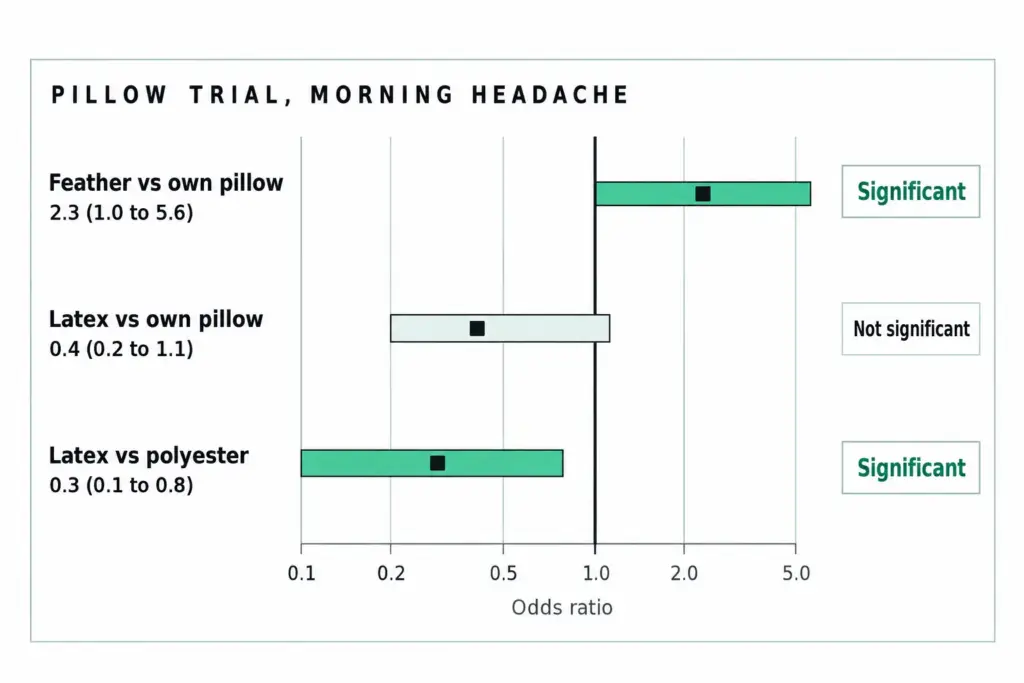
Latex went the other way. Against the own pillow its odds ratio was 0.4 (0.2 to 1.1), which looks like fewer headaches but crosses 1.0, so the authors could only call it an emergent effect. Against the polyester pillow it was 0.3 (0.1 to 0.8), and that comparison passes.
So the careful reading is small: feather looked worst, latex looked better, and only one latex comparison clears the bar. That makes latex a poor reason to throw out a pillow that is working. If you want to know how these pillow fills age once the novelty is gone, what each fill does by month six is the place to look.
What the Authors Could Not Say
The paper is short on the part most readers want. In the paper’s discussion, the authors state: “Our study could not determine the anatomical mechanisms underlying waking headache, stiffness or scapular/arm symptoms.” The link is measured. The reason is not known, and this article draws no reason of its own.
The second limit is who was in the room. Healthy side sleepers, no spine problems: the trial says nothing about anyone whose headaches are a condition rather than a bad night on a pillow.
What survives is its structure, and it is the useful part. The sleeper’s own pillow was one arm of the trial, so the study could only say “better or worse than what people already slept on.” That is the comparison you can run at home with nothing but your bed and a week. The other common path is going through a bunch of pillows in a single year, spending money each time, with nothing to compare any of them against.
Where the Pillow Presses and When the Ache Arrives
The study ended on a question without an answer, so this section leaves it and goes to the bed: two things you can note about your own mornings without any theory, where on the head the pillow was pressing and how long the ache stayed.
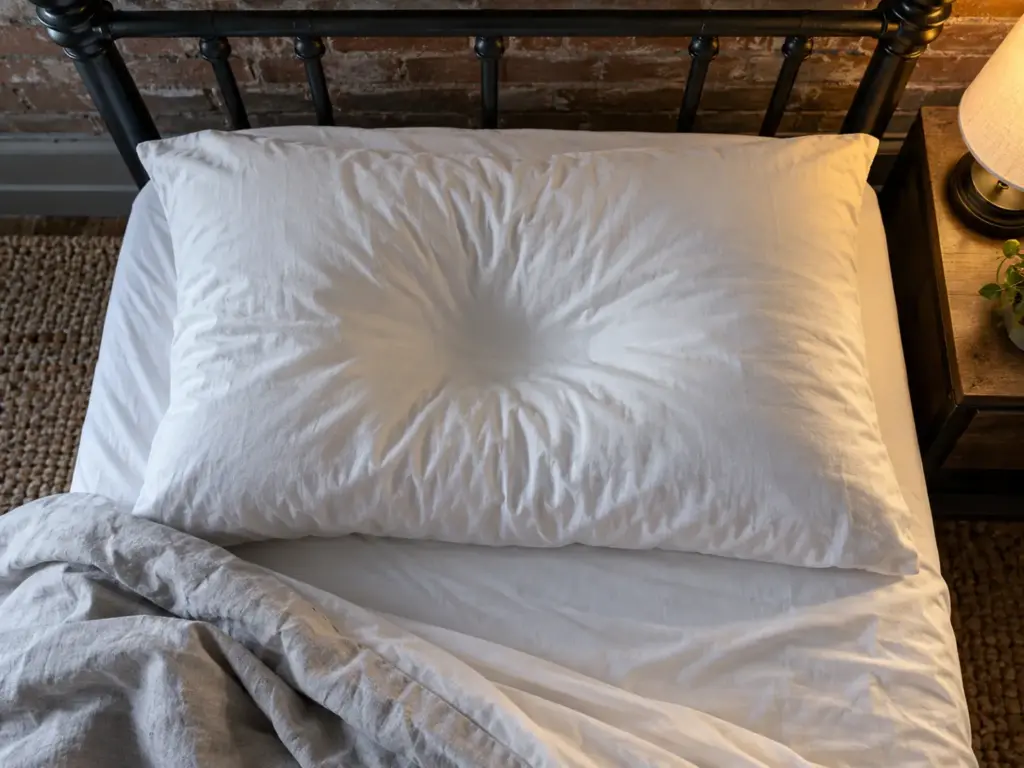
Where on the Head
The place of the pressure is the useful detail. Treat it as a cue for what to write down, not as an explanation. When you wake, before you move, note where the pressure sat: the base of the skull, behind one ear, across the crown, or nowhere at all. Nowhere counts as an answer too.
The thing people actually remember is the pillow’s mark, a crease on the cheek or a line behind the ear, and it is gone by breakfast.
Firmness belongs in this log with a limit attached. The trial measured headache and did not measure firmness, so there is no basis here for saying how firmness at the skull works. What you can say is that height and firmness are separate properties of a pillow, and why loft and firmness need two numbers explains how to read each one.
Keep a notebook or the phone on the nightstand and write the day’s line before your feet touch the floor. By the time breakfast is made, the pillow’s mark is gone and the memory has already been tidied into something it was not.
When It Starts and How Long It Lasts
The trial’s diary sorted symptom length into three boxes: an hour or less, half a day, all day. Your log can use the same three.
One line per morning is enough: which pillow, which night of the week, where the pressure sat, and which box. Add whether you slept on your side, back or stomach, since the trial’s sleepers were all side sleepers and you may not be. Nothing else. No scores out of ten, and no guesses about cause, because a guess written down tends to be read back a week later as a result.
Why One Night Proves Nothing
Go back to the 19.6 percent. On their own pillows, before anything had changed, about one sleeper in five woke with a headache. A single bad morning could be the pillow, and it could be the other nights’ ordinary noise; a single good morning proves just as little. A pattern needs a week of lines, and a pillow earns a verdict only after it has been compared with the old one.
Which Fills Hold Their Shape (and the Fold Test)
A pillow that tested fine in spring is not the same pillow in autumn, and the fill is what changed. So before a week-long test starts, the pillow itself needs thirty seconds of looking at, for what age has done to it.

Why “Replace Every Two Years” Is the Wrong Clock
The retailers who give a lifespan for each fill do not agree with one another, and none of their figures comes from a neutral measurement, so this article offers no number. Shape is the better clock. Replace a pillow by its fill and not by the year goes through it fill by fill, and the rule underneath is simple: a pillow that has kept its shape can stay, and one that has lost it needs replacement, whatever the date on the tag.
The other clock leads back to the store. Very soft pillows often go flat quickly, and each flat one sends you back to the store for another. That is a pattern from one person’s year, not a measurement, but it matches how the cycle runs: buy, flatten, buy again, and never test anything for a week.
The Fold Test, in Three Motions
Fold the pillow in half and press the air out. Let go. Watch what it does. A pillow that opens up again has kept its shape; one that stays folded, or opens slowly and leaves a crease, has not.
The longer version, with the tables, is fold it before you replace it, and it is the same check whether the pillow is nine months old or nine years.
What the Pillow Remembers
Fill leaves three kinds of evidence: a lump, a hollow, and an edge that has gone soft. The lump is the one you feel before you see it. A clumped fill can feel like rocks under the head, and that is exactly what some sleepers describe.
The flat spot is not always in the middle. It sits where the head lands, which is why a pillow can look plump from the doorway and be flat where it matters. The loft you sleep on is the one at that spot, not the one printed on the tag.
Crouch so your eyes are level with the mattress and look at the pillow from the side before you plump it. Plumping hides the hollow for exactly as long as you are looking.
A Fair Test: One Pillow, One Change, One Week
The trial gave the structure, seven nights per pillow and a week on the old one between trials, and you can borrow it without a lab. The idea is that only one thing in the bed changes at a time, or the result means nothing.
Free Changes First
Before buying anything, there are changes the house already allows. Flip the pillow. Move it up or down the bed so the head lands somewhere else on it. Take the second pillow out, or stack one you already own.
Each of these is one change, and the word to hold onto is one: a new protector, a pillow flipped and a different sleeping position in the same week gives you three suspects and no verdict.
One Change, Seven Nights, Then a Week Back on the Old Pillow
Give the change seven nights and fill in the log from the last section each morning. Then go back to the old pillow for a week. That week is the step everyone skips, and it is the one that makes the next comparison honest.
Compare each change against your own pillow, not against your memory of the last one, because memory of a pillow is a poor instrument. That was the trial’s own comparison. For height, the tables live in our guides: pillow height for side sleepers, set by the shoulder if you sleep on your side, or neck pillows for back sleepers if you sleep on your back.
If the log shows no difference after two changes, the pillow was probably not what moved, and that counts as a result too. The next section says who to ask.
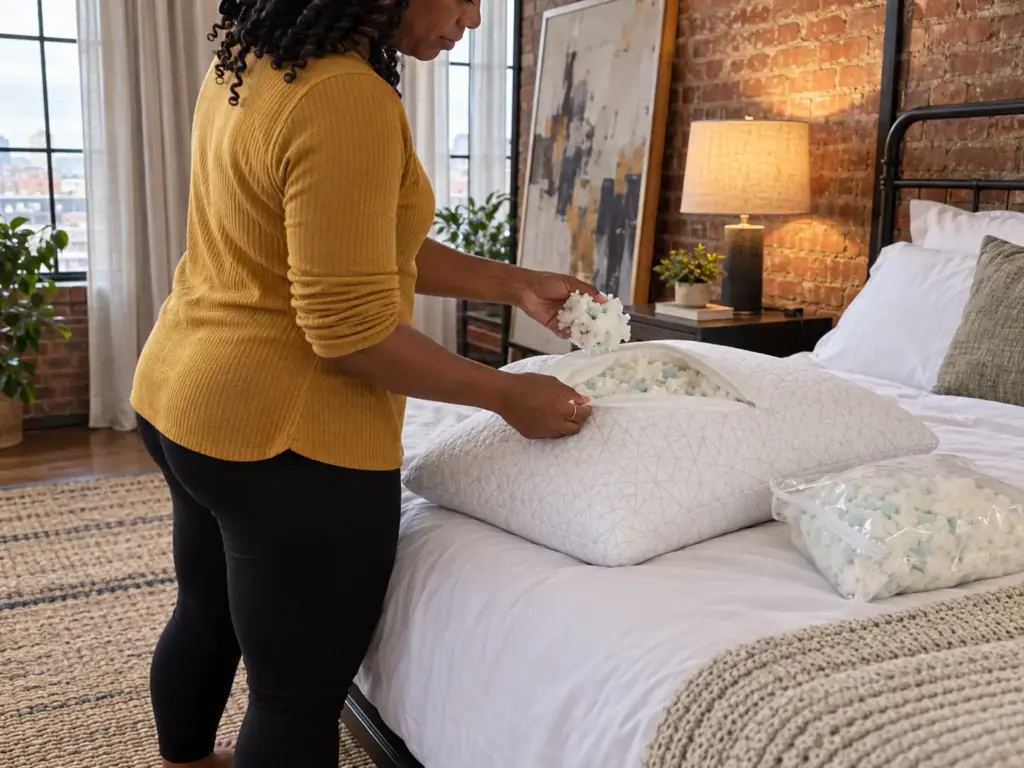
The Fill You Can Change Without Buying a Second Pillow
A second pillow is the usual way to change height, and it brings a new fill, a new shape and a new smell along with it. The Coop Home Goods Original Adjustable Pillow, Queen avoids that: it is stuffed with cross-cut memory foam and microfiber, and a bag of extra fill comes in the box, so height becomes a quantity you add or take out between weeks. The listing gives the blend as 76 percent viscoelastic polyurethane foam and 24 percent polyester gel fiber, in a queen that measures 19 by 29 inches. It is a way to run the test, not a treatment, and it earns its place only if the free changes above settled nothing.
The catch sits in the reviews. Amazon’s summary of them says several customers report an awful smell, a topic with roughly 3.7K mentions. That is an aggregate rather than any one buyer’s account, so how strong the smell is and how long it lasts is unknown. A smell is also a second thing changing in the bed, so unpack the pillow and let it sit for a few days before night one of the test.
When you change the fill, move it by a small handful in or out, not by a pillow’s worth. A big jump shifts height and firmness together, and you are back to two variables.
When It Isn’t the Bed: Signs to Bring to a Doctor
The test either moves the log or it does not, and this section is the other half of that answer: signs no pillow can settle, handed over in one block and in the words of the people who treat them.

Mayo Clinic’s Q&A on headaches that should never be ignored includes this one: “Headaches that wake you from sleep or are present when you wake up.” That is a reason to book a visit, and the visit is the answer; no log and no pillow settles it first. The same Q&A names headaches that become more frequent or progressively more severe, and headaches that do not improve with over-the-counter medication.
Mayo’s guidance on headaches sends people to an emergency room, or to 911, for any of these:
- the worst headache of your life
- a sudden, severe headache
- a headache with confusion or fainting
- a headache with numbness or weakness on one side
- a headache with trouble speaking or trouble walking
- a headache with a stiff neck
The trial drew the same fence from its side: its people were healthy side sleepers with no spine problems, so it cannot say what a pillow does for anyone with a headache disorder.
What the bed can still do is keep the record. A week of mornings in writing, with place, timing and which pillow, gives an appointment something firmer to start from than “it’s been a while.” And for telling the pillow apart from the rest of the bed, when it’s the pillow and when it isn’t picks up where this section stops.
What to Change Tonight, and What to Look At in a Month
Three things carry over from all of this:
- The link between pillow type and waking headache is measured but unexplained: feather looked worst, latex looked better, and the authors did not know why.
- A morning log of place and timing, plus one change at a time for seven nights, is how you settle the question in your own bed.
- Anything on the last section’s list is not a pillow question.
Then comes the check for later. A month after the test, look at the hollow under your head once more and compare it with the one you started from; a hollow that has deepened means the fill is still losing its shape.
For tonight, pick the one free change that seems most likely to matter, such as the second pillow, make only that one, and before you get up tomorrow write a single line: which pillow, where it pressed, how long it lasted. The full guide to pillow height and neck pain covers the numbers behind that choice, and the same question for back pain works through the mattress side of it.
Frequently Asked Questions
01Can the type of pillow change how often you wake with a headache?
One 2010 trial found feather pillows linked to more waking headaches than people’s own pillows, and no pillow to be clearly protective. The authors could not say why. Latex looked better, but only against the polyester pillow did the difference hold.
02How long should you test a pillow before deciding?
Test each pillow for seven nights, then spend a week back on your old pillow before trying the next one, as the trial did. One night tells you very little. A short morning log of the pillow, where it pressed and how long the ache lasted is your record.
03How do you know if your pillow is too high?
Look at it from the side, at mattress level, with your head on it: the neck should not bend up or down. Height tables for each sleeping position are in the neck guide.
04How do you know when a pillow has gone flat?
Fold it in half and let go: a pillow that stays folded, or has a hollow where your head lands, has lost its shape. Replace it by shape, not by year. The fold check has the full steps.





Tried it on your own bed?
No comments yet. Tell us what you changed, and what the sheet did after a few washes.