



What’s in here7 sections
- Why Affordable Pillows for Neck Pain Fail at the Gap Under the Neck
- What “Cervical” on a Cheap Pillow Label Actually Promises
- How a Cheap Fill Loses the Lump Your Neck Sits In
- Budget Neck Pillows Worth a Towel Roll Test, With Their Flaws
- When the Pillow Isn’t the Problem, and Who Takes Over
- Roll First, Fill Second, Spend Last
- Frequently Asked Questions
You wake with your head sitting at a perfectly fine height and your neck hanging in the air beneath it, on a pillow that cost little and said “cervical” on the package. A pillow has two jobs: it holds the head at the right height, and it fills the space under the neck. A budget pillow usually does the first and leaves the second to chance.
This guide sorts the affordable pillows for neck pain worth testing. The neck guide handles height; this one starts at the gap under the neck and a free towel test for it, then reads what “cervical” on a label proves, shows how a cheap fill loses its shape, gives three picks with their flaws, and ends where the bed stops being the answer.
Quick Answer
A cheap neck pillow fails at the one spot a price tag cannot show: the gap under the neck. Test that gap for free with a rolled hand towel, judge it by the second morning, and spend only on a fill you can shape into it. The fill decides, not the price band.
Why Affordable Pillows for Neck Pain Fail at the Gap Under the Neck
Most pillow shopping starts with pillow height, and height deserves the attention. The head has to sit level with the spine, and for a side sleeper the shoulder sets the height. But the neck is a separate span with a need of its own, the neck support point that a pillow tuned for head height leaves unmet. Between the base of the skull and the top of the shoulder there is a curve, and a pillow tuned only for the head leaves that curve hanging over a hollow.

Head height is one job, the support under the neck is another
A sleeper can have the right height at the ear and still wake with the neck bridging an empty space all night. The two jobs do not trade off: a pillow that is perfect for the first can be useless for the second, and the reverse is true as well.
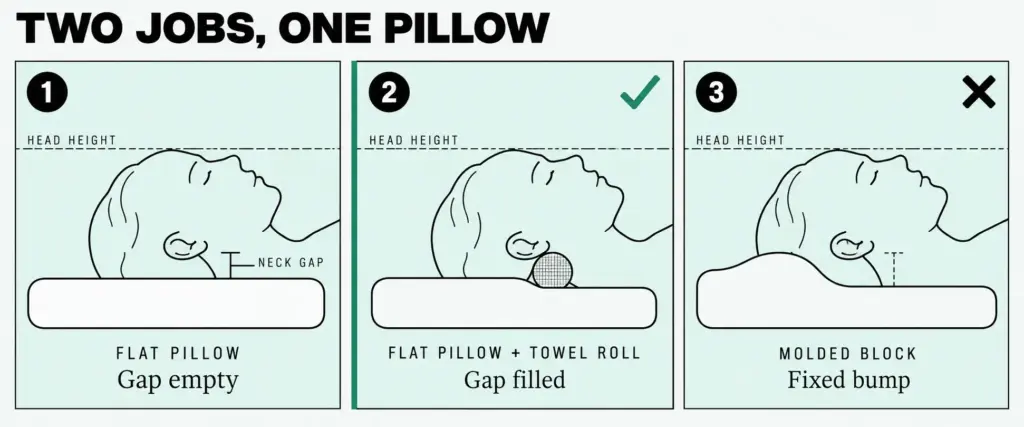
Some sleepers put the zone in plain terms: the neck wants a lump of pillow under it, with the head in a depression, so that it stays in the proper alignment. That is the whole specification for neck alignment.
A physical therapist’s guide on Spine-health says the same thing from the other side: for side sleepers it pairs a rolled towel or roll-shaped pillow under the neck, “supplemented with a pillow for the head.” The neck’s support is a second piece. It is not a bigger pillow.
The reflex fix for a hanging neck is more height, and on a flat pillow that makes the problem worse. A taller stack lifts the head further and the hollow stays a hollow. A cheap rectangle of uniform fill presses to one height across its whole width, and the dip under the neck is a different height from the dip under the skull. Nothing in that shape knows the difference, which is why a pillow can be the right thickness and the wrong pillow.
You can feel the gap on the pillow you own. Lie on it the way you sleep and slide a flat hand under your neck. Fingers that pass through easily are touching air, and the neck has been resting on nothing for as long as you have used that pillow.
On the side the hollow is wide, because the shoulder stands off the mattress, and the wider the shoulder width, the deeper the hollow. On the back it is shallower, which is one reason a pillow can suit a back sleeper and fail the same person after they roll over. The test below works for either position, and the result is only as honest as the position you sleep in most. Morning stiffness is what you are comparing at the end of it, not the first lie-down.
The towel roll that tests it for free
Before any purchase, build the test. A hand-sized bath towel, folded lengthwise and rolled firmly, should come out 3 to 5 inches across (the measurement comes from chiropractor Steven Yeomans on Spine-health).
It should feel like a firm bolster, not a loaf. Think of it as a homemade neck roll. Lay it so it fills the hollow under the neck while the head stays on the pillow you already own.
This is a test of the bed, not a treatment. It answers one question: does support in that exact zone change what the mornings are like? If it does, you now know what a replacement pillow has to do, and you know it before spending a cent. If it does not, the pillow was never the variable, and that is worth knowing too.
Change one thing at a time. A new roll and a new pillow in the same week make it impossible to say which one did anything, so the roll goes under the neck beside the pillow you already own, and the pillow stays the same until the roll has had its answer. A towel also has a virtue no purchase has: it can be thickened by one more fold or thinned by one fewer, so you can find the size that works in an evening instead of in a return window. Combination sleepers in particular end up wanting two rolls of slightly different thickness, one for nights on the back and one for nights on the side, which is a hint that the pillow they buy should be one they can reshape and not a block with a single answer.
Read the roll by the morning, not the first lie-down
The first lie-down on a new towel roll feels fine at almost any size. A roll that is too large feels like support for the first minute, then shows what it is doing by the second or third morning. Spine-health warns off a towel that is too large, because a roll that is too big or too high can overextend the neck, the same kind of failure as a pillow that is simply too thick. So build it at the smaller end of the range, give it two or three nights, and read the result in the morning.
Reading it takes one line of attention. On each of those mornings, compare how the neck feels on getting up with how it felt on the old setup, and write the word down before the day starts, while the comparison is still fresh. Memory rounds toward whatever you expected, and a roll you built yourself is a roll you want to work. A written line from the first morning and another from the third is a better judge than the afternoon’s impression, and it keeps the test about the bed and not about hope.
Start the roll near 3 inches across, not 5. A roll that is too big feels like support the first night and reads as a problem by the third morning, and a thin roll is easy to thicken with one more fold of the towel.
What the result tells you matters more than the roll itself. When the roll under the neck changes the mornings, the pillow you need is one whose fill can be moved into that zone, which is exactly what the next two sections are about. When nothing changes after a fair few nights, the pillow is not what is deciding the morning, and the last section of this guide is where to look next.
What “Cervical” on a Cheap Pillow Label Actually Promises
Once the neck’s support point has a name, the words that claim to handle it turn up on pillows at every price: cervical, orthopedic, contour, “neck pain relief.” None of them is a measurement. Each describes a shape or a hope, and a buyer can check most of what they cover without opening the box.

A contour is a fixed shape and your neck is not a fixed size
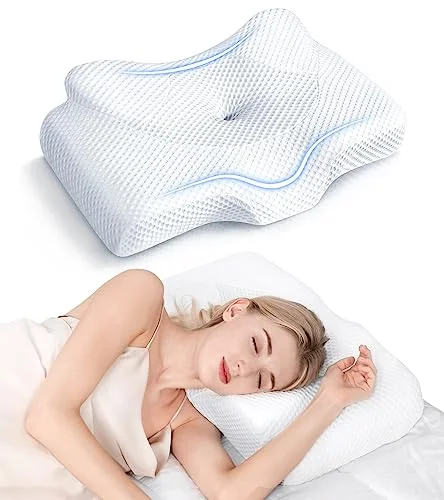
A contoured pillow is one shape with one rise. The neck zone it was cut for is an average one, and the real distance from skull to shoulder, and the real depth of the hollow, differ from person to person and change with how the person lies. Contour pillows for back sleepers have their own failure, a rise that forces a chin tuck, covered on its own page. Here the point is simpler: a rise that was cut for someone else’s neck lands in the wrong place on yours.
Scroll the cervical listings at the low end of the price range and the same outline keeps appearing: a dip for the head, a rise for the neck, sold under a dozen different names. A new brand on the front of the box does not mean a new shape inside it. That is why comparing cervical pillows by name gets nowhere, and why comparing them by what you can measure (the height in inches, whether the fill is named, whether any of it can be removed) gets somewhere.
Turning a pillow over for a second height is a version of the same shape, not a fit. The Osteo pillow, hollow-centered memory foam, flips 180 degrees between 5.2 and 4.1 inches. That is two fixed options. Two options on a number the pillow cannot see is a choice between two guesses, and the number that matters, how deep your hollow runs, is on neither side of the flip.
The molded block keeps its rise exactly where the factory put it. A neck that does not line up with it does not find out the first night, when any new foam feels like relief, but on the second morning.
What the printed note says and the title does not
Osteo’s listing title calls it a “Cervical Pillow for Neck Pain Relief.” Its own printed note says “This product is not for medical use and cannot treat diseases.” The label disagrees with itself, and the second statement is the one a buyer can rely on. A pillow is a pillow, and the word on the front describes a shape and a hope, not an outcome.
What did happen on beds is the better evidence. Amazon’s review summary, generated from the reviews and not a quote of any one of them, says opinions on firmness are mixed, with others saying “it’s too hard.” That is a pillow doing what a fixed hollow does: it suits the neck it happens to match and not the rest. The same skill of reading a label for what it names, and what it skips, is the subject of what the firmness labels actually name.
A listing can contradict itself in more places than the title. One TEMPUR-Neck listing says its pillow is for “side and back sleepers” in the text and “Back and Stomach Sleepers” in its own comparison table, which is a reason to read the whole page before trusting one line of it.
Four things on a listing can be checked without opening the box, and they say more than the badge on the front:
- A height printed in inches, not a size word like “standard”
- The fill named: shredded foam, one solid piece, fiber, or a mix
- Whether any of the fill can come out, and whether a spare bag is included
- A trial period, with the terms on the page
A listing that gives none of the four has told you everything its label is willing to say.
Foam certificates need the same reading. CertiPUR-US covers what the foam is made of and what it breathes out: no formaldehyde, ozone depleters or regulated phthalates, and low VOC emissions. That is useful for the room. It says nothing about how high the pillow holds the head or where it supports the neck, so a certificate on a neck pillow answers a question nobody asked about shape.
A fill you can move is the cheaper way to a custom shape
A custom-molded pillow is built to one neck and costs accordingly. The budget route to the same idea is a fill you can add to or take out. Loose shredded foam, or foam mixed with softer fiber, can be pushed into the hollow under the neck, pulled out of a spot that rides too high, and topped up from a spare bag. That is the whole mechanism: height and neck fill become settings instead of facts printed on a tag.
It has a catch the next section is about. Loose fill is a material, and materials differ in how well they hold the shape you gave them. A fill you can move is only worth having if it stays moved.
There is also a cost that a molded block does not have: the lump needs rebuilding. Pushed into place on Monday, it spreads a little under a sleeping head by Friday, and a minute with the hands puts it back. For a sleeper who wants to set a pillow once and never touch it again, that minute is a real drawback and the case for a solid block gets stronger. For a sleeper who is still finding the setting, the minute is the price of a pillow that can be changed to fit a neck that nobody has measured yet.
How a Cheap Fill Loses the Lump Your Neck Sits In
An adjustable fill can be shaped into the zone the first section described. A fill is also where the budget version of a shaped pillow gives out, so this section is about what the knockoff loses.
The knockoff that looks the same and holds less
The same failure shows up again and again with budget pillows. Cheaper knockoffs often fall short on this, and the price tag is not the whole story.
The knockoff pillow matched on the listing words, shredded memory foam, adjustable, queen, and differed where a listing cannot show it: how fast the fill comes back after a head leaves it, and how long it keeps the lump it was given.
That makes the failure one of recovery. A pillow whose middle compresses and returns slowly, or not at all, has lost the thing that made it worth adjusting. The mechanism behind it is the subject of shredded versus solid memory foam: loose pieces move when pressed, and they move away from where the head presses, so a lump built under the neck migrates toward the sides over weeks. That fill shift is the slow part of the failure.
Not every budget pillow fails, though. A Coop owner writes that “it’s worth it to me to spend more on one that’s lasted for a couple years.” The spender and the saver are describing one problem from opposite ends: the money is for the fill’s staying power, not for the label.
What the review summary names, and what it can’t
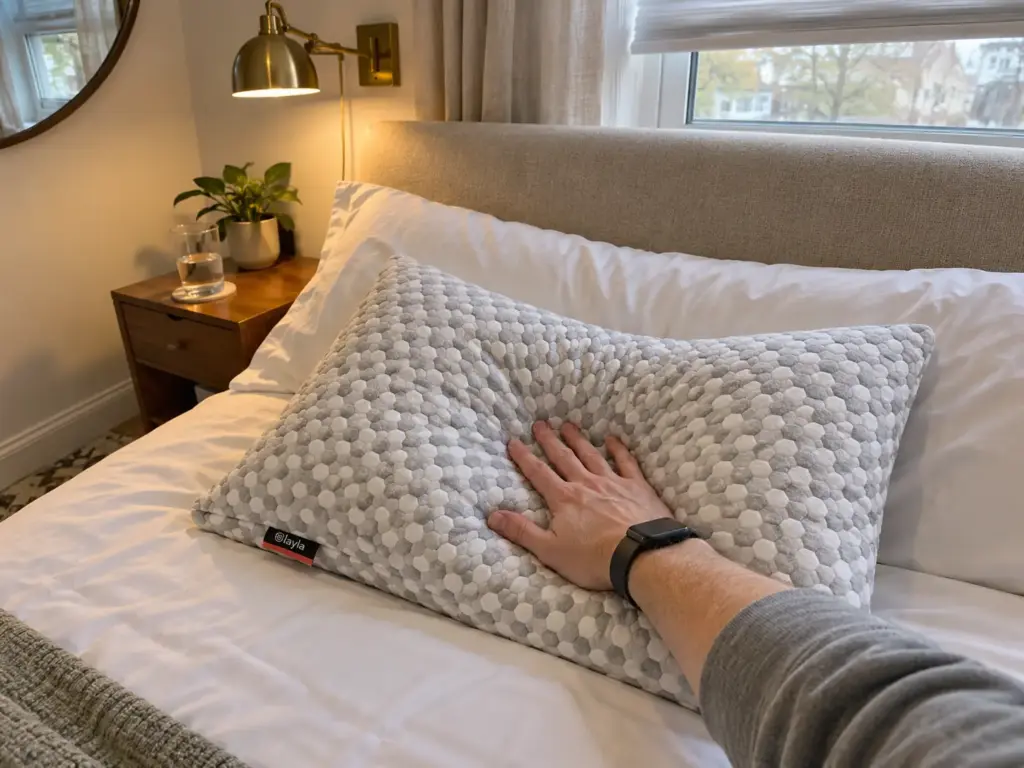
The Layla Sleep Adjustable Fill Kapok Pillow shows the failure in a listing. It is shredded memory foam mixed with kapok fiber, sold as a King in one piece, shipped overstuffed so you remove fill to set the loft. Amazon’s review summary, a machine summary of the reviews and not a quote of any one, says it “doesn’t maintain shape after 6 months and becomes very flat.” A summary cannot say how each pillow was kept or washed, so read it as a pattern to test for, not a verdict.
But the pattern matches what usually goes wrong, and it is the same loss: the lump a neck needs is the first thing a tired fill gives up, because it is the part of the pillow that carries a point load while the rest of the pillow carries a spread one.
It is also the part you cannot see go. A pillow can look full from across the room and have lost its middle, which is why the check below is a press and not a glance.
Compression is the other end of the same problem. The Coop arrives compressed, Business Insider’s reviewer reports, and takes about ten minutes of hand-fluffing, or about ten in the dryer, before the loft is real. The first lie-down on it is not the pillow you will sleep on. Fluffing, and which fills it can fix is worth reading before a return, because a fill that looks flat out of the bag and a fill that has gone flat after months are two different problems.
The first-week press test and the 100-night trial
The check is free. Press the middle of the pillow with a flat hand, let go, and watch. A fill that comes back and keeps the lump you built is behaving. A pillow that holds the dent is the failure in the making, and it is easier to find in the first week than in the sixth month.
Build the lump, press the middle flat with your hand, and check it again after a night of sleeping on it. A fill that has not recovered the lump by then is the fill that will have gone flat by the time the trial ends.
Press it again on the third morning, in the same spot, and compare the two presses. A fill that returned at once the first time and drags the second time is telling you the same thing the six-month complaint tells in advance, only sooner and for free. Do it before the trial window closes, while a refund is still a form and not an argument.
The trial is the safety net for the fill. The Coop lists a 100-night sleep trial and a five-year warranty, and 100 nights is long enough for the fill to settle, which is the test the whole article is about. Whether that guarantee follows the pillow when it is bought on Amazon is a line to read on the listing itself before ordering. And a trial has limits: what a return window can and can’t test is covered in its own guide, including the nights a return cannot give back.
Budget Neck Pillows Worth a Towel Roll Test, With Their Flaws
With the gap, the label and the fill failure on the table, the picks are the pillows that pass the towel test in different ways: a fill you move by hand, a cheaper version of the same idea, and a molded block that keeps its shape by design. Each comes with its flaw, so a cheap pillow for neck pain is judged on what it gives up as well as what it holds.

The pick whose fill you can move by hand
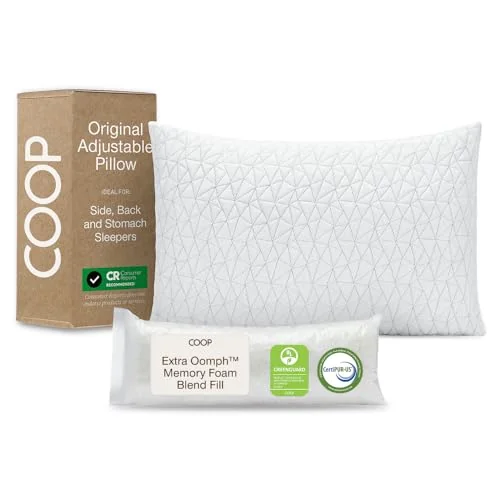
The Coop Original Adjustable (Queen, 20 by 30 inches) is the one pick here designed to have fill taken out and put back. It is cross-cut memory foam, 76 percent, with 24 percent polyester gel fiber, and an extra bag of fill in the box. That bag is the point: loft is set by how much fill you keep, and the bag is the only way to put some back.
Business Insider’s reviewer, who shared one pillow design with her husband, wrote that the two of them “could buy the same pillow and get a comfortable custom feel.” For two sleepers with different needs, that is the answer in structure: one product, two fills, two settings.
What it costs you is heat and shape. The same reviewer found the memory foam “felt a bit hot,” and the pillow does not give the full, rounded loft of a hotel pillow however much fill you add or take out. It also needs the ten minutes of fluffing described above before the first night.
The cheaper version of the same idea
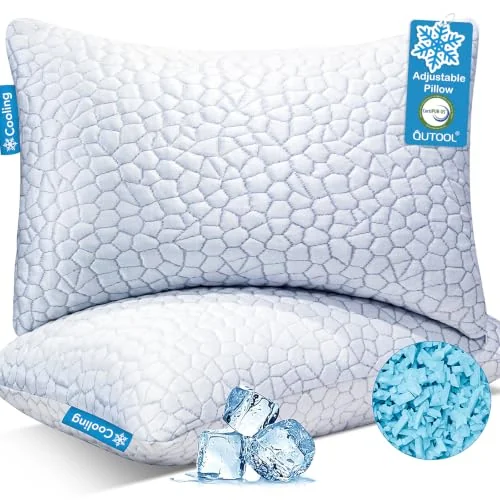
The QUTOOL Cooling Pillow (Queen, set of 2) runs the same fill logic in the cheaper band: 85 percent cross-cut memory foam and 15 percent soft microfiber, in a cover that is 60 percent polyester and 40 percent rayon from bamboo. “Cooling” in the name is a label, not a measurement: the cover is polyester and rayon, and the foam underneath is the same kind of foam as any other, so judge it by the fill, which is the part that does the work. Two pillows in the set also means one for each sleeper, or a second to test against.
Smell is the complaint. Amazon’s review summary, again a machine summary and not a set of quotes, says “some report an awful smell.” An odor is a first-days problem, aired out before you judge the pillow, and it is not the same failure as a fill that loses its shape. But it belongs in the decision, because a pillow you cannot stand near the face fails the test as surely as one that goes flat.
The molded block, and when it is not worth the difference
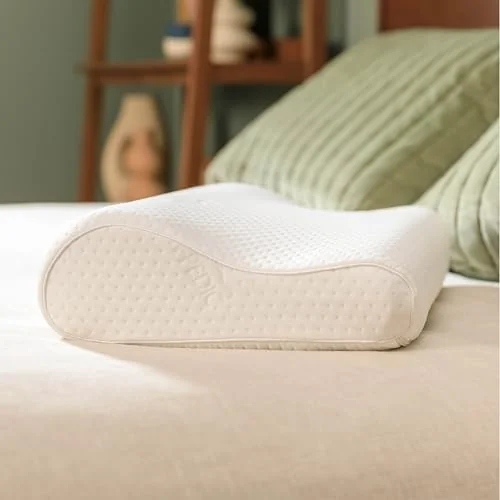
The TEMPUR-Neck Medium Profile (2-pack) is one piece of TEMPUR material, extra firm, listed at 3 to 4.75 inches high. It keeps its shape by design, which is the exact failure the fill sections are about, and it is the reason this is the pick that costs more. Molded neck pillows are said to last a few years.
Fit is where it slips, and the listing shows it. The product text says the pillow suits “side and back sleepers” and the comparison table says “Back and Stomach Sleepers.”
Amazon’s review summary says several buyers found it “too small or too large around the neck.” That follows from a fixed block: its one bump is right for the neck it matches and wrong for any other. Fixed-block pillows also have no fill amount to adjust, so the towel test has to be done on the first night with the pillow itself.
The obvious pick stops being obvious here. The molded block that costs more looks like the serious answer. When the thing being tested is a fill, the cheaper memory foam pillow does the same job: it moves, it stays moved, and it costs less to find out.
The molded block earns its place only if the towel roll says a fixed bump is what the neck wants. For what a cheap fill gives up over the months, the affordable side-sleeper guide takes it further, and what each fill does by month six is the wider map.
Run the towel test again on the new pillow’s second morning, not its first, and do it while the trial window is still open. The second morning is where a lump that is too high, or a fill that will not hold, shows up.
| Pillow | Fill | Can you move the fill | The flaw |
|---|---|---|---|
| Coop Original Adjustable | Cross-cut memory foam and gel fiber | Yes, with a spare bag | Runs warm; arrives compressed |
| QUTOOL Cooling Pillow | Cross-cut memory foam and microfiber | Yes | Some report an odor |
| TEMPUR-Neck Medium | One piece of molded foam | No, fixed shape | Listing contradicts itself on who it suits |
When the Pillow Isn’t the Problem, and Who Takes Over
The roll, the label and the fill all assume the bed is the variable. This section lists what to rule out in the room first, then says where the bed stops being the answer.

The free changes that come before another pillow
Free first. The towel roll from the first section costs nothing and comes before any replacement. Folding or fluffing the pillow you already own, before you replace it, can fix a fill that has simply bunched. And keep the old pillow in reach as a baseline: the same two mornings on the old pillow and the new one tell you more than any description of either.
Switch back to the old pillow for two mornings before deciding the new one is better. A change that fixes the mornings shows in the first week; one that keeps almost working for a month is usually not the pillow.
The mattress and the room
Other answers point at the room around the pillow, such as monitor height pulling the head forward. The mattress under the shoulders is the other thing to rule out before a third pillow in a year. Those are things to rule out, not a diagnosis, and they cost nothing to check. The headache case has its own page: pillow headaches, and when it’s the bed and when it isn’t.
When you do want another pillow, the next step is on the pillow side: measure the loft by sleep position instead of guessing.
Where it stops being a bedding question
Knowing when to see a doctor starts with a short list.
Some things are not bedding questions at all: numbness or tingling into an arm or hand, neck pain after a fall or a hit, a stiff neck with a fever, or weakness. Those go to a doctor, and the pillow waits. The same goes for pain that does not move after the free changes above have had a fair run. Mayo Clinic’s neck pain guidance names the threshold: pain that “Persists after several weeks of self-care.”
A pillow cannot answer that, and neither can this page.
Back to the bed, where the work is.
Roll First, Fill Second, Spend Last
Three things carry the whole page. The gap under the neck is a separate job from head height, and a pillow that does only the first is the common failure. The fill decides a cheap pillow, not the price band, so what you are paying for is how well the fill holds the shape you gave it. And the free test comes first: the rolled towel costs nothing, and it tells you what to buy before you buy it.
Later, press the middle of the pillow after a few weeks of nights. If it has gone flat in the center and stays that way, the lump is gone and the pillow is doing the head’s job alone again.
For tonight, roll the towel to about 3 inches, set it under the neck beside the pillow you own, and notice what the second morning is like, not the first.
Frequently Asked Questions
01What is the best pillow to use for neck pain?
The best pillow is the one whose height fits your shoulder and whose fill can be shaped into the gap under the neck. The neck guide covers the height side; the towel roll covers the gap.
02Is there a neck pillow that actually works?
A neck pillow does what its fill and shape allow, and the word cervical on a label proves nothing about height or support. Test any pillow with the towel roll first, and judge it on the second and third mornings.
03Is a cheap adjustable pillow good for a stiff neck?
A cheap adjustable pillow can work as bedding when the fill can be moved into the gap under the neck and keeps its shape. The knockoff that goes flat is the failure to avoid; the press test in the fill section checks for it.
04How long should I try a new pillow before I decide?
Judge a new pillow by its second and third mornings, not the first lie-down. Fluff a compressed fill before you start, and read the return window on the page you bought from before you begin.
05Is a cervical pillow better than a regular one?
A cervical pillow is a fixed shape cut for an average neck, so the question is whether that shape matches yours. The label alone does not say. A pillow with a fill you can move lets you test the fit.





Tried it on your own bed?
No comments yet. Tell us what you changed, and what the sheet did after a few washes.