


What’s in here8 sections
- Two Ways a Pillow Goes Wrong Under a Back Sleeper
- The Pillow Change That Came First
- The Mattress Sets the Shoulders, the Shoulders Set the Head
- The Rise Under the Neck Against the Dip Under the Head
- Two Pillows Worth a Fair Run
- When It Stops Being the Pillow
- Put the Old Pillow Back Tonight, Then Judge by Height
- Frequently Asked Questions
You changed pillows a few weeks ago, the new one felt right for a night or two, and now your neck is stiff before you are out of bed. For back sleepers the pillow fills the gap behind the head, and because there is no shoulder to lean on and no mattress catching the side of the head, nothing corrects its mistakes: too tall and the chin tips toward the chest, too soft and the head slips off center. A stiff neck can trace back to the week you started trying new pillows, one after another, so the first step with this kind of stiffness is the timeline, not a shopping cart. This guide covers how to tell which way your pillow is failing, what to undo before you spend anything, and the two adjustable pillows worth a fair run.
Quick Answer
A back sleeper’s pillow comes down to one measurement: how high it holds the head above the mattress, all night. Too tall tips the chin toward the chest; too soft lets the head sink and roll. Put the last pillow you changed back on the bed before you buy anything new.
Two Ways a Pillow Goes Wrong Under a Back Sleeper
Lying on your side, a pillow has a shoulder to work against and a mattress to catch the head. Lying on your back, it has neither.
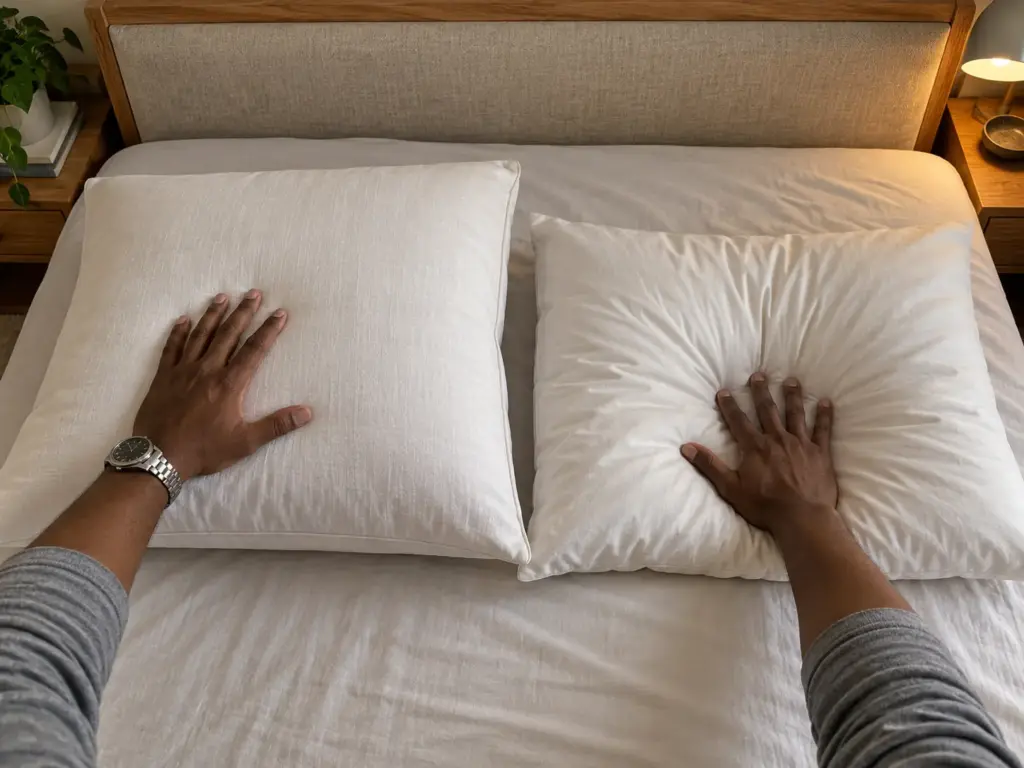
Whatever height the pillow holds is the height of your head for the whole night, and it can miss in two directions: the head propped too far forward, or the head slumped and drifting off the middle. What you want is neck alignment in the plain sense, a neutral neck, the head level with the spine and neither tipped forward nor dropped back, and a back sleeper’s pillow is the only thing deciding that. The cure for one tends to cause the other, because the fill you add to stop the slump is the fill that lifts the chin.
The general version of this problem, for every sleeping position, is in the pillar on whether a pillow is too high or too flat; this page is about the one position with nothing to lean on.
Too tall: the chin tips toward the chest
A pillow that is too tall props the head forward, and the chin ends up closer to the chest than the neck would choose by itself. A 3-star reviewer of a contour pillow described the higher of its two edges the same way: it “still keeps your head up too high pushing your chin into your neck.” That is a reviewer’s description of a feel, not a measurement, but it matches what the measurements say.
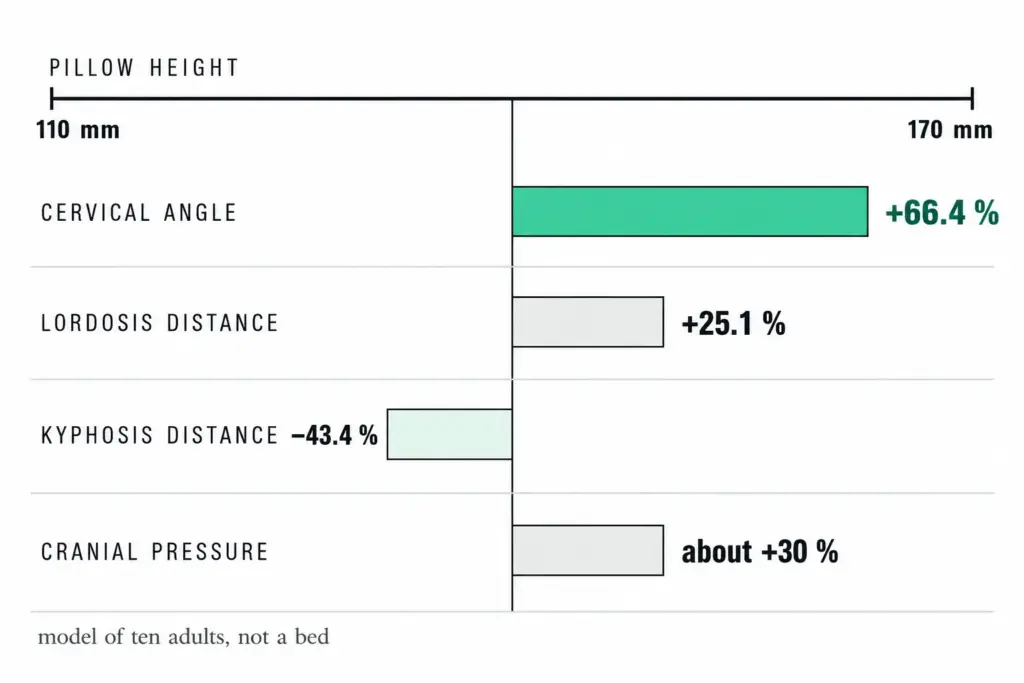
A 2016 PeerJ study built a computer model from ten healthy adults and raised the pillow under it in steps. Going from 110 mm to 170 mm (about 4.3 to 6.7 inches), the modeled cervical angle rose 66.4 percent and the pressure on the back of the head rose about 30 percent.
Treat those as numbers from a model, not from a bed: nobody slept on anything, and three of the paper’s six authors are employed by Infinitus, the maker of the pillow shape tested. The direction of the trade is still worth keeping, though. Height buys a more bent neck and a harder press at the back of the head, and you pay for both at once.
A table in a 2021 review of the pillow-height literature adds a reason this is so common. Summarizing an earlier study of pillows on the shelf, it says they “were too high for the supine position and too low for lateral positions.” A pillow shaped around the side sleeper arrives tall for the person lying flat. If the stiffness started the week you moved to a thicker pillow, when it’s the pillow and when it isn’t separates a wrong height from a pillow that simply needs a few nights to settle.
Too soft: the head sinks, then rolls
Softness is the other lever. Think of pillows as having two attributes, softness and height. If you sink into the pillow, your head won’t flop around. The pillow that cups the head is doing its job. The pillow that gives way is not the same thing.
A soft pillow that is also low, or has lost some of its fill, keeps yielding until the head sits near the mattress with nothing rising at either side to hold it in the middle. At that point the head roll begins: the head goes wherever it leans, and it leans toward whichever side the room, the partner or the last turn of the night has favored. The head that flops to one side is the pillow giving way; the chin that sits on the chest is the pillow holding too well. Same night, opposite faults.
Why one number is not enough
A loft figure on a package assumes a mattress it cannot see and a head it has never met, which is why a single number fails here.
The softness decides how far the head sinks into the pillow, the height decides where it stops, and for a back sleeper the two have to agree. Raise the number to stop the sinking and the chin may lift; lower it for the chin and the head may start to slide. That is the argument behind why loft and firmness need two numbers, and the loft for a back sleeper by measurement gives the general pillow loft range to start from, which for a back sleeper is a medium loft. What this page adds is what to do when the range does not work for you.
And it often does not, because no study has pinned down the number you would need. According to a 2021 review of the pillow-height evidence in *Healthcare*, “there remain no firm conclusions about the optimal pillow height for the supine and lateral positions.” So the target height comes from your own bed, found by changing one thing at a time, which is exactly where the next section begins.
The Pillow Change That Came First
Knowing the two directions does not tell you which one you are in. The cheapest evidence is not on a shelf. It is the order of events in your own bed: what changed first, and what got stiff after.

What changed first
Someone who tries a polyester pillow, then an adjustable-fill pillow, then foam pillows that feel too stiff, one after another, can end up blaming the new pillows as a group. A timeline can do what no spec sheet can: it points at the pillows as a group instead of at any one of them.
You can run the same check on paper in two minutes. Write down the date the stiffness started, then list every change in the bed within the two weeks before it: a new pillow, a new pillowcase that fits tighter or looser, a mattress topper, a new mattress, a different room. If the first line of the list is a pillow, you have a suspect. Fiber fills often do not provide the best support, which matters for the timeline: a polyester pillow that flattens within a week reads, at the time, as a new pillow going wrong, and it is easy to blame the shape when the fill is what gave out.
Putting the old pillow back for a fair run
The old pillow is your baseline, not a relic, and the cheapest free test there is. Put it back on the bed and give it a fair run before deciding anything, because it answers the one question a new pillow cannot: whether the stiffness was there before the change. If it is gone, the closest stand-in is the pillow you slept on without complaint for the longest. That one is the best measurement of the height your head wanted.
Hold the rest of the bed still for the run: same pillowcase, same end of the bed, no new topper that week. A test with two changes in it cannot tell you which one did the work, and a week spent on it is gone.
One catch deserves saying out loud: a pillow that felt right on the first night often settles differently once its fill compacts, so the old one may not feel the way you remember it. If it has been slept flat for years, it may be spent rather than right, and how often to replace pillows, by fill not by year is the page for telling a pillow with a past from a pillow past its use.
A week is also a trial, not a verdict, in either direction. A 3-star reviewer of a contour pillow gave it “a fair chance” for about a week before stopping, and that is a reasonable amount of time for one change. It is not a reasonable amount of time to reverse a whole opinion of a pillow, new or old.
How long a fair run is, and where it stops
Roughly a week per change is enough to tell whether something moved. A single night tells you very little, and a pillow that is still compacting can mislead you in both directions.
The whole exercise needs a ceiling, or it turns into a habit of buying pillows. A few weeks is that ceiling. Past it, another pillow stops being the right move, and the last section of this guide says what is.
Before you count a week as fair, check one more thing: is the pillow still under your head when you wake? A pillow that creeps out from under you overnight cannot be judged on its height, and why a pillow drifts by morning explains the mechanism so you can rule it out before you blame the loft.
The Mattress Sets the Shoulders, the Shoulders Set the Head
If neither pillow explains the stiffness, look under the shoulders. A back sleeper’s head sits where the mattress lets the torso go, whatever the pillow was designed to do, and mattress firmness is the one variable no pillow page lists. Hong’s PhD thesis at The Hong Kong Polytechnic University put sixteen volunteers on their backs on three lab foam mattresses, hard, medium and soft (120, 42 and 20 pounds on the standard 25 percent compression test), with the same cervical pillow on all three. Compared with the medium mattress, “the head was raised by 30.5 ± 15.9 mm, and the neck was raised by 26.7 ± 14.9 mm” on the soft one.

The thesis names Sinomax as the supplier of the mattresses and Infinitus as the supplier of the pillow, so both are makers’ materials.
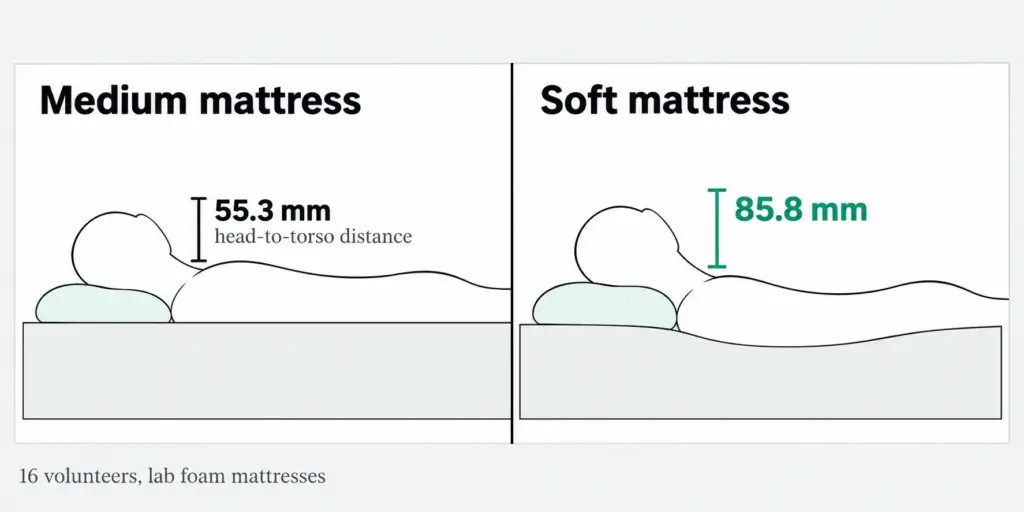
The mechanism is in the thesis’s own words: “the torso sank deeper in the soft mattress, but the head and neck sank less, resulting in a forward head position in the bed.”
Notice what the figure text adds. To the eye, the thesis says, “there was no noticeable difference in the head height between the three mattresses.”
The pillow looks the same height on every bed. What changed is how far the head sits from the torso: 85.8 ± 21.5 mm on the soft mattress against 55.3 ± 8.9 mm on the medium one. The shoulder sink is the whole difference: the shoulders dropped, and the pillow stayed where it was.
The thesis also says that head height “does not significantly alter the spinal curvature” up to a point, so do not read this as a rule that higher is worse. It is a reason the same pillow can feel different after the bed changes.
The limits matter. These were lab foam mattresses, sixteen volunteers with an average age of 29, and one pillow model. The thesis also runs a computer model of a single 37-year-old man, and those predictions are left out here, because a model of one person is not a measurement of you.
What survives is the practical part. The pillow that suited a medium mattress can sit too tall on a softer one, which complicates the usual fix for a head that sinks: a firmer, taller pillow is exactly the one that rides highest on a mattress that lets the torso drop. Pillow height against mattress takes that pair apart from the back-pain side, and the mattress question for the side sleeper runs the same logic for the side.
The Rise Under the Neck Against the Dip Under the Head
If the head has to sit at one height and stay in the middle, the shape matters as much as the fill, and the listing is where the shape is written, in numbers if you know where to look. Most of the time it is not written under the word that sounds like it.
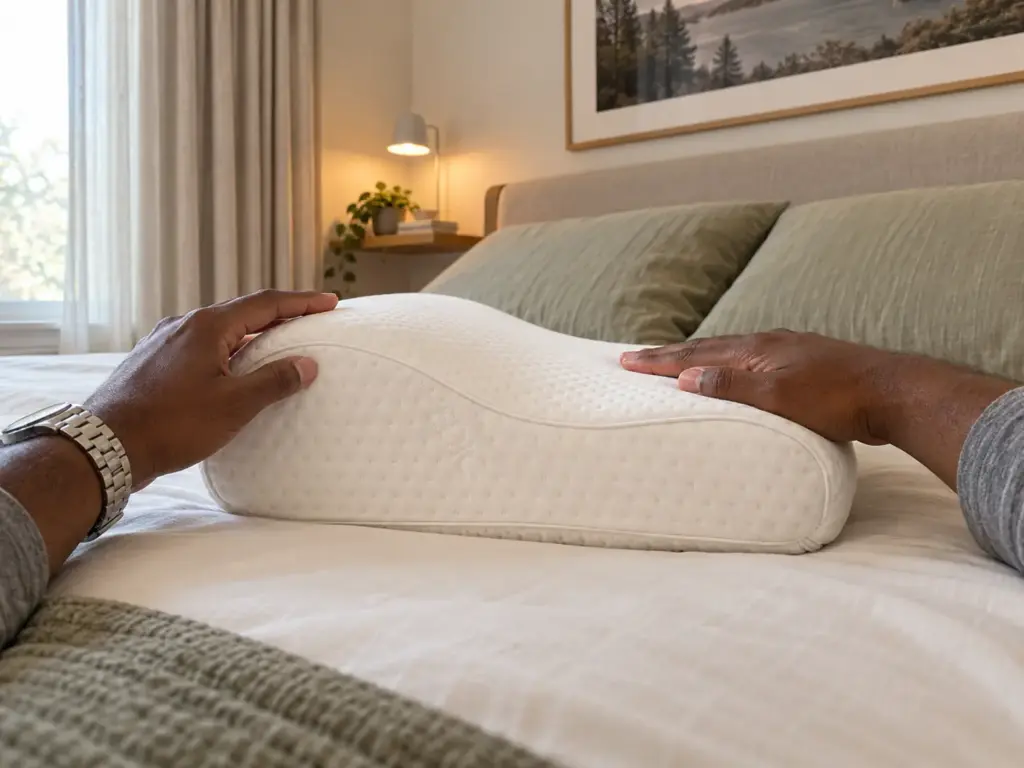
Reading the dip and the rise off the listing
The design logic behind a dip comes from the same 2021 review: “The pillow height in the middle area was lower for the supine position, and both sides were higher for the lateral position.” For a back sleeper that means a lower middle for the head to sit in, and a higher edge to support the neck behind it. The two numbers to find on any listing are the height under the head and the height at the sides, and then the question of whether the rise lands under the neck or under the ear. A rise under the ear is a lump the head has to climb over.
A hollow-center pillow from Osteo, covered in the next section, prints both numbers in its size field, 5.2/4.1 inches, and tells you to rotate the pillow 180 degrees “to enjoy a higher or lower” setting. Read those as two thicknesses, one on each side of the same pillow, and the dip becomes something you can judge from the page. The TEMPUR-Pedic TEMPUR-Neck Pillow, Medium Profile, 2-pack shows a different version of the same idea: a single piece of extra-firm TEMPUR material listed at 3 to 4.75 inches, sold in Small, Medium and High profiles, with back and stomach sleepers named on the listing. You pick the rise by size, not by the word on the cover.
What it costs you is the firmness that makes it hold its shape.
A 3-star reviewer from June 2026 found the pair “much firmer than expected” and stopped using it after about a week of giving it “a fair chance,” because of waking with neck pain.
A 2022 reviewer of the Small profile wrote that the newer foam is stiffer and firmer, that the contour bumps run 3.5 and 4.3 inches, and that the taller one still pushed the chin toward the neck, the same complaint as in the first section. Same pillow, same listing, two different heights for two different heads. That is the point of the size ladder, and the reason the choice of size is the whole decision.
Lay a hardcover book across your current pillow where your head goes, press down with a flat hand, and measure the height with a ruler. A listing prints the height of the pillow as it ships, and your head presses it down. The pressed number is the one to hold against a listing’s center and side heights.
Why “cervical” is a word and not a spec
The obvious pick for a stiff neck is the contour pillow with a bump under the neck. It works only if the bump lands under your neck and not under your skull, and only if its height is yours, which the TEMPUR reviewers above disagree about for the same product. A word like “cervical” on the cover promises none of that.
It names a shape idea, a nod to the curve of the neck (the cervical curve), with nothing behind it that says how high, how soft or how deep. Why “cervical” has no standard behind it is in the pillar, so it is not argued again here.
What to read instead is short: the center height and the side height, both in inches.
Then whether the pillow lets you change either one at home, by turning it, by taking out an insert or by taking out fill. The fill itself, which decides what the numbers do after a few weeks. A cover that says cervical and prints none of these gives you a pillow to guess at.
What the fill does by month three
Fill decides whether a height stays a height. A shredded fill, whether shredded memory foam or shredded latex, shifts rather than compresses, which is why it can be set to your height and also why it moves. A 5-star Coop reviewer from 2015 reports that nearly two weeks in, the pillow was “just flatter in the middle” because the head, neck and shoulders pushed the material to the sides, and that it was easy to “knead” it back to the center. That is the free fix for a head that sinks, and fold it before you replace it goes through the rest of the options before money comes into it.
Polyester fiberfill and down alternative fills sit at the soft end of this range, and the thread’s warning about fiber fills applies most to them.
Solid memory foam does the opposite. It keeps its shape and recovers slowly: a 2022 reviewer remembers the older TEMPUR foam as “gooey/dough like,” which is the slow-recovering feel in the reviewer’s words. Shredded against solid foam explains why one needs tending and the other needs patience.
Shredded latex sits between them, and the example here is a latex pillow, the Natural Latex Shredded Foam Pillow, King, Set of 2: shredded natural latex from Sri Lanka in an organic cotton cover that washes in the machine, with fill you can add or remove, and a King listing of 32 x 16 x 7 inches. What holds once the head moves covers latex in general.
This particular set has two catches. A 3-star reviewer from 2023 wrote that it performs like a standard poly-filled pillow and that “there is no latex ‘bounce back,'” the spring of solid latex that shredded fill does not carry. And a 2-star reviewer from August 2026 found the pillows “way too firm and full,” still too thick for their neck after taking out half the stuffing. A thick pillow at the King size starts high, so take fill out before you decide it is the wrong pillow, and take out less than you think you need.
Two Pillows Worth a Fair Run
No pillow is a fix. Since no target height has been published for a back sleeper, the two worth a fair run are the ones whose height you can change at home, and each of them comes with a reason to doubt it. Neither is needed if the old pillow, back on the bed, did the job, or if the mattress was the fault.
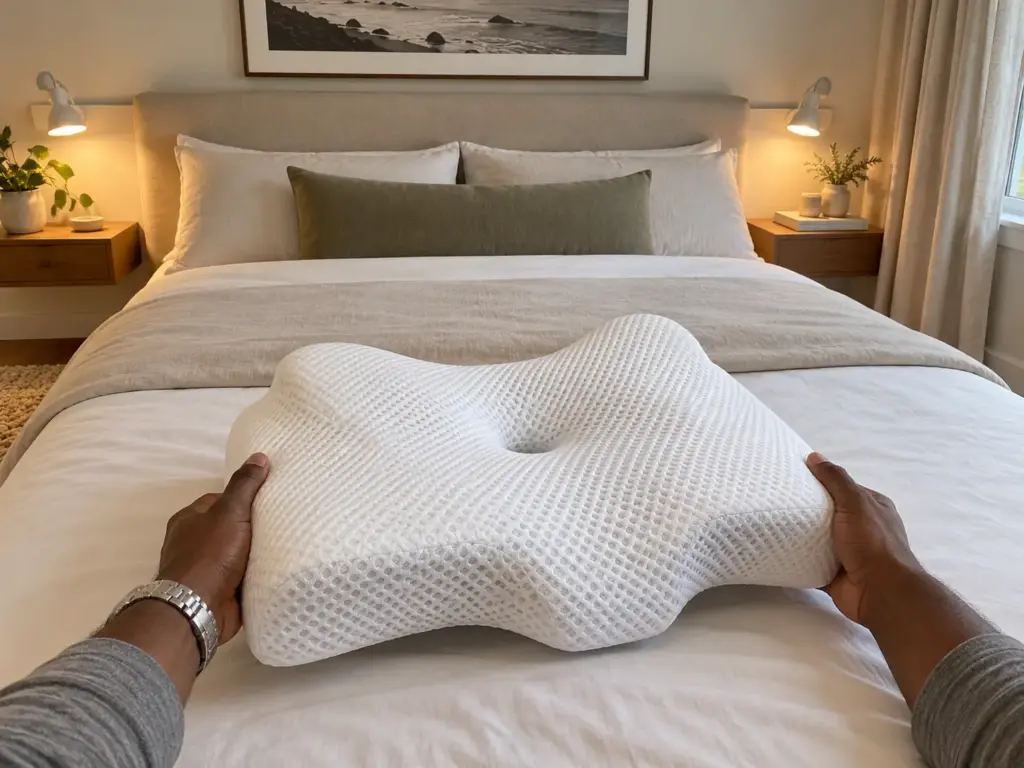
The one that turns around: Osteo
The Osteo hollow-center pillow is built around the dip. Its memory foam has a hollow in the middle for the head and a rise on each side, the Queen listing gives two thicknesses of 5.2 and 4.1 inches, and the pillow rotates 180 degrees to switch between them. A removable insert at the bottom adds height options, which makes this the one hollow shape here with both thicknesses printed on the page before you buy.
The catches are the ones the page itself reports. The review summary says opinions on firmness are “mixed,” with some finding it not too firm or too soft and others finding it too hard; a 4-star reviewer from August 2026 could not open the zipper for the extra fill and worried it would break; and a 5-star reviewer from October 2026 says the foam “is on the firmer side,” so it is not for someone who likes to sink in.
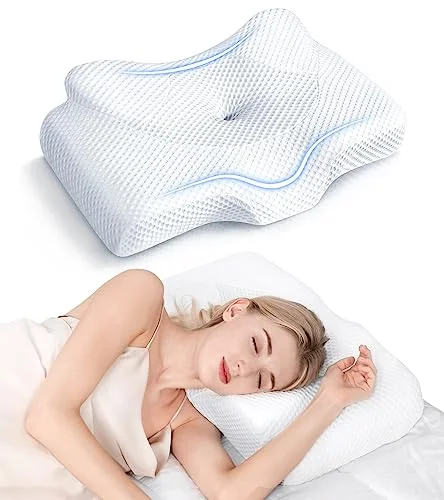
The one you can empty: Coop
The Coop Home Goods Original Adjustable Pillow solves the same problem from the other direction: instead of two fixed heights, one height you set by hand. It is a cross-cut memory foam and microfiber blend, 76 percent foam and 24 percent polyester gel fiber, and an extra bag of fill comes in the box, so you remove fill for a softer feel or add it for a firmer one, and the removable fill comes out in a few minutes. The listing adds a line that is easy to skip: cooler environments “may cause the foam to feel firmer,” so a pillow set in a warm room in July is a different pillow in a cold bedroom in January.
Its catches are in the reviews. A 3-star reviewer from July 2026 says the current foam is “light and airy” and the fill that is sold as shredded “looks more like cubes,” where the original, in the reviewer’s account, was 100 percent shredded foam with no fiberfill mixed in. A 4-star reviewer from 2018 found the material stays the same temperature as your face and ends up “flipping my pillow about 4 times a night.”
For a shared bed, a 5-star reviewer from September 2026 writes: “We both love that you can adjust the pillow to whatever you need as far as firmness and fluff.” That is one pillow with the fill changed, not two different pillows.
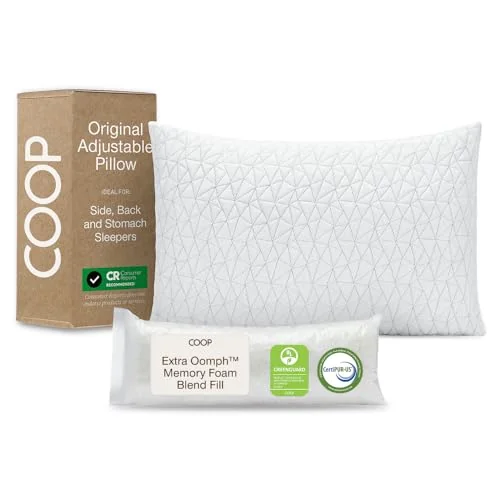
Set an adjustable pillow in the room it lives in, with the heat at the level you sleep at. The Coop listing says cooler rooms firm the foam, so a setting made on a warm afternoon can feel different by the time the bedroom cools down. Check it again after the first cold night before taking out more fill.
Which of the two costs less to be wrong about
Of the two, Osteo is the lower-cost card, and its two fixed heights make it easier to reason about: you either get on with 5.2 or with 4.1 inches, or you do not. The Coop is the one with more room to adjust and more to tend, and its foam is the part of the listing reviewers disagree about most. Neither is worth buying before the old pillow has had its run on the bed, because a pillow you can change is still a pillow that may not be the problem. If the seller offers a trial period, read its terms first: a fair run only works if the pillow can go back.
If you start the night on your back and finish it on a side, the pillow has two jobs rather than one, and for the back sleeper who rolls onto a side is the page that handles three positions in one night.
When It Stops Being the Pillow
A fair run of bed changes has a limit. Past it, the question is no longer about fill, loft or mattress. It is a question for someone who can examine the neck, and a pillow cannot stand in for that.

What the bed can and cannot settle
The bed can settle the things that belong to the bed: the height of the pillow, how soft it is, what it is filled with, how the mattress under the shoulders behaves, and what changed in what order. It cannot settle whether the stiffness has a reason beyond the bed, and no pillow on this page is offered as an answer to that.
So the rule stays simple. Keep the pillow that comes closest, stop buying new ones, and change one thing at a time. The third new pillow in a month is a sign to stop changing pillows, not a reason to buy a fourth.
The signs that go straight to a clinician
Mayo Clinic’s neck-pain guidance lists “Persists after several weeks of self-care” and “Is accompanied by headache, weakness, numbness or tingling” among the reasons to see a doctor. That is the hand-off, in one clause. For a bed article the useful form is a short list of what means the bed is no longer the place to look:
- Numbness, tingling or weakness in an arm or hand
- A new or severe headache
- Pain after a fall or a crash
- No change after a fair run of bed changes
If any of those is true, see a doctor, and do not wait for a better pillow to explain it. If none is, you are back at the bed, with the old pillow and one change at a time.
Put the Old Pillow Back Tonight, Then Judge by Height
Three things carry the rest. Undo the last change before you buy anything, because the pillow that came before the stiffness is the cheapest test there is. Read height and softness as one measurement, from the dip under the head and the rise under the neck rather than from the word on the cover. And set a limit of a few weeks on the whole experiment, so that when it runs out you go to the last section, not to a fourth pillow.
For later, the check that matters is not the first week. Months on, look at whether your head still sits where it did at the start, with the middle holding and the sides where they were. If the middle has gone flat or the fill has crept to the edges, the height you chose is no longer the height you have.
Tonight, put the old pillow back on the bed, change nothing else, and for a week note only one thing on waking: whether the stiffness is lighter, the same or gone. A week is enough to tell whether the pillow was the change that mattered.
Frequently Asked Questions
01What kind of pillow is best for a back sleeper with neck pain?
The best pillow for a back sleeper holds the head at one steady height, with a dip under the head, so the chin never tips toward the chest. No pillow treats pain, so put the old one back for a fair run before buying a new one.
02Is a hard or soft pillow better for neck pain?
Neither on its own, because firmness and height are two separate numbers that have to agree under a back sleeper’s head. A 2021 review found no firm conclusion on the best height, so the number comes from your own bed.
03How long should I try a new pillow before deciding?
Give each change about a week, one change at a time, and stop the whole experiment after a few weeks. A single night tells you little. If nothing moves by then, it is no longer a pillow question; the last section covers where it goes.
04Does a cervical pillow work for back sleepers?
It can, when the dip sits under the head and the rise under the neck, but the word cervical on a cover is a label, not a spec. Read the center and side heights off the listing, as the neck pillar explains.
05Can my mattress make my pillow feel too tall?
Yes: on a softer mattress the torso sinks and the head sits higher, so the same pillow can feel too tall. In a Hong Kong Polytechnic University thesis, the head sat about 30 mm higher on a soft lab mattress than on a medium one.





Tried it on your own bed?
No comments yet. Tell us what you changed, and what the sheet did after a few washes.