



What’s in here7 sections
You lie down on your side with your neck settled into the dip, and the pillow feels exactly as the listing promised. Some hours later you wake on your back, the rise that held your neck is sitting behind your shoulder blade, and your head has dropped off the edge of the hollow. Nothing went wrong in between: cervical pillows are a fixed curve cut for an average neck in one position, and a fixed curve only fits the position it was cut for. This guide reads that curve in inches, follows it through a roll, and sorts the claims on a listing into the ones a pillow can be checked against and the ones that belong to a doctor.
Quick Answer
A cervical pillow helps only when its rise under your neck and its hollow for your head land where your own neck and shoulder need them, and the word cervical promises neither. Both can be read in inches and tested with a roll before the trial closes.
A Fixed Curve Is Cut for an Average Neck
The shape on the listing has two parts, and everything below depends on telling them apart.
A rise under the neck and a hollow for the head
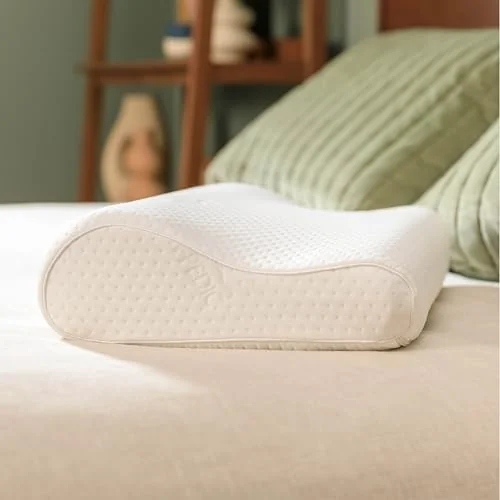
A cervical pillow is a raised ridge with a dip beside it. The rise sits under your neck and lifts it, and the hollow cradles your head and lets it settle a little lower than the neck. That is the whole design, and the pillow knows exactly two numbers about you: the height of the rise and the hollow depth. Both were fixed at the factory.
Your neck was not. Consumer Reports notes in its pillow test method that a pillow may offer different support depending on how wide your shoulders are and how much your spine curves at the back of your neck, so two sleepers can buy the same pillow and get different support from it.
A physician quoted in a Forbes review gives the direction: “If you have particularly broad shoulders or a longer neck, you may need a pillow that is more robust.” More shoulder, more rise. Less shoulder, less.
This is also why the first nights mislead. Pillows that feel amazing for a couple of nights, then go flat too fast or feel way too high, are a familiar complaint. A new pillow is at its full height and has not been slept down yet, so what you feel in week one is a height, not a fit.
What the word leaves out
“Cervical” names a shape. It says nothing about how tall the rise is, how deep the hollow is or how firm the foam is, and a single model can ship in several sizes (more on that in the next section). The argument over what the label does and doesn’t promise is made elsewhere on this site, so here it stays at one sentence: the word is a shape, and the numbers are yours to find. Cheap fill is the usual reason they stop matching, because height is the first thing it gives up, and what cheap fill does to a pillow’s height is worth reading before you trust any stated loft.
The measuring starts at home. How to find the gap your rise has to fill is the towel test in the neck pillar, and doing it first makes the rest of this page easier to use.
The Shapes on the Market, Measured in Inches
Now that the curve has two numbers, the question is which shape puts them where your shoulder needs them, and the listing rarely prints either.

Hollow, contour, crescent and roll
Five shapes cover nearly everything sold under the word. A hollow (or butterfly-shape) pillow has a hollow center, a dip in the middle with a rise on one or both sides. A contour is a raised wave with no hollow at all.
A dual-height pillow is thicker at the sides than in the center, a crescent curves around the shoulder, and a roll is a cylinder that goes under the neck alone. Each one answers the same question, how high the neck should sit against the head, with a single fixed answer.
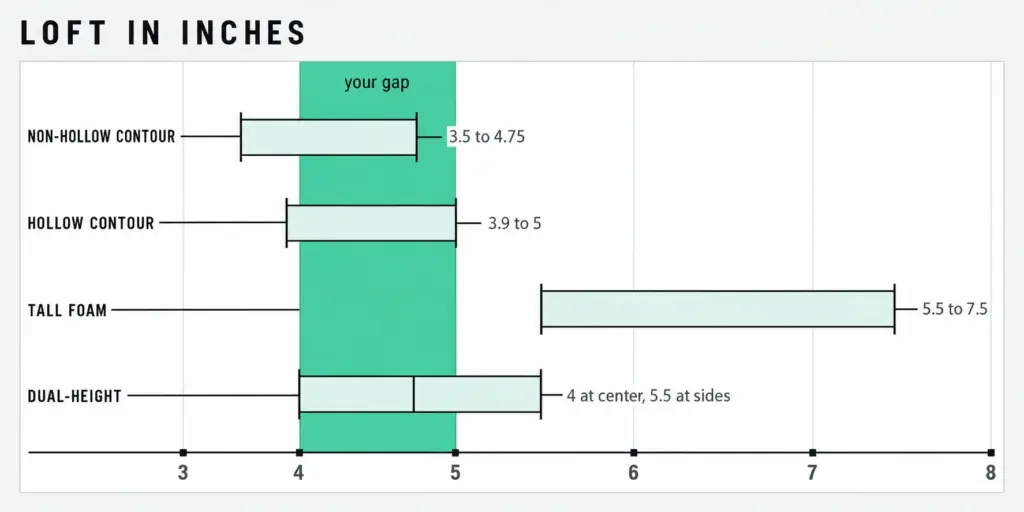
In inches, the families overlap more than the labels suggest. A non-hollow contour comes in 3.5, 4 or 4.75 inches depending on the size you pick, and a hollow contour runs from 3.9 to 5. A tall foam pillow starts at 5.5 and goes to 7.5, and a dual-height model measures 4 inches in the center and 5.5 at the sides (all of these are the stated figures from a Forbes roundup’s spec boxes).
The spread inside one model is just as telling: a little over an inch in the first case, two full inches in the tall one. Your neck-to-shoulder gap did not change by two inches because the product page did, so the size you choose matters as much as the shape.
Which of those heights suits you depends on the shoulder. How the shoulder sets the height for a side sleeper is its own measurement, and the back-sleeper version of this, where too much rise tips the chin down, runs the other way.
Loft is the thickness with nobody’s head on it
The number on the box is loft, and the Sleep Foundation grades it as the total thickness when the pillow is not compressed. Under your head the foam sinks, so a stated 4 inches is less once your head is on it. That makes the box number a ceiling, and a starting point for loft by sleep position rather than an answer to it. Loft by sleep position is where the per-sleeper numbers are set.
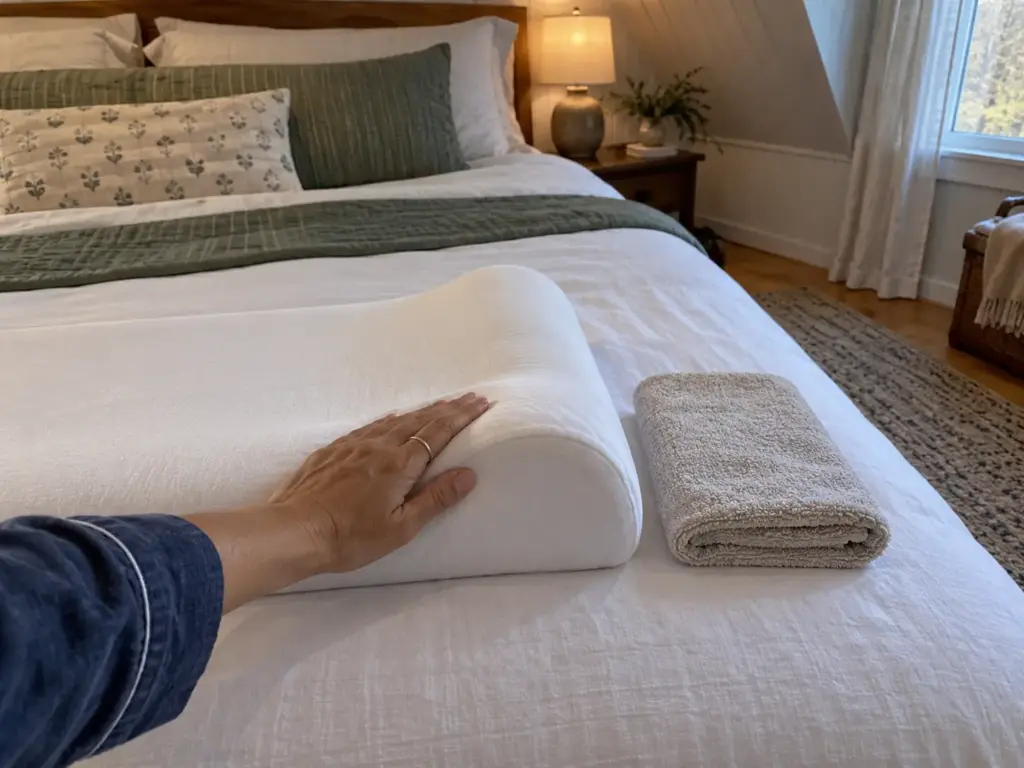
Before any pillow goes into a cart, do the free part. On your side, fold a towel until the stack fills the gap between your ear and the mattress, measure it in inches, and add a little for the sink. That number against a shape’s stated range tells you more than the word on the box. If it lands between 3.5 and 4.75 inches and you mostly stay in one position, one product in this set was built for exactly that: a non-hollow contour that prints its height.
The mattress is part of the height
The same pillow is a different height on a different bed. On a soft mattress, the Sleep Foundation explains, your frame sinks deeper, which brings the surface closer to your head and neck and calls for less loft; a firm mattress holds you up and calls for more. So a 4-inch pillow that fits on a firm bed can be too tall on a soft one, with no change at all in your neck.
Pillows sold in several heights make the point loudest. Some sleepers try the medium of a premium foam pillow first and end up going with the tallest, while others warn that the low and medium sizes of some pillows are really unsupportive. The middle of three feels like the safe call, but a middle is only safe when the sizes are cut around an average, and a shoulder isn’t averaged. (It is also the size many people reach for first, which is a poor reason to keep it.)
Build the towel stack on the bed you actually sleep on, then press it flat with your palm for a slow count of ten before you measure. A stack measured on a table or the floor never sinks, and the one on a soft mattress does, which is the exact error a stated loft hides.
What a Roll Does to the Curve
The measurements give you the right pillow for the position you fall asleep in, and the rest of the night is a different question. You don’t know how often you roll, because asleep you can’t count it, and no measurement exists for how far a rise travels when a sleeper does. What follows is mechanism and the reports of people who have lived on the shape.

Where the rise ends up at three in the morning
Forbes states the weak point of the hollow shape outright: “The cervical shape isn’t ideal for sleepers who switch positions frequently at night.” Customers quoted in the same review describe the failure from the bed, “difficulty finding a comfortable position when switching between side and back sleeping.”
The mechanism is a matter of the gap. On your side, the pillow has to fill the space your shoulder opens between head and mattress, and the Sleep Foundation notes that an unfilled gap lets the head fall to the side. Roll onto your back and that gap closes, so the same height now pushes the head forward. The rise that sat under your neck ends up behind the shoulder blade, or the hollow has traveled until it sits under one ear.
You did nothing wrong, since the curve was cut for one position, and pillows for combination sleepers start from that fact because the side night and the back night set different heights.
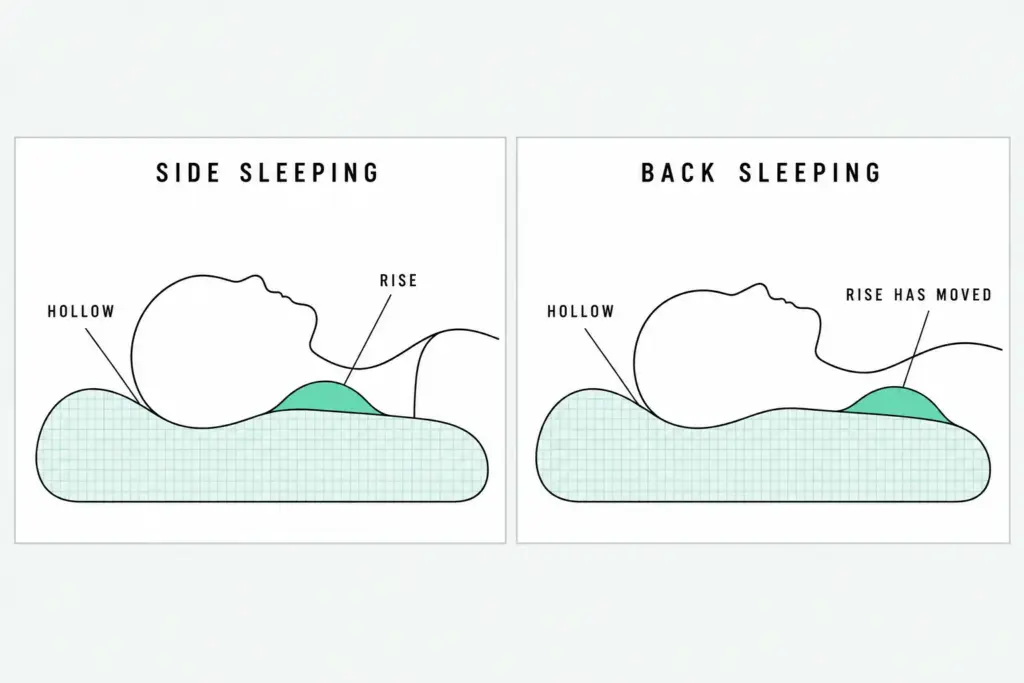
You can see this without buying anything. Photograph the pillow in the morning before you touch it, then fold a towel to stand in for the rise and repeat the next night. Whichever part moved, the pillow, the towel or you, is the part that needs fixing.
Take the photo from the foot of the bed with the pillow’s seam or tag in the frame. A seam gives you a landmark, and it is the only way to tell a pillow that slid from one that rotated, which are two different problems.
The shapes that forgive a roll, and the ones that don’t
A U-shaped side-sleeper pillow carries the same limit. Forbes says its design “limits its usefulness for combination side sleepers, who alternate between their side and back.” A pillow that keeps its shape is the right promise for a sleeper who stays put and the wrong one for a sleeper who rolls, because the less it gives, the less it can follow you.
The workarounds sleepers use have one thing in common: a height they can change in the dark. A combination sleeper who splits time between side and back can find an ergonomic pillow comfy both ways. Another option is buckwheat, where the insides can be shifted, with a smaller pillow hugged so the arm fits: a bigger one for the head, a smaller one for the arm, and the hull moves wherever the head needs it. A third keeps a water pillow because it can be made as soft or as firm as wanted by adding more water.
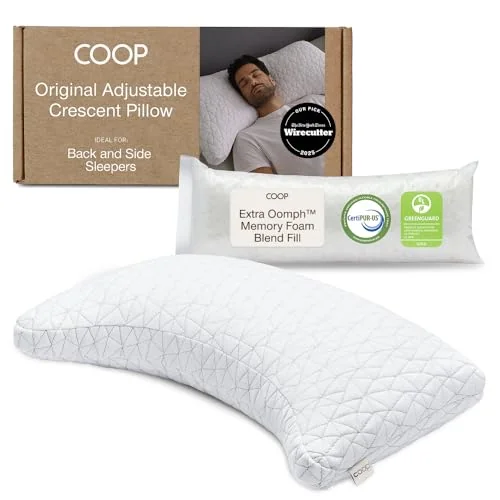
The crescent sits between the two worlds. Its curve wraps the shoulder side, and when the fill is adjustable the height follows the position instead of fighting it. Some of the drift you find in the morning belongs to the bed rather than the pillow, and why a pillow drifts by morning has its own explanation. The product card for an adjustable crescent comes next.
Fill, Cover and the Trial Window
If the curve fails when you roll, the way out is a height you can change, and that depends on what is inside, what covers it and how long you have to find out.

What the fill decides
Fill comes in three main families: memory foam, which dominates, then down and latex. Solid foam keeps one height for life, while shredded foam (memory foam cut small enough to move) lets you take fill out or add it, an adjustable loft, which is the difference between a pillow you buy and a pillow you tune. What each fill does by month six is a separate comparison, and shredded versus solid memory foam settles the narrower question of a fixed shape against an adjustable height.
Reviewers describe the difference in practical terms. Forbes quotes a combination sleeper on its staff who says “if it starts to flatten over time you can easily add to the fill to plump it up again,” and another contour pillow has a piece of memory foam at the bottom you can remove if the pillow feels too high.
The free version is probably in your bedroom already. Check the seam of the pillow you own for a zipper, and if there is one, you already have the experiment: take a handful out, sleep on it, and see which half of the night changes. If there is none, a crescent with adjustable fill is the shape built for the side-to-back sleeper.
The cover and the wash
A washable cover is what makes a pillow washable in practice, since the foam core is not. The routine is the same on most of them: a cold wash on a gentle cycle for the cover, air dry or line dry, and spot-clean the core. A pillow protector under the pillowcase is one more layer that can be washed in the core’s place. The care label is the authority on every step, so read it before the first wash, and let the cover dry fully before it goes back on.
The cover only protects the fill, and the fill is what loses height. Consumer Reports tests that directly: it leaves a 225-pound evenly distributed load on each pillow for 96 hours, then measures thickness and firmness before and after hand-fluffing. Four days under that weight is the lab’s stand-in for months of sleep, and the question it asks is the one you’ll ask yourself in the fourth week: does the height come back?
The trial window, and the weeks the shape takes
The sleep trial decides how much of this you can afford to find out. One contour in this set ships with no trial at all, and Forbes notes the maker doesn’t accept returns on it. Another carries 30 nights, with a reviewer describing a few weeks of adjustment before the shape stopped being a problem. The crescent style carries 100 nights.
Thirty nights sounds generous, but a shape that takes a few weeks to learn, and shows its failure only on the nights you roll, can close its window with the answer still unclear.
On day one, put the last night of the trial in your phone and set a reminder a week before it. That reminder is the day you compare your morning photos, because the decision you need to make is whether the pillow was still where you put it.
Changing anything else inside the window also changes the test. A new topper, a different protector or a new mattress alters the height, and pillow height against mattress is the place to start before you decide a pillow failed.
If height is the real question and a shape isn’t worth buying yet, the cheapest way to find out is the same line in a flat cut. The Coop Home Goods Original Adjustable Pillow is shredded cross-cut memory foam and microfiber, 20 by 30 inches, with extra fill in the bag, so you can test an adjustable height before paying for a contour. It is not a cervical shape, so it tells you about height and says nothing about the rise, and Forbes notes that some reviews complain of an off-gassing smell. A budget ergonomic pillow can beat an expensive one for the neck, which is an argument for testing height cheaply before committing to a shape.
Take fill out one handful at a time and sleep on each change for two nights before touching it again. After five handfuls you can no longer say which one fixed or broke the height, and fill that has left the pillow is hard to recover.
The Claims a Curve Can’t Test, and When It Isn’t the Pillow
With the height measured, the roll tried and the trial running, what remains are the sentences on the listing that no pillow can be checked against. Some of them sound reasonable.

What a pillow can be checked against
Four things can be checked. The first is height in inches: the figure on the box, and then the towel stack on your own mattress. The second is firmness, which Consumer Reports grades through support and resilience, with support judged by the angle between head and torso, where pillows that minimize that angle score better.
The third is the cover and how it washes, and the fourth is the length of the trial. All four belong to the bed, and you can run them yourself.
The check gives different answers at different times. A week-one check reads the foam, and a month-one check reads the sleeper. Run both, and trust the second more.
What goes to a doctor, not a duvet
Listings promise things a shape has no way to deliver: an angle that “aligns” named vertebrae, relief of pain, healing, even less snoring or relief for sleep apnea. None of those is a measurement, and a pillow can’t be tested against any of them. It has a height and a firmness, and those are the only claims it can be held to.
One sleeper who kept buying pillows concluded that the pillow had been taking the blame for how the day had gone, which is a fair reminder that a pillow is rarely the whole story.
The line sits with a doctor. Neck pain that does not go away after a few weeks, or arm weakness, numbness or pins and needles alongside it, is a question for a GP, and the NHS guidance on neck pain says to “see a GP if it does not go away.” Headaches that seem to follow a pillow have their own page: when pillow headaches are the bed and when they aren’t. Everything else on this page is the bed: height, firmness, fill, cover and trial.
The Morning Check That Settles Whether It Fits
Three things to keep:
- A cervical pillow has two numbers, the rise and the hollow, and both are read in inches against your shoulder and your mattress.
- A fixed curve fits the position it was cut for, so test the roll before you trust the shape.
- The trial window is the real test, and it can be shorter than the weeks the shape takes to learn.
The check for later is the hollow. After a month, press the center of the pillow where your head rests: if the dip is shallower than it was, the foam has lost height there, and the pillow you sleep on is no longer the one you bought.
Tonight, fold a towel to the gap between your ear and the mattress, set it where the rise should be, and photograph the pillow in the morning before you touch it. Notice whether the rise is under your neck or behind your shoulder, because that is the measurement worth buying by.
Frequently Asked Questions
01Does a cervical pillow really help?
It helps only when its rise and hollow land where your own neck and shoulder need them, which you can measure in inches. The shape itself promises no result, so check height, firmness and the trial before trusting the word.
02Is it good to sleep with a cervical pillow?
It works when the shape matches the position you sleep in all night. If you roll, look at where the pillow sits in the morning first, and prefer fill you can adjust so the height can follow you.
03What is the best cervical neck pillow?
There is no single best one; the best is the height that fits your shoulder and your sleeping position. A non-hollow contour suits a sleeper who stays put, and an adjustable crescent suits one who rolls.
04Which kind of neck pillow is best?
It depends on how you sleep: a contour for back sleepers who stay in one position, a crescent or adjustable fill for sleepers who go from side to back. Measure the gap before you choose.
05How long does it take to get used to a cervical pillow?
One reviewer describes a few weeks of adjustment on a contour pillow, and a 30-night trial can end before that. Nothing guarantees it will feel right, so mark the trial's last night on day one.





Tried it on your own bed?
No comments yet. Tell us what you changed, and what the sheet did after a few washes.